In the world of metallurgy, stainless steel is one of the most versatile and durable materials. Among the various types of stainless steel, 201 stainless steel has attracted much attention for its unique combination of properties and cost-effectiveness. Known for its excellent corrosion resistance, high tensile strength, and impressive formability, 201 stainless steel is a popular choice for a wide range of applications, from kitchenware to industrial equipment. In this article, we will take a closer look at the other side of 201 stainless steel.
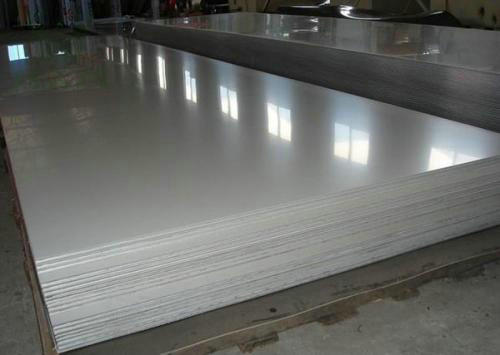
What is 201 Stainless Steel?
201 stainless steel is an austenitic stainless steel primarily composed of the following elements:
| Element | Content |
|---|---|
| Chromium (Cr) | 16.0% – 18.0% |
| Nickel (Ni) | 3.5% – 5.5% |
| Manganese (Mn) | 5.5% – 7.5% |
| Nitrogen (N) | ≤ 0.25% |
| Carbon (C) | ≤ 0.15% |
Compared with 304 stainless steel, 201 stainless steel has lower nickel content but higher manganese and nitrogen content, making it cost-effective while maintaining acceptable corrosion resistance.
201 stainless steel is commonly used for budget-friendly applications where excellent corrosion resistance is not critical.
Equivalent Grades for 201 Stainless Steel
| Region/Standard | Standard/Specification | Equivalent Grade | UNS Designation | Notes |
| USA | ASTM A240 / AISI | 201 | S20100 | The most common designation (American Iron and Steel Institute / American Society for Testing and Materials). |
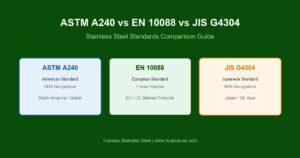
| Europe | EN 10088-2 | 1.4372 | N/A | Also named X12CrMnNiN17-7-5. |
| Japan | JIS G4304 | SUS201 | N/A | Japanese Industrial Standards. |
Characteristics and Advantages of 201 Stainless Steel
Corrosion Resistance
201 stainless steel has moderate corrosion resistance, suitable for mild environments. It is resistant to rust in indoor and low-moisture applications.
Strength and Hardness
High manganese and nitrogen content improve its tensile strength and hardness, making it durable for long-term use in many applications.
Magnetic Properties
Unlike 304 stainless steel, 201 may exhibit slight magnetic properties, which can be useful for certain industrial applications.
Formability and Weldability
201 stainless steel has good formability, allowing it to be used in sheet, plate, and coil forms. It can also be welded easily, though post-weld annealing may be required for optimal mechanical properties.
Cost-Effective
The lower nickel content reduces production costs, making 201 stainless steel more affordable compared to 304 or 316 stainless steels.
Core Properties and Processing Characteristics of 201 Stainless Steel
Outstanding Mechanical Properties: High Strength is a Highlight
201 Stainless Steel performs excellently in terms of mechanical properties, particularly its strength. It is this high-strength characteristic that makes it an ideal choice for many engineering applications.
| Mechanical Property | 201 Stainless Steel (Annealed, Min.) | 304 Stainless Steel (Annealed, Min.) | Huaxiao Metal Professional Comparison |
| Yield Strength (0.2% Offset) | 275 MPa (40 ksi) | 205 MPa (30 ksi) | 201 is stronger, with higher load-bearing capacity. |
| Tensile Strength | 690 MPa(100 ksi) | 515 MPa (75 ksi) | Overall strength advantage, suitable for structural support. |
| Elongation (in 2 in. / 50.8 mm) | 40% | 40% | Good ductility, ensuring formability. |
| Hardness (Rockwell B) | ≤100 | ≤92 | 201 is relatively harder, offering better wear resistance. |
Corrosion Resistance
201 stainless steel performs well in indoor and mildly humid environments, but it is more prone to rust in highly humid or saline conditions compared to 304. For kitchen equipment, indoor handrails, or decorative trim, it provides reliable durability at a lower cost.
Best Practices:
Apply surface passivation for additional corrosion protection
Avoid prolonged exposure to chlorides or acidic conditions
Consider 304 stainless steel for outdoor or marine applications
Formability and Processing Advantages
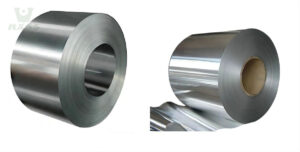
201 Stainless Steel Sheet possesses good formability and can be subjected to deep drawing, bending, and rolling. Although its work hardening rate is high, which may require a higher processing force, its plasticity still meets the requirements of the vast majority of manufacturing processes. Huaxiao Metal provides precisely processed 201 stainless steel coil to ensure high efficiency on the customer’s high-speed stamping and bending production lines.
Welding Performance: Handle with Caution
201 Stainless Steel can be welded using all conventional welding techniques. However, due to its relatively higher carbon content, there is a risk of intergranular corrosion in the weld heat-affected zone when welding thick sections or without proper post-weld treatment.
Huaxiao Metal Technical Advice:
Select Appropriate Filler Material: Welding materials similar to 304 are commonly used.
Post-Weld Treatment is Crucial: For critical applications, post-weld cleaning, pickling, and passivation are strongly recommended to restore the corrosion resistance of the weld area—a critical step for ensuring product longevity.
Heat Treatment and Heat Resistance
201 Stainless Steel cannot be hardened by heat treatment; it can only be strengthened through cold working. It’s annealing temperature is typically between 1010°℃ and 1093°C, requiring rapid cooling through the carbide precipitation range to prevent sensitization. Its oxidation resistance temperature can reach 840°C, but its performance is not as stable as higher nickel alloys under continuous high-temperature exposure.
Application Guidance – Where 201 Stainless Steel
201 stainless steel is best suited for applications where cost, formability, and moderate corrosion resistance are the main considerations.
Recommended Uses:
Indoor decorative elements & furniture: Excellent choice for panels, frames, and trims
Kitchen appliances & utensils (non-critical): Safe and cost-effective
Cold forming and press operations: Superior work hardening and bending performance
Caution – Less Suitable For:
Marine or coastal environments
Outdoor use in high humidity or chemical exposure
Applications demanding high corrosion resistance, where 304 or 316 is preferred
Is 201 Stainless Steel Resistant to High Temperatures?
201 stainless steel is not considered high-temperature-resistant stainless steel. The high-temperature resistance of 201 stainless steel is below 315℃. If the temperature exceeds this, heavy metals will precipitate in the material, and creep and material deformation will occur. Therefore, stainless steel needs to be used at the corresponding temperature, and special high-temperature resistant stainless steel is required in high-temperature environments.
Can 201 Stainless Steel Increase its Hardness?
201 stainless steel belongs to austenitic stainless steel. The structure of austenitic stainless steel is the austenite phase. It will not change phase when heated, so its hardness cannot be increased by conventional heat treatment methods. The hardness of austenitic stainless steel mainly depends on its chemical composition and cold working treatment method. Through cold working such as cold rolling and cold drawing, cold drawing can deform the grains of stainless steel, thereby increasing its hardness. However, the hardness increased by this method is also limited, and it will have a certain impact on the plasticity and toughness of stainless steel.
Can 201 Stainless Steel be Stretched?
It depends on whether 201 J1, J2, or J4 is used. The factors that affect the stretching of 201 stainless steel are mainly the copper content. The lowest copper content is J2, which contains 0.3% copper and is a low-copper material. It is not suitable for stretching and is only suitable for products with large-angle bending. J1 contains 0.8% copper and is a semi-copper material. It is suitable for large-angle ordinary shallow stretching products. J4 contains 1.5% copper and is a high-copper material. It is the best material in the 201J series and is suitable for deep stretching and small-angle products.
At present, our company mainly sells 304, 201, 316L, 304L, 309S, 310S, 321, 430, 2205 duplex steel, antibacterial steel and other stainless steel coils, plates, strips, bars, wires, pipes, laser cutting parts, etc., which can meet the needs of Kaiping, slitting, frosting, mirroring, cutting, oil grinding, brushing, sheet metal, stamping products, etc. We have established long-term strategic cooperative relations with many well-known brand companies, and the product materials provided are widely used in kitchen and bathroom supplies, environmental protection equipment, architectural decoration, catering and medical, petrochemical, animal husbandry, and other fields.
If you want to know our 201 stainless steel price, you can contact us.
Pricing & Procurement Logic – How Buyers Decide on 201 SS
While 201 ss is often cheaper than 304, real procurement decisions consider multiple factors:
1. Alloy Composition & Raw Material Cost
Lower nickel content reduces cost, while manganese and nitrogen affect work hardening and tensile strength
2. Product Form & Size
Coils, sheets, and plates differ in processing cost; narrower or thicker custom sizes increase unit cost
3. Surface Finish & Appearance
Decorative finishes like BA or No.4 may raise the price slightly; matte or industrial finishes remain economical
4. Market & Supply Considerations
Nickel market fluctuations, manganese inventory, and regional production affect quoting
Larger orders often enjoy better per-unit pricing
Procurement Tip: Always clarify your intended use, required finish, and order quantity before requesting quotes to ensure the most cost-effective solution.
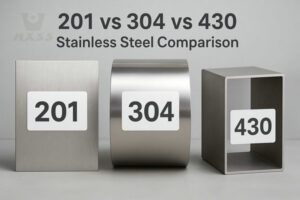
201 Stainless Steel vs Other Stainless Steels
| Feature | 201 Stainless Steel | 304 Stainless Steel | 316 Stainless Steel |
|---|---|---|---|
| Nickel Content | 3.5% – 5.5% | 8% – 10.5% | 10% – 14% |
| Manganese Content | 5.5% – 7.5% | 2% – 2.5% | 1% – 2% |
| Nitrogen Content | ≤ 0.25% | ≤ 0.10% | ≤ 0.10% |
| Corrosion Resistance | Moderate | Good | Excellent |
| Magnetic | Slight | Non-magnetic | Non-magnetic |
| Cost | Low | Medium | High |
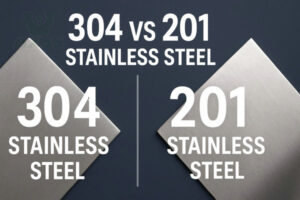
201 stainless steel is ideal for budget-conscious projects where moderate corrosion resistance is acceptable. For harsh environments, 304 or 316 stainless steel is recommended.
How to Source High-Quality 201 SS from Huaxiao Metal
Huaxiao Metal’s Quality Commitment for 201 Stainless Steel
In a fragmented market where quality can be inconsistent, selecting a reliable supplier is paramount. Due to the flexibility in its composition, 201 stainless steel is more susceptible to “under-specifying” or “falsification.” Huaxiao Metal makes the following commitments to you:
Strict Adherence to International Standards: All of our 201 stainless steel strictly adheres to international production and inspection standards such as ASTM A240/A666, EN 1.4372, or JIS SUS 201.
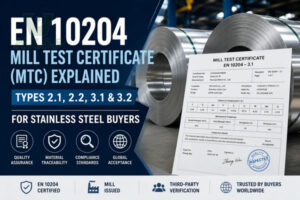
Provision of Original Mill Test Certificates (MTC): For every batch of delivered material, we provide traceable Mill Test Certificates (MTC) detailing the exact chemical composition and mechanical properties, ensuring the authenticity and quality of your 201 stainless steel.
Advanced Testing Equipment: We utilize Spectrometers (PMI) for elemental analysis to ensure that critical elements like Nickel (Ni), Manganese (Mn), and Nitrogen (N) comply with standards, eliminating the risk of “high-carbon, low-nickel” inferior products.
Key Factors and Trends Affecting 201 Stainless Steel Pricing
The 201 stainless steel price is a major concern for many clients. The primary factors influencing its quotation include:
Raw Material Price Volatility: The market price fluctuations of the three core alloying elements—Nickel, Chromium, and Manganese—are the foundation determining the price of 201 stainless steel.
Product Form and Specification: 201 stainless steel coil is usually less expensive than 201 stainless steel sheet. Thinner sheets typically incur higher processing costs than thicker plates.
Surface Finish Requirements: High-precision finishes (such as 8K mirror or fine NO.4 hairline finish) require additional processing steps, leading to higher costs.
Order Quantity and Delivery Cycle: Large volume orders can usually secure a more competitive 201 stainless steel quote.
Huaxiao Metal’s Pricing Advantage: Through optimized supply chain management and large-scale production, we effectively mitigate the risks associated with raw material volatility, allowing us to offer you highly competitive 201 stainless steel pricing.
Immediate Inquiry and Contact Process
We encourage you to contact our sales engineering team directly to obtain customized 201 stainless steel solutions and accurate quotations.
Information Required for Quotation (Please provide the following key data):
Product Form: 201 Stainless Steel Sheet / Coil / Pipe?
Specification: Thickness (mm) * Width (mm) * Length (mm) or Coil Weight (Tons).
Surface Finish: 2B / BA / NO.4 / 8K? Is protective film required?
Quantity: Total Order Volume (Tons).
Application Environment: (Indoor / Outdoor / Dry / Humid), which helps us provide the most professional advice.
Inquire Now Button or call the Huaxiao Metal service hotline immediately to receive your exclusive 201 stainless steel product quote and professional technical consultation! We look forward to becoming your most trusted stainless steel partner!
FAQ:
Can 201 stainless steel be used outdoors?
Yes, for light outdoor environments, but it may corrode in high humidity or salty conditions. For better corrosion resistance, consider 304 or 316 stainless steel.
Can 201 stainless steel be welded?
Yes, it has good weldability, but post-weld annealing may be needed to restore mechanical properties.
What surface finishes are available for 201 stainless steel?
Common finishes include 2B, BA, No.4 brushed, and mirror. Select based on functional and decorative needs.
How to distinguish 201 stainless steel from 304?
201 stainless steel contains lower nickel and may exhibit slight magnetic properties, while 304 is generally non-magnetic.
Is 201 stainless steel cost-effective?
Yes, due to lower nickel content, 201 stainless steel is more affordable than 304 and 316 stainless steels.
How can I tell the quality and authenticity of 201 stainless steel?
Professional identification methods include:
Chemical Composition Analysis: Spectrometers are used to determine the exact content of key elements such as nickel, manganese, and chromium.
Magnetic Testing: Although it exhibits a slight magnetic property after cold working, 304 stainless steel generally maintains its non-magnetic state more stably than 201.
Acid Testing/Chemical Identification: A professional stainless steel identification chemical can be used to quickly distinguish 201 stainless steel from 304 stainless steel by its color change.
MTC Certification: When purchasing, be sure to request a Material Traceability Certificate (MTC) from Huaxiao Metal; this is the most reliable guarantee of quality.
What specifications does Huaxiao Metal offer for its 201 stainless steel products? Can I customize them?
Huaxiao Metal offers 201 stainless steel sheets, coils, strips, and tubes. Our offering covers a wide range of standard and non-standard specifications. Yes, we fully support customization, including specific thicknesses, widths, strips, flattening, and special surface treatments. Please inform our sales team of your specific requirements.
201 J1–J5 Sub-Grade Guidance
In actual production and procurement, 201 stainless steel is typically subdivided into sub-grades such as J1, J2, J3, J4, and J5 based on differences in manganese and copper content and formability.
These sub-grades are widely used in the Asian market to differentiate deep-drawing capabilities, surface stability, and cost levels, especially for kitchenware and decorative applications.
👉 For a detailed understanding of the sub-grades from J1 to J5 and how to select the appropriate grade, please see this blog post. 201 J1, J2, J3, J4, J5 Stainless Steel: The Ultimate Guide to J-Series Sub-Grades