In international metal trade, choosing the right stainless steel is not only crucial for cost control but also directly impacts the durability and safety of end products. Addressing the high standards required by the South American and European markets, this article will delve into the core differences between stainless steel 201 vs 304 vs 430, focusing on their technical parameters, corrosion resistance, and application scenarios, to help purchasing managers make optimal decisions.
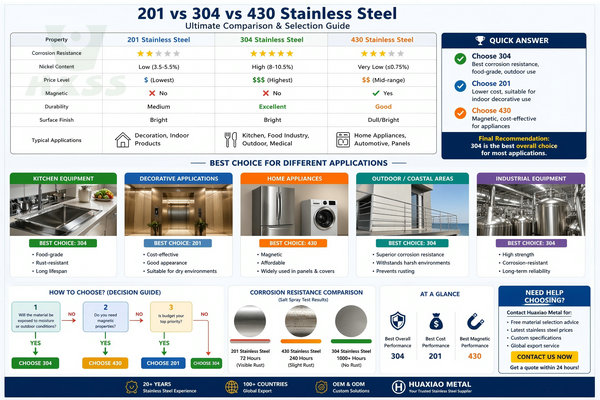
If you’re choosing between 201, 304, and 430 stainless steel:
- Choose 304 → Best corrosion resistance, food-grade, outdoor use
- Choose 201 → Lower cost, suitable for indoor decorative use
- Choose 430 → Magnetic, cost-effective for appliances
👉 Final Recommendation:
For most applications, 304 stainless steel is the best overall choice due to its superior corrosion resistance and durability.
201 vs 304 vs 430 Stainless Steel Comparison Table
| Property | 201 Stainless Steel | 304 Stainless Steel | 430 Stainless Steel |
|---|---|---|---|
| Corrosion Resistance | ⭐⭐ | ⭐⭐⭐⭐⭐ | ⭐⭐⭐ |
| Nickel Content | Low | High (8-10.5%) | Very Low |
| Price | 💲 (Lowest) | 💲💲💲 (Highest) | 💲💲 |
| Magnetic | No | No | Yes |
| Durability | Medium | Excellent | Good |
| Typical Use | Decoration | Food / Industry | Appliances |
What Is the Difference Between 201, 304, and 430 Stainless Steel?
The main difference lies in:
Chemical Composition
- 201 → Low nickel, high manganese
- 304 → High nickel → best corrosion resistance
- 430 → Ferritic, almost no nickel
👉 This directly affects price and performance
Corrosion Resistance (Most Important Factor)
304 > 430 > 201
- 304 → Excellent (outdoor, marine, food safe)
- 430 → Moderate (indoor / mild environments)
- 201 → Lower (may rust in humid environments)
👉 If corrosion matters → always choose 304
Price Difference
- 201 = cheapest
- 430 = mid-range
- 304 = most expensive
👉 Why? Nickel content drives cost.
Magnetic Properties
- 430 → ✅ Magnetic
- 201 / 304 → ❌ Non-magnetic
👉 Important for appliances & industrial use.
Workability
- 304 has excellent ductility, making it suitable for deep drawing and complex welding.
- 430, due to its ferritic structure, is prone to brittle fracture under high stress conditions, and its weldability is weaker than 304.
- 201 has high strength and hardness, making it suitable for supporting structures, but its formability is poor.
Best Stainless Steel for Different Applications
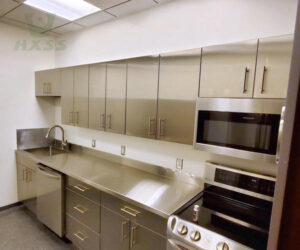
Kitchen Equipment
👉 Best choice: 304 stainless steel
- Food-grade
- Rust-resistant
- Long lifespan
Decorative Applications (Indoor)
👉 Best choice: 201 stainless steel
- Cost-effective
- Good appearance
- Suitable for dry environments
Home Appliances
👉 Best choice: 430 stainless steel
- Magnetic
- Affordable
- Widely used in panels & covers
Outdoor / Coastal Areas
👉 Only choice: 304 stainless steel
- Superior corrosion resistance
- Prevents rusting
How to Choose: Stainless Steel 201 vs 304 vs 430
Selecting the right grade is a balance between service life, environmental factors, and project budget. As a leading industrial supplier, Huaxiao Metal recommends choosing based on these three critical dimensions:
1. Consider the Environment (The “Corrosion” Test)
Choose 304: If your project is located in coastal areas (high salinity), chemical processing plants, or requires strict food-grade hygiene (e.g., European food safety standards). It offers the best long-term ROI by preventing rust-related failures.
Choose 430: For indoor, dry environments such as kitchen appliance panels or interior elevators. It resists mild atmospheric corrosion without the high cost of nickel.
Choose 201: Only for indoor decorative applications in non-humid regions where cost-saving is the absolute priority and surface exposure to moisture is minimal.
2. Consider the Function (The “Processing” Test)
Need Deep Drawing or Welding? Go with 304. Its high nickel content makes it incredibly ductile and easy to weld without cracking.
Need Magnetic Properties? Go with 430. Since it’s a ferritic steel, it is naturally magnetic—ideal for induction cooker bottoms or magnetic signage.
Need High Surface Hardness? 201 is harder and more brittle, making it suitable for structural components that don’t require complex forming.
3. Consider the Total Budget (The “Cost” Test)
304 (High-End): Highest initial cost but lowest maintenance. Essential for B2B contracts requiring 10+ years of durability.
430 (Mid-Range): A cost-effective alternative to 304 for specific industrial uses, offering better stability than 201.
201 (Economy): The lowest price point. Best for high-volume, low-margin bidding projects where the environment is controlled.
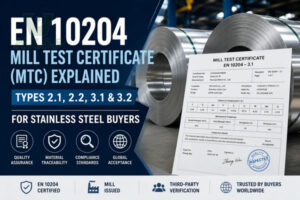
Expert Tip from Huaxiao Metal: If you are unsure, request an MTC (Mill Test Certificate). Many “low-price” 304 products in the market are actually high-manganese 201. We provide full traceability to ensure you get exactly what you pay for.
FAQ: Common Questions About 201, 304, and 430 Stainless Steel
Is 304 always better than 201 and 430?
Yes, in terms of corrosion resistance and durability. However, it is more expensive.
Which stainless steel is best for outdoor use?
304 stainless steel
Which of the three offers the best "Price-to-Performance" ratio?
It depends on your market. 430 stainless steel often provides the best middle ground. It offers significantly better corrosion resistance than 201 and is much cheaper than 304 because it is nickel-free. For B2B buyers in the appliance and automotive trim industries, 430 is the most cost-efficient “all-rounder.”
Can 430 or 201 truly replace 304 in industrial projects?
Only under specific conditions. 201 can replace 304 only in strictly indoor, low-moisture structural roles. 430 can replace 304 in high-heat or magnetic environments (like heat exchangers). However, for any application involving acidic chemicals, heavy welding, or outdoor exposure, 304 remains irreplaceable due to its high nickel content.
In a mixed-material project, how do I avoid "Galvanic Corrosion" between these grades?
When using 201, 304, and 430 together, ensure they aren’t in direct contact in wet environments. While all are stainless steels, their different electrode potentials can cause the “less noble” 201 to corrode faster when in contact with 304. We recommend using consistent fasteners (preferably 304) across the entire assembly.
Why does Huaxiao Metal suggest 430 over 201 for kitchenware, even if 201 is cheaper?
Safety and Stability. 430 is a ferritic steel that is highly resistant to stress corrosion cracking and is widely recognized as food-safe for dry contact. 201, due to its high manganese content, can sometimes release metallic ions in acidic food environments, making 430 the more professional and compliant choice for the global market.
If I need to polish the surface to a Mirror 8K finish, which grade should I pick?
304 provides the best results. While all three can be polished, the austenitic structure of 304 results in a deeper, clearer reflection. 430 can achieve a high shine but often has a slightly “grainy” texture, and 201 may develop tiny “black spots” over time due to its manganese inclusions.
Conclusion: Which Stainless Steel Should You Choose?
Choosing between 201, 304, and 430 stainless steel ultimately depends on your application, environment, and budget.
- 304 stainless steel remains the best overall choice for most projects, thanks to its excellent corrosion resistance and long-term durability
- 201 stainless steel is a cost-effective option for indoor decorative use where corrosion risk is low
- 430 stainless steel is ideal when magnetic properties and affordability are required, especially in appliances
If you are unsure, 304 is the safest and most reliable option for long-term performance.
Need Help Choosing the Right Stainless Steel?
At Huaxiao Metal, we don’t just supply materials — we help you choose the right solution.
👉 We offer:
- Free material selection advice
- Competitive and transparent pricing
- Custom sizes and global export support
📩 Contact us today to get a fast quote within 24 hours and ensure you select the most suitable stainless steel grade for your project.