
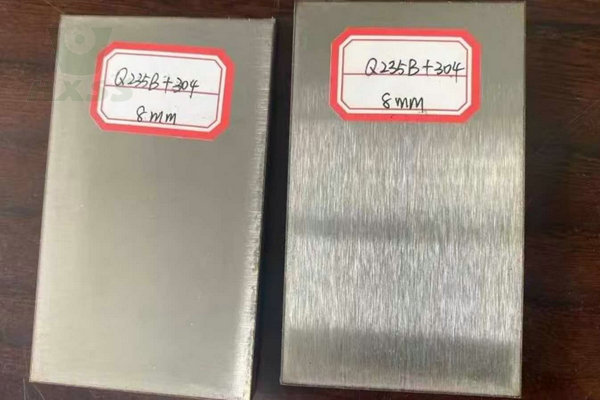
Huaxiao Metal is a professional manufacturer and supplier of Q235B + 304 Clad Steel Plate, offering high-quality bimetal composite plates that combine the strength of carbon steel (Q235B) and the corrosion resistance of stainless steel (304).
Our Q235B + 304 clad plates are widely used in pressure vessels, chemical processing equipment, storage tanks, and heat exchangers, providing excellent mechanical performance at an economical cost.
Contents [hide]
Q235B + 304 Clad Steel Plate Available Sizes and Standards
We supply Q235B + 304 Clad Steel Plates according to GB/T 8165, GB/T 13148, ASTM A263, and ASME SA263 standards.
| Specification | Range |
|---|---|
| Total Thickness | 3 mm – 150 mm |
| Stainless Steel Layer Thickness | 0.5 mm – 10 mm |
| Width | Up to 3000 mm |
| Length | Up to 12000 mm |
| Surface Finish | 2B / BA / Brushed / Mirror (on 304 side) |
Custom thickness ratios and special sizes are available upon request.
What Is Q235B + 304 Clad Steel Plate?
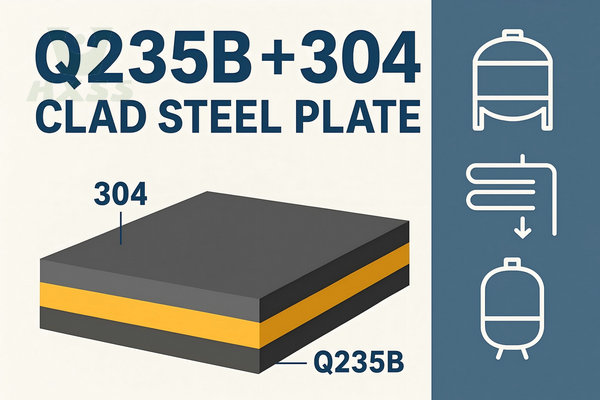
Q235B + 304 Clad Steel Plate is a composite steel plate made by metallurgically bonding two different metals — a Q235B carbon steel base layer and a 304 stainless steel cladding layer.
Through advanced processes such as explosion bonding, hot rolling, or vacuum diffusion, the two layers form a strong, permanent metallurgical bond that cannot be separated under normal service conditions.
Base layer (Q235B): Provides high strength, good weldability, and cost efficiency.
Clad layer (304): Offers excellent corrosion resistance, oxidation resistance, and a clean surface finish.
This combination enables engineers to achieve both structural integrity and corrosion resistance while reducing material cost compared with using solid stainless steel plates.
Manufacturing Process of Q235B + 304 Clad Plate
At Huaxiao Metal, the production of Q235B + 304 clad plates follows international standards and strict quality control.
We can produce the clad plates using different bonding technologies according to the customer’s project needs:
1. Explosion Bonding Process
A high-energy detonation force is used to bond the stainless steel and carbon steel layers instantly.
This method ensures a strong interface with excellent metallurgical bonding and minimal heat impact.
2. Hot Rolled Cladding
The stainless and carbon steel sheets are rolled together under high temperature and pressure, forming a uniform composite structure suitable for large-scale production.
3. Vacuum Diffusion Bonding
This high-precision process utilizes a vacuum furnace to facilitate atomic diffusion between the two materials, making it ideal for ultra-clean or high-pressure applications.
Each process can be customized based on plate thickness, size, bonding strength, and surface requirements.
Material Composition and Typical Properties
| Layer | Material | Description |
|---|---|---|
| Cladding Layer | 304 Stainless Steel | Austenitic stainless steel with excellent corrosion and oxidation resistance. |
| Base Layer | Q235B Carbon Steel | Structural carbon steel with good weldability, toughness, and mechanical strength. |
Mechanical Properties
| Property | Value (Typical) |
|---|---|
| Tensile Strength | ≥ 400 MPa |
| Yield Strength | ≥ 235 MPa |
| Bonding Strength | ≥ 400 MPa |
| Elongation | ≥ 20% |
| Clad Layer Thickness Ratio | 10% – 30% (customizable) |
Advantages of Q235B + 304 Clad Plate
1. Excellent Corrosion Resistance
The 304 stainless steel surface provides superior resistance to rust, acid, and oxidation, extending equipment life even in harsh chemical or marine environments.
2. High Strength and Weldability
The Q235B base layer maintains high mechanical strength and weldability, allowing the plate to be easily fabricated and installed using standard carbon steel techniques.
3. Cost-effective Alternative to Solid Stainless Steel
By using carbon steel as the backing, the overall material cost is reduced by 30–50%, while maintaining surface corrosion protection equivalent to stainless steel.
4. Strong Metallurgical Bond
The interface strength between 304 and Q235B exceeds 400 MPa, ensuring stable performance under pressure and temperature changes.
5. Wide Customization Options
Huaxiao Metal can tailor the thickness ratio, bonding method, surface finish, and size based on the customer’s drawing or application requirements.
Typical Applications
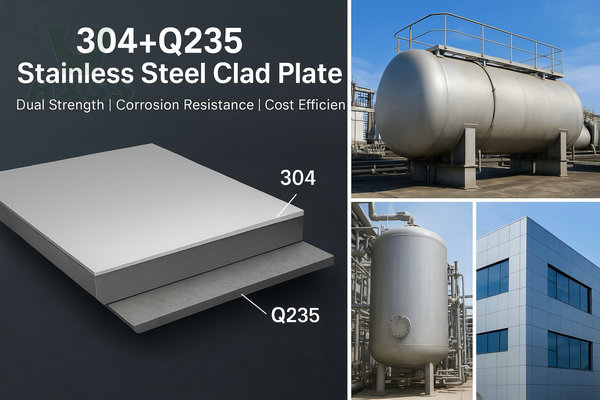
Q235B + 304 Clad Steel Plates are widely used in industries that require corrosion resistance combined with mechanical strength, including:
Pressure vessels and chemical reactors
Heat exchangers and condensers
Storage tanks and pipelines for corrosive media
Desalination and water treatment equipment
Marine and offshore engineering
Food and pharmaceutical processing facilities
For engineering projects that require other combinations (like 316L+Q345R, 2205+16MnR, or 904L+Q235B), Huaxiao Metal also provides customized clad steel solutions.
Looking for Q235B + 304 Stainless Steel Clad Plate for your next project?
Send us your drawing or specification today — our team will provide a technical solution and the best quotation within 24 hours!
Quality Assurance
Strict inspection of bonding strength, ultrasonic flaw detection, and surface quality.
Mechanical and chemical testing according to GB/T, ASTM, and ASME standards.
Material certificates and mill test reports (MTC) are available for each batch.
ISO9001-certified production process ensures stable and consistent quality.
Why Choose Huaxiao Metal as Your Clad Plate Supplier
Over 15 years of experience in stainless steel and composite materials manufacturing.
Advanced explosion bonding and rolling production lines.
Strong technical support team for engineering and project customization.
Competitive pricing with direct factory supply.
Global export service covering Asia, Europe, South America, and the Middle East, etc.
FAQ About 304+Q235 Stainless Steel Clad Plate
What is a 304+Q235 stainless steel clad plate?
304+Q235 stainless steel clad plate is a composite material made by bonding a layer of 304 stainless steel to a base of Q235 carbon steel. This combination provides excellent corrosion resistance from the stainless layer and high strength and cost efficiency from the carbon steel base.
What are the advantages of using 304+Q235B clad plates?
Excellent corrosion and oxidation resistance from 304 stainless steel.
High mechanical strength and weldability from Q235B carbon steel.
Lower cost than using pure stainless steel plates.
Ideal for pressure vessels, chemical tanks, and structural applications.
What is the typical thickness ratio between stainless steel and carbon steel layers?
Typically, the stainless steel layer occupies 10–20% of the total thickness, depending on customer requirements and intended use.
How are 304+Q235B clad plates manufactured?
These plates are produced through explosion bonding, hot rolling, or solid-phase bonding, ensuring a strong metallurgical bond between the two metals with no risk of delamination under normal conditions.
The price of Q235B + 304 Clad Steel Plate depends on several factors:
Plate thickness and size
Ratio of stainless to carbon steel layers
Surface finish (2B, BA, or mirror)
Required processing (cutting, polishing, forming)
Contact Huaxiao Metal today for the latest Q235B + 304 Clad Plate price list, technical datasheet, and free quotation.