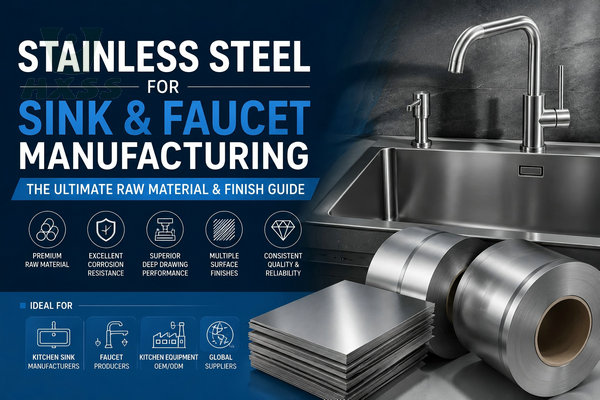
When sourcing raw materials for stainless steel sink and faucet manufacturing, producers face a critical challenge: selecting the right stainless steel grade that delivers excellent deep-drawing performance, superior corrosion resistance, attractive surface aesthetics, and long-term durability.
The quality of the raw material directly affects production efficiency, forming performance, surface consistency, and the service life of the final product. Choosing the wrong material can result in cracking during deep drawing, inconsistent finishes, higher rejection rates, and increased manufacturing costs.
As a leading B2B stainless steel supplier, Huaxiao Metal provides premium stainless steel coils, sheets, and customized processing solutions for sink manufacturers, faucet producers, and kitchen equipment OEMs worldwide. In this guide, we explore the best stainless steel grades, thicknesses, surface finishes, and sourcing considerations to help manufacturers optimize product quality and production performance.
Why Stainless Steel Is the Preferred Material for Sinks and Faucets
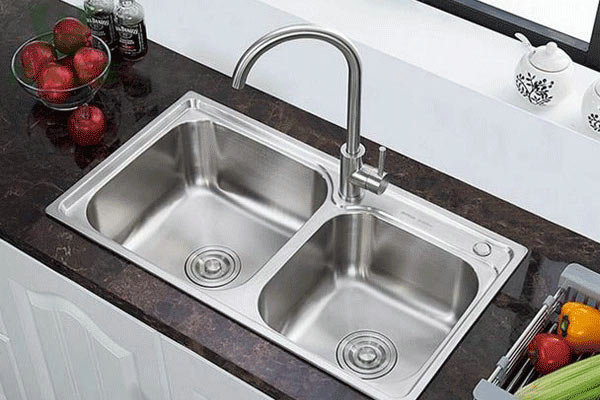
Compared with traditional materials such as ceramic, cast iron, or plastic, stainless steel offers several significant advantages.
Excellent Corrosion Resistance
Kitchen environments are constantly exposed to water, detergents, food acids, and moisture. Stainless steel forms a protective chromium oxide layer that helps prevent corrosion and staining.
Superior Hygiene
The smooth non-porous surface inhibits bacterial growth and is easy to clean, making stainless steel ideal for food preparation areas.
High Strength and Durability
Stainless steel withstands impact, heat, and daily wear without cracking or deforming.
Attractive Appearance
Modern brushed, satin, and mirror finishes provide a premium aesthetic suitable for residential and commercial kitchens.
Sustainability
Stainless steel is 100% recyclable and supports environmentally responsible manufacturing practices.
What Stainless Steel Grades Are Used for Sink Manufacturing?
Selecting the correct stainless steel grade directly impacts product performance, manufacturing efficiency, and customer satisfaction.
| Grade | Corrosion Resistance | Formability | Typical Application |
|---|---|---|---|
| 201 Stainless Steel | Good | Good | Economy kitchen sinks |
| 304 Stainless Steel | Excellent | Excellent | Residential sinks |
| 304DQ Stainless Steel | Excellent | Outstanding | Deep-drawn premium sinks |
| 316 Stainless Steel | Superior | Excellent | Coastal and marine environments |
| 430 Stainless Steel | Moderate | Good | Commercial kitchen equipment |
For most sink manufacturers, 304 stainless steel remains the industry standard due to its balanced combination of corrosion resistance, formability, and cost-effectiveness.
Why 304 Stainless Steel Is the Industry Standard for Kitchen Sinks
When customers search for premium kitchen sinks, the majority of high-quality products are manufactured using 304 stainless steel.
Key Advantages of 304 Stainless Steel
Excellent Corrosion Resistance
Containing approximately 18% chromium and 8% nickel, 304 stainless steel provides strong resistance against rust and household chemicals.
Outstanding Formability
304 stainless steel performs exceptionally well during deep drawing and stamping processes.
Food-Grade Safety
304 stainless steel complies with food-contact requirements and is widely used in kitchens, food processing facilities, and restaurants.
Long Service Life
Properly manufactured 304 stainless steel sinks can maintain performance and appearance for decades.
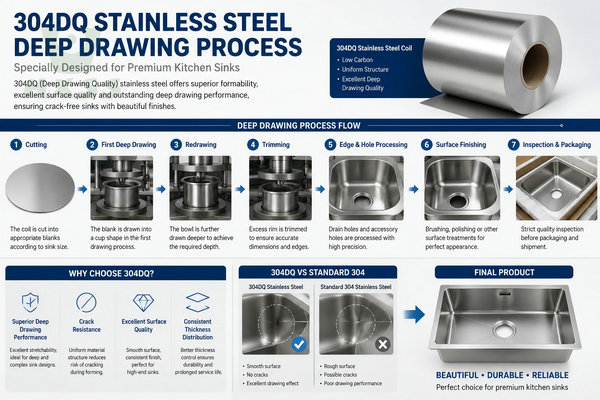
What Is 304DQ Stainless Steel and Why Is It Important?
As sink designs become deeper and more complex, standard 304 stainless steel may not always provide optimal forming performance.
This is where 304DQ (Deep Drawing Quality) stainless steel becomes essential.
Benefits of 304DQ Stainless Steel
-
Enhanced deep drawing capability
-
Reduced risk of cracking during forming
-
Better thickness distribution
-
Improved surface consistency
-
Higher production yield
For manufacturers producing single-bowl sinks, handmade sinks, and premium kitchen sinks, 304DQ material can significantly improve production efficiency and reduce scrap rates.
Recommended Stainless Steel Thickness for Sink Manufacturing
Thickness selection affects durability, noise reduction, product weight, and manufacturing costs.
| Thickness | Common Application |
|---|---|
| 0.5 mm | Entry-level sinks |
| 0.6 mm | Standard household sinks |
| 0.8 mm | Premium residential sinks |
| 1.0 mm | Commercial sinks |
| 1.2 mm | Heavy-duty industrial sinks |
Most premium kitchen sink manufacturers prefer thicknesses between 0.8 mm and 1.2 mm.
Best Stainless Steel Surface Finishes for Sinks and Faucets
Surface finish influences aesthetics, maintenance requirements, and consumer perception.
No.4 Brushed Finish
The most popular finish for kitchen sinks.
Advantages:
- Modern appearance
- Scratch concealment
- Easy maintenance
- Excellent customer acceptance
BA (Bright Annealed) Finish
BA stainless steel provides a smooth reflective appearance.
Advantages:
- Attractive brightness
- Uniform surface quality
- Suitable for decorative applications
Mirror Finish
Mirror-polished stainless steel delivers a luxurious appearance often used for decorative faucets and premium kitchen products.
Anti-Fingerprint Finish
Anti-fingerprint technology helps reduce visible smudges and improves maintenance convenience.
Increasingly popular in high-end residential projects.
Stainless Steel Materials Used for Faucet Manufacturing
While sinks primarily require excellent formability, faucets require additional attention to:
- Corrosion resistance
- Surface appearance
- Precision machining
- Welding performance
Common materials include:
304 Stainless Steel
Most widely used for premium residential faucets.
316 Stainless Steel
Preferred for coastal regions and marine environments due to enhanced chloride resistance.
304L Stainless Steel
Suitable for welded faucet structures where lower carbon content improves weld quality.
Stainless Steel Sink Manufacturing Process
Understanding the production process helps manufacturers choose appropriate raw materials.
Step 1: Coil Preparation
Stainless steel coils are inspected for thickness accuracy and surface quality.
Step 2: Slitting and Blanking
Coils are processed into specific dimensions according to sink designs.
Step 3: Deep Drawing
Large hydraulic presses form sink bowls through one or multiple drawing operations.
Step 4: Trimming and Edge Processing
Excess material is removed and edges are refined.
Step 5: Welding
Additional components are assembled when required.
Step 6: Surface Finishing
Brushing, polishing, or mirror finishing is applied.
Step 7: Quality Inspection
Manufacturers verify:
- Thickness
- Dimensions
- Surface quality
- Corrosion resistance
- Weld integrity
Step 8: Packaging and Shipment
Finished products are prepared for domestic and export markets.
How to Choose a Stainless Steel Supplier for Sink Manufacturing
Reliable raw material supply is critical for production consistency.
Manufacturers should evaluate suppliers based on:
Material Consistency
Stable chemistry and mechanical properties.
Surface Quality
Uniform BA or No.4 finish.
Deep Drawing Performance
Verified DQ and DDQ capabilities.
Production Capacity
Ability to support large-volume orders.
Export Experience
Professional packaging and global logistics support.
Technical Support
Responsive assistance for manufacturing challenges.
Why Sink and Faucet Manufacturers Choose Huaxiao Metal
Huaxiao Metal supplies stainless steel materials to manufacturers worldwide across kitchen equipment, household appliance, and food-service industries.
Our advantages include:
- 201, 304, 304L, 316L, and 430 stainless steel
- Deep Drawing Quality (DQ/DDQ) materials
- BA, No.4, Mirror, and customized finishes
- Precision slitting and cut-to-length services
- Stable thickness tolerance control
- Global export experience
- Custom dimensions available
- Fast quotation and technical support
Whether you manufacture kitchen sinks, handmade sinks, commercial wash basins, or stainless steel faucets, selecting the right raw material partner can significantly improve product quality and production efficiency.
FAQ About Stainless Steel for Sink & Faucet Manufacturing
What stainless steel is best for kitchen sinks?
304 stainless steel is generally considered the best balance of corrosion resistance, durability, and cost for most kitchen sink applications.
What is the difference between 304 and 430 stainless steel sinks?
304 contains nickel and offers significantly better corrosion resistance than 430 stainless steel.
What thickness is best for stainless steel sinks?
Premium sinks typically use 0.8 mm to 1.2 mm stainless steel.
Why do stainless steel sinks sometimes show rust spots?
Most rust spots are caused by surface contamination, iron particles, or harsh environmental conditions rather than failure of the stainless steel itself.
Which surface finish is easiest to maintain?
No.4 brushed finish is generally considered the easiest finish to maintain while effectively hiding minor scratches.
Can stainless steel sinks be recycled?
Yes. Stainless steel is 100% recyclable and is one of the most sustainable materials used in kitchen equipment manufacturing.