301 stainless steel is unique among austenitic grades: through cold working alone, it can achieve tensile strengths from 515 MPa (annealed) to over 1,850 MPa (extra hard) — a 3.6× increase without any heat treatment. This extraordinary work-hardening capability makes 301 the material of choice for springs, automotive stampings, electronics contacts, and structural components where high strength-to-weight ratio is critical.
But selecting the wrong temper can be costly. Too hard, and the material cracks during forming. Too soft, and the finished part lacks the strength to perform. This guide explains every 301 stainless steel temper condition defined by ASTM A666, compares their mechanical properties, and provides a practical selection framework so you can specify the correct temper with confidence.
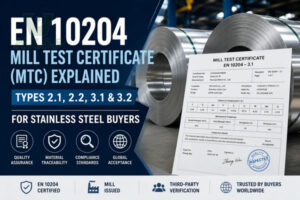
Need 301 temper coil for your project? Contact Huaxiao Metal — we supply all ASTM A666 tempers from 0.2mm to 3.0mm with EN 10204 3.1 MTC.
What Is 301 Stainless Steel Temper?
The Work-Hardening Mechanism
301 (UNS S30100 / EN 1.4310) is a metastable austenitic stainless steel. The term “metastable” is key: its austenite phase is not fully stable at room temperature and can transform to martensite (a harder, stronger phase) when subjected to mechanical deformation. This phenomenon is called Strain-Induced Martensitic Transformation (SIMT), and it is the reason 301 work-hardens far more dramatically than 304 or 316.
When 301 coil is cold rolled — passing through precision rolls under enormous pressure — three things happen simultaneously:
Grain elongation in the rolling direction increases dislocation density
Austenite transforms to martensite (alpha-prime martensite, which is magnetic and hard)
Strength increases while ductility decreases in a predictable, controllable manner
The percentage of cold reduction determines the temper designation. More cold reduction means more martensite, higher strength, lower elongation, and greater magnetism.
ASTM A666 vs ASTM A240 — Which Standard Applies?
A common source of confusion: 301 chemical composition is defined in both ASTM A240 and ASTM A666, but temper conditions are only defined in ASTM A666.
| Standard | Scope | Applies to 301? |
|---|---|---|
| ASTM A240 | Plate, sheet, strip for pressure vessels | Yes — chemistry + annealed properties |
| ASTM A666 | Annealed and cold-worked austenitic SS | Yes — defines ALL temper conditions |
| EN 10088-2 | Stainless steel flat products (Europe) | Yes — European equivalent |
| JIS G4305 | Cold-rolled SS sheet and strip (Japan) | Yes — Japanese equivalent |
| GB/T 3280 | Cold-rolled SS sheet and plate (China) | Yes — Chinese equivalent |
If your specification calls for a specific temper (1/4 hard, 1/2 hard, etc.), the governing standard is ASTM A666. ASTM A240 only covers annealed material.
Six 301 Temper Conditions Explained
ASTM A666 defines five standard temper conditions for 301, plus a sixth commercial designation used in the industry. Each represents a specific cold reduction range with corresponding minimum mechanical properties.
Annealed (Dead Soft)
Annealed 301 is the softest, most ductile condition. The coil is solution-annealed at 1,010–1,150°C and rapidly cooled (water quenched) to dissolve all carbides and produce a fully austenitic, stress-free microstructure.
Cold reduction: 0% (fully annealed after cold rolling)
Typical use: Deep drawing, severe forming, welding
Magnetism: Essentially non-magnetic (permeability < 1.02)
Key advantage: Can be formed into complex shapes without cracking
1/4 Hard Temper
1/4 Hard is the first cold-worked temper, produced by approximately 20% cold reduction from the annealed condition. It offers a balance of increased strength with retained formability.
Cold reduction: ~20%
Typical use: Automotive trim, brackets, clips
Magnetism: Slightly magnetic
Key advantage: 67% higher tensile than annealed, still formable
1/4 Hard is the most popular temper for automotive stamping because it can be formed into complex shapes while providing enough dent resistance and structural rigidity.
1/2 Hard Temper
1/2 Hard results from approximately 40% cold reduction. At this temper, significant martensitic transformation has occurred, doubling the tensile strength compared to annealed.
Cold reduction: ~40%
Typical use: Springs, spring clips, battery contacts, EMI shielding
Magnetism: Moderately magnetic
Key advantage: The “sweet spot” for spring manufacturing
1/2 Hard is the most widely specified temper for spring applications. The yield strength of ≥ 760 MPa ensures springs maintain their loaded position, while 15% minimum elongation allows stamping without edge cracking.
3/4 Hard Temper
3/4 Hard is produced by approximately 60% cold reduction. The material is approaching its formability limit — bending requires generous radii and specialized tooling.
Cold reduction: ~60%
Typical use: High-strength springs, structural reinforcements
Magnetism: Noticeably magnetic
Key advantage: Yield strength ≥ 930 MPa in compact geometries
Full Hard Temper
Full Hard represents approximately 70% cold reduction — the maximum standard temper defined in ASTM A666. The material is at its peak strength but has minimal remaining ductility.
Cold reduction: ~70%
Typical use: Maximum-strength springs, reinforcement plates
Magnetism: Strongly magnetic
Key advantage: Tensile ≥ 1,275 MPa — more than double annealed
Extra Hard (Commercial Designation)
Extra Hard is a commercial designation beyond ASTM A666, produced by cold reduction exceeding 70%. It is not a standard ASTM temper but is available from specialized mills.
Cold reduction: >70% (mill-specific)
Typical use: Ultra-high-strength flat parts — no bending
Magnetism: Very strongly magnetic
Key advantage: Tensile up to ~1,850 MPa
Note: Extra Hard values are not guaranteed by ASTM A666 and should be confirmed with the mill test report for each heat.
301 Temper Mechanical Properties Comparison
The table below summarizes minimum mechanical properties for each temper per ASTM A666. These are minimum values — actual properties on your mill test certificate will typically be higher.
| Temper | Cold Reduction | Tensile (MPa) | Yield (MPa) | Elong. (%) | HV | HRC (approx.) |
|---|---|---|---|---|---|---|
| Annealed | 0% | ≥ 515 | ≥ 205 | ≥ 40 | ≤ 218 | — (≤ 92 HRB) |
| 1/4 Hard | ~20% | ≥ 860 | ≥ 510 | ≥ 25 | 250–300 | ~25 |
| 1/2 Hard | ~40% | ≥ 1,030 | ≥ 760 | ≥ 15 | 310–370 | ~32 |
| 3/4 Hard | ~60% | ≥ 1,210 | ≥ 930 | ≥ 10 | 370–430 | ~37 |
| Full Hard | ~70% | ≥ 1,275 | ≥ 1,000 | ≥ 5 | 430–490 | ~43 |
| Extra Hard* | >70% | up to 1,850 | up to 1,450 | < 3 | ≥ 500 | ~48+ |
*Extra Hard is a commercial designation, not a standard ASTM A666 temper. Values are typical, not guaranteed.
Key observations:
From annealed to full hard, tensile strength increases by 147% (515 → 1,275 MPa)
From annealed to full hard, elongation decreases by 87% (40% → 5%)
The strength-to-ductility trade-off is predictable and linear
1/2 Hard provides the best balance: 2× strength of annealed with 37.5% of the ductility
How to Choose the Right 301 Temper
Selecting the correct temper requires evaluating three factors: required strength, forming complexity, and service conditions.
Spring Manufacturing — 1/2 Hard to Full Hard
Springs must maintain their loaded position without permanent deformation. The critical property is yield strength.
Light-duty springs (battery contacts, clips): 1/2 Hard (YS ≥ 760 MPa)
Medium-duty springs (compression/extension springs): 3/4 Hard (YS ≥ 930 MPa)
Heavy-duty springs (high-load flat springs): Full Hard (YS ≥ 1,000 MPa)
For spring applications, specify the minimum yield strength on your purchase order, not just the temper designation.
Automotive Stamping — 1/4 Hard to 1/2 Hard
Simple shapes (flat brackets, panels): 1/2 Hard
Moderate complexity (trim, molding, channels): 1/4 Hard
Complex shapes (deep-drawn): Annealed, then re-tempered
1/4 Hard is the automotive industry standard — allows 180° bends at 1× thickness radius with 67% higher tensile than annealed.

Electronics and Precision Stamping — 1/2 Hard to 3/4 Hard
Battery contacts: 1/2 Hard, 0.2–0.3mm
Connector terminals: 3/4 Hard, 0.15–0.3mm
EMI shielding strips: 1/2 Hard, 0.1–0.2mm
Precision stamped springs: 3/4 Hard to Full Hard, 0.2–0.5mm
Aerospace Components — Full Hard (with full certification)
Aerospace demands maximum strength-to-weight with complete traceability. Requires EN 10204 3.2 MTC, heat number traceability, and PMI verification.
Railway and Transportation — 1/2 Hard to Full Hard
Car body panels: 1/2 Hard
Structural reinforcement: 3/4 Hard to Full Hard
Crash-absorbing structures: Full Hard
301 Temper Selection Chart
| Application | Tensile (MPa) | Max Bend Radius | Recommended Temper | Thickness |
|---|---|---|---|---|
| Deep drawn parts | 515–700 | Flat (0°) | Annealed | 0.5–2.0mm |
| Automotive trim, channels | 860–1,000 | 1× T | 1/4 Hard | 0.5–1.5mm |
| Clips, light brackets | 1,030–1,150 | 2× T | 1/2 Hard | 0.3–1.0mm |
| Battery contacts, EMI shielding | 1,030–1,200 | 2× T | 1/2 Hard | 0.1–0.3mm |
| Compression springs, flat springs | 1,210–1,350 | 3× T | 3/4 Hard | 0.5–2.0mm |
| High-load springs, fasteners | 1,275–1,450 | 4× T | Full Hard | 1.0–3.0mm |
| Ultra-high strength flat parts | 1,450–1,850 | No bending | Extra Hard | 1.0–3.0mm |
| Structural reinforcement | 1,275+ | 4× T | Full Hard | 1.5–3.0mm |
| Precision electronic contacts | 1,210–1,350 | 3× T | 3/4 Hard | 0.15–0.5mm |
| Aerospace brackets | 1,275+ | 4× T | Full Hard | 0.5–2.0mm |
Formability and Bend Radius by Temper
| Temper | Min Bend Radius (ASTM A666) | Practical Recommendation | Forming Notes |
|---|---|---|---|
| Annealed | 0× T (180° flat) | Deep draw, stretch form | Maximum formability |
| 1/4 Hard | 1× T (90°) | Safe for most stamping | Good for trim, brackets |
| 1/2 Hard | 2× T (90°) | Proper tooling clearance | Suitable for spring shapes |
| 3/4 Hard | 3× T (90°) | Carbide tooling | Limited forming; avoid sharp radii |
| Full Hard | 4× T (90°) | Pre-cut when possible | Minimal forming; cracks if over-bent |
| Extra Hard | Not recommended | Flat strip only | Cracks at any bend |
Bend direction matters: Bending perpendicular to the rolling direction provides better formability. For 1/2 Hard and harder, always specify grain direction on engineering drawings.
301 Temper and Magnetic Properties
| Temper | Permeability (μ) | Martensite (approx.) | Magnetic? |
|---|---|---|---|
| Annealed | < 1.02 | < 5% | Essentially non-magnetic |
| 1/4 Hard | 1.02 – 3.0 | 10–25% | Slightly magnetic |
| 1/2 Hard | 3.0 – 15 | 30–50% | Moderately magnetic |
| 3/4 Hard | 15 – 40 | 50–70% | Noticeably magnetic |
| Full Hard | 40 – 80 | 70–85% | Strongly magnetic |
| Extra Hard | > 80 | > 85% | Very strongly magnetic |
Why this matters:
Quality verification: If 1/2 Hard 301 is not at least slightly magnetic, it may not have received adequate cold reduction
Application restrictions: Non-magnetic applications (MRI, sensors) require annealed 301 or 304/316L
Inspection: PMI guns can detect martensite content to verify correct temper
This magnetic transformation is normal and expected — it is not a quality defect. It is a direct result of the work-hardening mechanism that gives 301 its exceptional strength.
301 vs 304 vs 17-7 PH — High-Strength Alternatives
| Property | 301 (Full Hard) | 304 (Cold Worked) | 17-7 PH (TH1050) |
|---|---|---|---|
| Max tensile strength | ~1,275 (1,850 Extra Hard) | ~1,100 MPa | ~1,450 MPa |
| Temper standard | ASTM A666 | ASTM A666 | AMS 5529 |
| Hardening mechanism | Strain-induced martensite | Dislocation density | Precipitation hardening |
| Formability at max strength | Limited (4× T bend) | Very limited | Good (form annealed, then age) |
| Corrosion resistance | Moderate (16–18% Cr) | Good (18–20% Cr) | Good (16–18% Cr) |
| Cost | Low (less Ni) | Medium | High |
When to choose 301: High strength from cold rolling without heat treatment, cost-sensitive applications, wide strength range from single grade.
When to choose 304: Corrosion resistance more important than max strength, non-magnetic requirement. See our 304 cold rolled stainless steel coil page.
When to choose 17-7 PH: High strength AND complex formability, can accommodate heat treatment, aerospace springs. See our Precipitation Hardening Stainless Steel
Heat Treatment and Annealing of 301
Solution Annealing
Temperature: 1,010–1,150°C (1,850–2,100°F)
Atmosphere: Hydrogen or vacuum (bright anneal); air (standard)
Cooling: Rapid water quench or fast forced-air cool
Result: Fully austenitic, hardness ≤ 92 HRB
Critical: Cooling must be rapid through 900–500°C. Slow cooling causes carbide precipitation (sensitization). See our 316/316L stainless steel page for sensitization details.
Stress Relief
Temperature: 350–425°C (660–800°F) for 1–2 hours, air cool
Result: 5–15% residual stress reduction, minimal strength change
Use: Precision springs and dimensional-critical parts
Cannot Harden by Heat Treatment
301 cannot be hardened by heat treatment (quench and temper). Unlike martensitic grades (410, 420, 440C), 301’s strength comes exclusively from cold working. Heating above 425°C progressively softens it as martensite reverts to austenite.
301 Coil Specifications by Temper
| Parameter | Specification |
|---|---|
| Grade | AISI 301 / UNS S30100 / EN 1.4310 / JIS SUS301 |
| Standard | ASTM A666 |
| Temper | Annealed / 1/4 Hard / 1/2 Hard / 3/4 Hard / Full Hard / Extra Hard |
| Thickness | 0.2mm – 3.0mm |
| Width | 600mm – 1,500mm (standard: 1000, 1219, 1250, 1500mm) |
| Coil ID | 508mm (20″) or 610mm (24″) |
| Surface Finish | 2B (standard), 2D, BA (annealed only) |
| Tolerance | Per ASTM A480M |
| Certification | EN 10204 3.1 MTC (standard), 3.2 (third-party) |
Quality Inspection for 301 Temper Material
| Inspection | Standard | Purpose |
|---|---|---|
| Tensile Test | ASTM E8 | Verify TS, YS, elongation per A666 |
| Hardness Test | ASTM E18 / E92 | Fastest temper verification |
| Chemical Analysis | ASTM E1019 / E1086 | Verify 301 chemistry (Cr 16–18%, Ni 6–8%) |
| Bend Test | ASTM E290 | Verify formability per temper |
| PMI | — | XRF verify grade (not 304/201) |
| Magnetic Permeability | ASTM A342 | Verify martensite content vs temper |
Practical tip: A quick hardness test is the fastest way to verify temper on incoming material.
Standards and Equivalent Grades for 301
| Standard | Designation | Temper Standard |
|---|---|---|
| AISI (USA) | 301 | ASTM A666 |
| UNS (USA) | S30100 | ASTM A666 |
| EN (Europe) | 1.4310 | EN 10088-2 (C700/C850/C1000/C1150) |
| DIN (Germany) | X12CrNi17-7 | SEW 390 |
| JIS (Japan) | SUS 301 | JIS G4305 |
| GB (China) | 06Cr17Ni7 | GB/T 3280 |
| BS (UK) | 301S21 | BS 1449 Part 2 |
| ISO | X5CrNi17-7 | ISO 9444 |
European temper equivalents (EN 10088-2):
| ASTM A666 Temper | EN 10088-2 | Approx. Rp (MPa) |
|---|---|---|
| Annealed | 1.4310 annealed | ≥ 230 |
| 1/4 Hard | C700 | ≥ 700 |
| 1/2 Hard | C850 | ≥ 850 |
| 3/4 Hard | C1000 | ≥ 1,000 |
| Full Hard | C1150 | ≥ 1,150 |
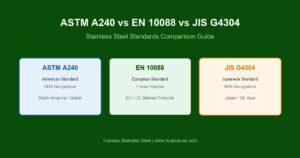
For detailed international standards comparison, see our blog: ASTM A240 vs EN 10088 vs JIS G4304 Standards Comparison
Buying 301 Temper Coil: MOQ, Lead Time, Certification
| Parameter | Detail |
|---|---|
| MOQ | 1 Ton (samples negotiable) |
| Lead Time (stock) | 7–15 days |
| Lead Time (production) | 25–35 days |
| Payment | T/T (30% deposit, 70% before shipment); L/C |
| Incoterms | FOB Shanghai / CIF / CFR / DAP / EXW |
| MTC | EN 10204 3.1 (free), 3.2 (SGS/BV/TÜV) |
| REACH/RoHS | Available for European buyers |
| C/O | Available for preferential tariff |
| HS Code | 7219.34.00 (<1mm, ≥600mm); 7219.24.00 (1–3mm); 7220.20.00 (<600mm) |
| Response Time | Within 12 hours |
| +86-13761906384 |
Frequently Asked Questions: 301 Stainless Steel Temper Guide
Conclusion
301 stainless steel’s temper range — from annealed (515 MPa) to full hard (1,275 MPa) and beyond — gives engineers and buyers an unmatched strength spectrum from a single grade. The key to successful 301 specification is matching the temper to your application:
Need maximum formability? Choose Annealed
Need formability + strength? Choose 1/4 Hard
Need spring performance? Choose 1/2 Hard
Need maximum strength? Choose 3/4 Hard or Full Hard
Always specify temper by ASTM A666 designation (not colloquial terms), require EN 10204 3.1 MTC with actual mechanical values, and verify incoming material with a hardness test.
Huaxiao Metal supplies 301 cold rolled coil in all ASTM A666 temper conditions from 0.2mm to 3.0mm, with full mill certification and 12-hour response time.