When sourcing stainless steel from China, international buyers frequently encounter three major standard systems: ASTM A240 (American), EN 10088 (European), and JIS G4304/G4305 (Japanese). Each standard defines stainless steel grades, chemical composition limits, mechanical property requirements, dimensional tolerances, and surface finish designations differently.
Understanding the differences between these standards is critical for B2B procurement. Specifying the wrong standard can lead to rejected shipments, failed material certification, and costly rework. This guide provides a comprehensive comparison of all three standards with practical cross-reference tables, tolerance data, and procurement guidance for buyers in Europe, South America, and Asia.
Three Major Stainless Steel Standards: Quick Overview
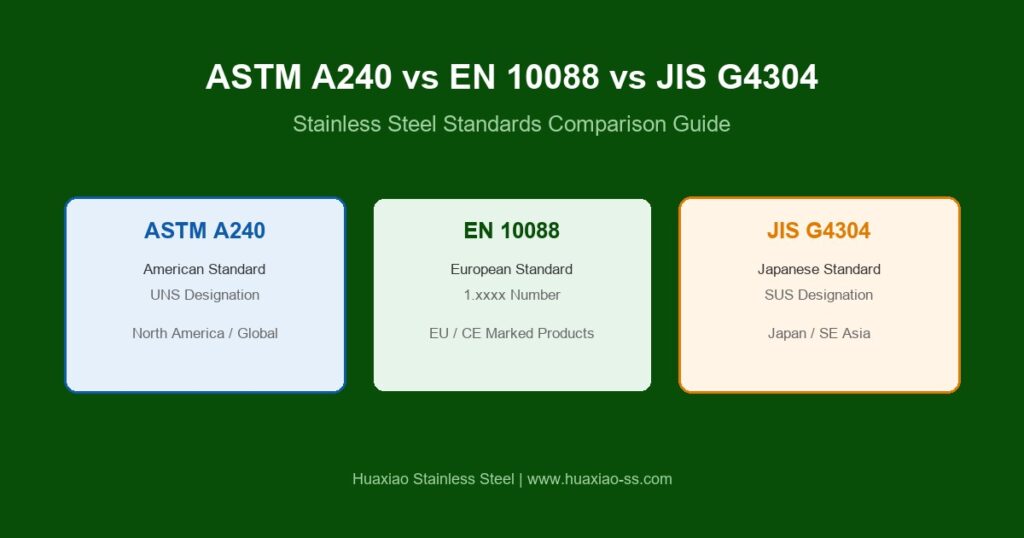
ASTM A240 / A240M
American standard by ASTM International. Covers chromium and chromium-nickel stainless steel plate, sheet, and strip for pressure vessels and general applications. Widely used in North America, Middle East, and many South American countries. Grade designations: 304, 316L, 430, 201 (UNS: S30400, S31603, etc.). General requirements per ASTM A480.
EN 10088 (Parts 1-5)
European standard by CEN. Part 1 lists all stainless steel grades; Part 2 covers sheet/plate/strip technical delivery conditions; Part 3 covers bars/rods/wire; Parts 4-5 for construction (CE marking). Mandatory for CE-marked products in EU. Grade designations: 1.4301 (304), 1.4404 (316L), X5CrNi18-10. Widely used in Germany, Italy, Spain, France.
JIS G4304 / G4305
Japanese Industrial Standard. G4304 covers hot-rolled stainless steel plate, sheet, and strip; G4305 covers cold-rolled. Grade designations use SUS prefix: SUS304, SUS316L, SUS430, SUS201. Important in Japan, South Korea, Taiwan, and Southeast Asian markets. Referenced alongside ASTM in many Asian procurement specs.
Scope Comparison: What Each Standard Covers
| Scope Item | ASTM A240 | EN 10088 | JIS G4304/4305 |
|---|---|---|---|
| Publishing Body | ASTM International (USA) | CEN (European Committee for Standardization) | JISC (Japanese Industrial Standards Committee) |
| Product Forms | Plate, sheet, strip (hot + cold rolled in ONE standard) | Part 2: sheet/plate/strip; Part 3: bars/rods/wire/sections | G4304: hot-rolled; G4305: cold-rolled (split by process) |
| Primary Markets | North America, Middle East, LATAM, global oil & gas | EU (Germany, Italy, Spain, France), CE-marked products | Japan, South Korea, Taiwan, Southeast Asia |
| Grade Naming System | Common name (304, 316L) + UNS (S30400, S31603) | Number (1.4301, 1.4404) + Symbolic (X5CrNi18-10) | SUS prefix (SUS304, SUS316L) |
| General Requirements | ASTM A480/A480M | EN 10021 (common technical delivery requirements) | JIS G4300 (general rules) |
| Thickness Tolerance Standard | Per ASTM A480 tables | EN 10029 (plate) / EN 10051 (hot-rolled strip) / EN 10048 (cold-rolled narrow strip) | Within G4304/G4305 standard tables |
| CE Marking | N/A (American standard) | Required for construction (Parts 4 & 5 per CPR 305/2011) | N/A (Japanese standard) |
| Latest Revision | 2024 (updated biennially) | 2014 (with amendments) | 2012 (with amendments) |
Grade Designation Cross-Reference: 10 Common Stainless Steel Grades
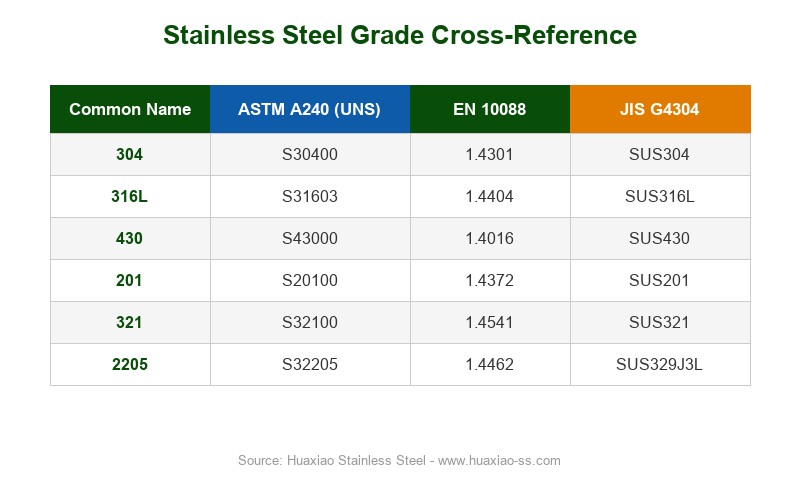
One of the most common challenges in international stainless steel trade is matching grade designations across standards. A European buyer asking for “1.4301” needs the same material as an American buyer requesting “304” or a Japanese buyer ordering “SUS304.” The table below provides a complete cross-reference for the 10 most commonly traded grades.
| Common Name | ASTM A240 (UNS) | EN 10088 (Number) | EN 10088 (Symbolic Name) | JIS G4304/4305 | GB/T (China) |
|---|---|---|---|---|---|
| 304 | S30400 | 1.4301 | X5CrNi18-10 | SUS304 | 06Cr19Ni10 |
| 304L | S30403 | 1.4307 | X2CrNi18-9 | SUS304L | 022Cr19Ni10 |
| 316 | S31600 | 1.4401 | X5CrNiMo17-12-2 | SUS316 | 06Cr17Ni12Mo2 |
| 316L | S31603 | 1.4404 | X2CrNiMo17-12-2 | SUS316L | 022Cr17Ni12Mo2 |
| 321 | S32100 | 1.4541 | X6CrNiTi18-10 | SUS321 | 06Cr18Ni11Ti |
| 430 | S43000 | 1.4016 | X6Cr17 | SUS430 | 10Cr17 |
| 201 | S20100 | 1.4372 | X12CrMnNiN17-7-5 | SUS201 | 12Cr17Mn6Ni5N |
| 410 | S41000 | 1.4006 | X12Cr13 | SUS410 | 12Cr13 |
| 904L | N08904 | 1.4539 | X1NiCrMoCu25-20-5 | SUS890L | 015Cr21Ni26Mo5Cu2 |
| 2205 (Duplex) | S32205 | 1.4462 | X2CrNiMoN22-5-3 | SUS329J3L | 022Cr23Ni5Mo3N |
Chemical Composition Comparison: 304 and 316L Across All Three Standards
While grade 304 from ASTM, EN, and JIS refers to the same basic alloy, the chemical composition limits are not identical. The differences are subtle but can matter in critical applications such as pressure vessels, pharmaceutical equipment, and food contact materials. Below is a detailed comparison for the two most commonly traded grades.
Grade 304 / 1.4301 / SUS304 Chemical Composition
| Element | ASTM A240 (S30400) | EN 10088 (1.4301) | JIS G4305 (SUS304) | Key Difference |
|---|---|---|---|---|
| Carbon (C) | ≤0.08% | ≤0.07% | ≤0.08% | EN is stricter (0.07% vs 0.08%) |
| Chromium (Cr) | 18.0-20.0% | 17.0-19.5% | 18.0-20.0% | EN range shifted lower (17.0% min) |
| Nickel (Ni) | 8.0-10.5% | 8.0-10.5% | 8.0-10.5% | Identical across all three |
| Manganese (Mn) | ≤2.00% | ≤2.00% | ≤2.00% | Identical |
| Silicon (Si) | ≤0.75% | ≤1.00% | ≤1.00% | ASTM is stricter (0.75% vs 1.00%) |
| Phosphorus (P) | ≤0.045% | ≤0.045% | ≤0.045% | Identical |
| Sulfur (S) | ≤0.030% | ≤0.030% | ≤0.030% | Identical |
| Nitrogen (N) | ≤0.10% | ≤0.10% | ≤0.10% | Identical |
Grade 316L / 1.4404 / SUS316L Chemical Composition
| Element | ASTM A240 (S31603) | EN 10088 (1.4404) | JIS G4305 (SUS316L) | Key Difference |
|---|---|---|---|---|
| Carbon (C) | ≤0.030% | ≤0.030% | ≤0.030% | Identical (all “L” grades) |
| Chromium (Cr) | 16.0-18.0% | 16.5-18.5% | 16.0-18.0% | EN range shifted higher (16.5% min) |
| Nickel (Ni) | 10.0-14.0% | 10.0-13.0% | 10.0-14.0% | EN Ni max is 13.0% vs 14.0% |
| Molybdenum (Mo) | 2.0-3.0% | 2.0-2.5% | 2.0-3.0% | EN Mo max is 2.5% vs 3.0% |
| Manganese (Mn) | ≤2.00% | ≤2.00% | ≤2.00% | Identical |
| Silicon (Si) | ≤0.75% | ≤1.00% | ≤1.00% | ASTM is stricter (0.75% vs 1.00%) |
Procurement Tip: A heat of 304 with C=0.075% and Cr=17.5% would pass ASTM A240 and JIS G4305 but FAIL EN 10088 (C limit 0.07%, Cr min 17.0% but composition must meet ALL requirements). When a buyer requires EN 10088 compliance, the mill must select heats that meet the EN composition window, which may be a narrower subset of ASTM-compliant material.
Mechanical Properties Comparison: 304 and 316L (Annealed Condition)
| Property | ASTM A240 (304) | EN 10088-2 (1.4301) | JIS G4305 (SUS304) |
|---|---|---|---|
| Yield Strength (Rp0.2) | ≥205 MPa (30 ksi) | ≥210-230 MPa* | ≥205 MPa |
| Tensile Strength (Rm) | ≥515 MPa (75 ksi) | 520-720 MPa | ≥520 MPa |
| Elongation (A80mm) | ≥40% | ≥45% | ≥40% |
| Hardness (HRB) | ≤92 HRB | ≤215 HBW | ≤90 HRB |
| Hardness (HBW) | ≤201 HBW | ≤215 HBW | ≤200 HBW |
*EN 10088-2 yield strength varies by thickness: ≥230 MPa for thickness ≤1mm, ≥220 MPa for 1-3mm, ≥210 MPa for >3mm. ASTM and JIS specify a single minimum value regardless of thickness.
Thickness Tolerance Comparison: Why It Matters for Coil and Sheet Buyers
Thickness tolerance is one of the most commercially sensitive specification items. A buyer ordering 2.0mm stainless steel coil may receive material measuring 1.92mm under one standard and 2.05mm under another. The tolerance systems differ significantly:
ASTM A480 Tolerance System
Single tolerance table for all widths. Uses nominal thickness with plus/minus tolerances. Example: 2.0mm sheet, width 1219mm = tolerance +/-0.18mm (range 1.82-2.18mm). Relatively generous compared to EN.
EN 10029 / EN 10051 System
Four tolerance classes (A, B, C, D, E) for plate; EN 10051 for hot-rolled strip. Buyer must specify class. Class B is default. Example: 2.0mm plate, Class B = -0.4/+1.3mm. More flexible but requires buyer to specify class.
JIS G4304/G4305 Tolerance
Separate tables for hot-rolled (G4304) and cold-rolled (G4305). Tolerances vary by width category. Example: 2.0mm cold-rolled sheet, width 1219mm = +/-0.15mm (range 1.85-2.15mm). Slightly tighter than ASTM for cold-rolled.
| Nominal Thickness | ASTM A480 (width >1200mm) | EN 10051 Class B | JIS G4305 (width >1200mm) |
|---|---|---|---|
| 0.5mm | +/-0.10mm | +/-0.05mm | +/-0.08mm |
| 1.0mm | +/-0.13mm | +/-0.08mm | +/-0.10mm |
| 2.0mm | +/-0.18mm | +/-0.11mm | +/-0.15mm |
| 3.0mm | +/-0.20mm | +/-0.14mm | +/-0.18mm |
| 5.0mm | +/-0.22mm | +/-0.16mm | +/-0.20mm |
Buyer Alert: EN 10051 tolerances are significantly tighter than ASTM A480 for the same nominal thickness. If your RFQ specifies “ASTM A240” tolerance but the buyer expects “EN 10088” tolerance, the mill may deliver material that passes ASTM but fails EN inspection. Always clarify the tolerance standard in the purchase order.
Surface Finish Designation Comparison
Surface finish designations differ across the three standards. The same physical finish may have different names, which can cause confusion in procurement specifications. The table below maps the most common surface finishes:
| Surface Description | ASTM A240 / A480 | EN 10088-2 | JIS G4304/4305 |
|---|---|---|---|
| Hot-rolled, annealed, pickled | No.1 | 1D | No.1 |
| Cold-rolled, annealed, pickled | 2D | 2D | 2D |
| Cold-rolled, skin-passed (most common) | 2B | 2B | 2B |
| Bright annealed | BA | 2R | BA |
| Brushed / satin polished (240 grit) | No.4 | G240 (or brushed) | No.4 (HL for linear) |
| Mirror polished | No.8 | P500 (or mirror) | No.8 |
Certification & MTC Requirements by Standard
Each standard system has its own certification framework. Understanding which Mill Test Certificate (MTC) type to request is essential for compliance and customs clearance.
ASTM Certification
ASTM A240 references ASTM A480 for general requirements. MTC typically includes: heat number, chemical composition, mechanical properties, and mill certification. No formal MTC type system like EN 10204. In practice, most US mills issue a "Mill Test Report" (MTR) equivalent to EN 10204 3.1.
EN 10204 Certification
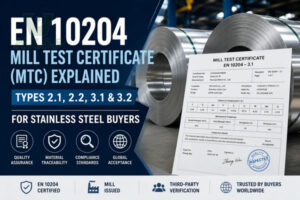
European standard EN 10204 defines 4 types: 2.1 (declaration), 2.2 (test report), 3.1 (mill inspection cert), 3.2 (third-party witnessed). EN 10088-2 requires Type 3.1 as default. Type 3.2 mandatory for pressure vessels (PED 2014/68/EU). Most widely accepted MTC system globally.
JIS Certification
JIS G0430 (equivalent to EN 10204) defines inspection documents. Types: 1 (non-specific), 2 (specific test), 3 (third-party witnessed). Less commonly referenced internationally. Most Japanese mills also provide EN 10204 3.1 certificates for export markets.
Best Practice: Regardless of which product standard (ASTM/EN/JIS) you specify, always request EN 10204 3.1 MTC from your supplier. It is the most universally accepted certification document in international B2B trade.
Which Standard Should You Specify? Decision Guide by Region and Application
Choosing the right standard to specify in your RFQ depends on your destination market, application, and buyer requirements. Use this decision matrix to determine the optimal specification:
European Union (Germany, Italy, Spain, France)
Specify EN 10088-2. Required for CE marking under Construction Products Regulation (CPR 305/2011). Pressure vessel applications also require PED 2014/68/EU compliance. MTC: EN 10204 3.1 minimum, 3.2 for pressure vessels.
North America (USA, Canada, Mexico)
Specify ASTM A240. Standard for ASME pressure vessel code compliance. Most US engineering firms and EPC contractors use ASTM exclusively. MTC: Mill Test Report (MTR) per ASTM A480.
South America (Brazil, Chile, Colombia, Argentina)
Often accepts both ASTM A240 and EN 10088-2. Brazil Petrobras specs typically reference ASTM. Chilean mining (CODELCO) often requires EN 10204 3.1. Colombia Ecopetrol uses API/ASTM. Argentina IRAM accepts both. Recommend: specify ASTM + request EN 10204 3.1 MTC.
Asia (Japan, South Korea, Taiwan, SE Asia)
Specify JIS G4304/G4305 for Japanese-influenced markets. South Korea and Taiwan accept both JIS and ASTM. Southeast Asia (Thailand, Vietnam, Indonesia) commonly uses JIS. For Chinese exports, GB/T standards apply domestically but most exporters can dual-certify to ASTM/EN.
5 Common Pitfalls When Mixing Standards (and How to Avoid Them)
1. Carbon Content Mismatch
A heat with C=0.075% passes ASTM A240 (limit 0.08%) but fails EN 10088 (limit 0.07%). Always verify the MOST RESTRICTIVE standard if dual certification is required.
2. Chromium Range Out-of-Spec
Cr=17.3% fails ASTM (18.0% min) but passes EN 10088 (17.0% min). Know which standard each element range belongs to. Do not mix and match.
3. Thickness Tolerance Dispute
Mill ships to ASTM A480 tolerance. Buyer inspects per EN 10051 (tighter). Material passes ASTM but fails EN. Result: shipment rejected, rework needed. Specify tolerance standard clearly in PO.
4. Wrong Surface Finish Name
Buyer requests "No.4 finish" (ASTM/JIS). Mill ships "G240" (EN designation). Same physical finish but different name on MTC. Communication breakdown. Include surface Ra value (e.g. Ra 0.4-0.6 microns) to avoid ambiguity.
5. Missing Dual Certification
Buyer needs both ASTM and EN compliance but only specifies ASTM in RFQ. Mill produces to ASTM only. EN compliance cannot be retroactively certified without re-testing. Always request dual certification upfront if needed.
Regional Compliance Requirements: Europe, South America, and Asia
Europe (EU/EEA)
European buyers require EN 10088-2 compliance as the baseline. Additional requirements include:
- CE Marking: Required for construction products per CPR 305/2011 (EN 10088-4/5)
- PED 2014/68/EU: Pressure Equipment Directive for pressure vessels
- REACH Regulation: Chemical safety compliance for all imported materials
- EN 10204 3.1/3.2 MTC: Mandatory for all stainless steel imports
- AD 2000 Merkblatt: German pressure vessel code (TUV certification)
South America
South American markets typically accept both ASTM and EN standards. Key country-specific requirements:
- Brazil: Petrobras N-1618/N-2562 (oil & gas), INMETRO certification, ASTM A240 widely used
- Chile: Mining sector (CODELCO, BHP) requires EN 10204 3.1 minimum, SGS inspection for 3.2
- Colombia: Ecopetrol specs (ASTM-based), INVIMA for pharma, ICONTEC local standards
- Argentina: IRAM standards (ISO-aligned), EN 10204 3.1 standard for imports
- All LATAM: WhatsApp preferred for communication, LCL consolidation important, HS Code and Certificate of Origin required
Asia-Pacific
Asia-Pacific markets have diverse standard requirements:
- Japan: JIS G4304/G4305 primary, JIS G0430 for MTC
- South Korea: KS D standard (aligned with JIS), ASTM also accepted
- Taiwan: CNS standard (JIS-aligned), ASTM commonly used
- Southeast Asia: Mix of JIS, ASTM, and EN depending on industry
- India: IS 6911 (national standard), BIS certification required for some products
How Huaxiao Supports Multi-Standard Compliance
Triple-Standard Production
Our mill produces stainless steel coil, sheet, bar, and tube compliant with ASTM A240, EN 10088-2, and JIS G4304/G4305 simultaneously. Heat selection optimized for the MOST RESTRICTIVE standard when dual certification is requested.
EN 10204 3.1 Included Free
Every shipment includes EN 10204 3.1 Mill Test Certificate at no additional cost. 3.2 third-party inspection (SGS, TUV, BV, DNV, Lloyds) available on request for pressure vessel and critical applications.
<12h Quote Response
Send your RFQ with grade, standard (ASTM/EN/JIS), dimensions, and quantity. Receive full quote with MTC sample within 12 hours. WhatsApp priority for urgent orders.
Global Shipping & Documentation
Complete export documentation package: EN 10204 MTC, Commercial Invoice (HS Code), Packing List, Bill of Lading, Certificate of Origin, Shipping Advice. LCL consolidation available for LATAM buyers.
Frequently Asked Questions: Stainless Steel Standards Comparison
No. ASTM A240 is the American standard and EN 10088 is the European standard for stainless steel flat products. While they cover similar grades (304, 316L, 430, etc.), the chemical composition limits, mechanical property requirements, and thickness tolerance systems differ. For example, EN 10088 limits carbon in 304 to 0.07% while ASTM A240 allows up to 0.08%. A heat that passes ASTM may fail EN certification.
The JIS equivalent of ASTM A240 304 (UNS S30400) is SUS304 per JIS G4304 (hot-rolled) or JIS G4305 (cold-rolled). The EN equivalent is 1.4301 (X5CrNi18-10) per EN 10088-2. All three designations refer to the same basic 18-8 chromium-nickel austenitic stainless steel, but with slightly different composition tolerance ranges.
Yes, this is called dual certification. The mill must select a heat whose chemical composition falls within BOTH the ASTM and EN tolerance windows. Since EN 10088 is often more restrictive (e.g., C limit 0.07% vs 0.08%), the heat must meet the stricter standard. Dual certification should be requested at the RFQ stage, not after production. Most reputable Chinese mills including Huaxiao can provide dual-certified material.
EN 10051 (for hot-rolled strip/sheet) is generally tighter than ASTM A480 for the same nominal thickness. For example, a 2.0mm cold-rolled sheet has a tolerance of +/-0.18mm under ASTM A480 but only +/-0.11mm under EN 10051 Class B. This means material produced to ASTM tolerance may fail EN inspection. Always specify the tolerance standard in your purchase order.
CE marking is required for stainless steel construction products (beams, columns, load-bearing elements) per the Construction Products Regulation (CPR 305/2011). These are covered by EN 10088-4 and EN 10088-5. For general-purpose sheet/plate/strip (non-construction), CE marking is not mandatory, but EN 10088-2 compliance and EN 10204 3.1 MTC are still expected by most EU buyers.
JIS G4304 covers hot-rolled stainless steel plate, sheet, and strip. JIS G4305 covers cold-rolled stainless steel plate, sheet, and strip. The grade designations are the same (SUS304, SUS316L, etc.) but the thickness tolerances, surface finish options, and mechanical property requirements differ between hot-rolled and cold-rolled products.
Use the cross-reference table in this guide. The most common conversions: 1.4301 = 304, 1.4307 = 304L, 1.4401 = 316, 1.4404 = 316L, 1.4541 = 321, 1.4016 = 430, 1.4372 = 201, 1.4006 = 410, 1.4539 = 904L, 1.4462 = 2205 Duplex. Always verify chemical composition ranges as they are not identical across standards.
Yes. Huaxiao can supply stainless steel coil, sheet, bar, and tube certified to ASTM A240, EN 10088-2, or JIS G4304/G4305, including dual or triple certification. Every shipment includes EN 10204 3.1 MTC. Contact [email protected] for a quote within 12 hours.
For international B2B trade, ASTM A240 is the most widely referenced product standard, and EN 10204 3.1 is the most universally accepted MTC format. Even when the product is manufactured to JIS or EN specifications, most buyers accept an EN 10204 3.1 certificate as proof of compliance. For EU-bound shipments, EN 10088-2 compliance is strongly recommended.
Chinese GB/T standards (e.g., GB/T 4237 for hot-rolled stainless steel plate/sheet, GB/T 4238 for cold-rolled) are broadly aligned with ASTM and EN but have some differences in composition ranges and tolerance tables. Most Chinese mills can produce to GB/T domestically and dual-certify to ASTM A240 or EN 10088-2 for export. When importing from China, always specify ASTM, EN, or JIS in your RFQ rather than accepting GB/T default.
Need Multi-Standard Certified Stainless Steel?
Huaxiao supplies ASTM A240, EN 10088-2, and JIS G4304/G4305 certified stainless steel coil, sheet, bar, and tube with EN 10204 3.1 MTC included on every shipment. Get your quote within 12 hours.
Email: [email protected]
Phone: +86-13761906384
Address: RM557. Build #3, NO.1388, Jiangyue Road, Shanghai, China,201114.