Call Us Today! +86-13761906384

201 Stainless Steel vs 301: Complete Comparison, Price, and Application Guide

In modern engineering and manufacturing, material selection is one of the most crucial decisions. Especially when using stainless steel, choosing the right stainless steel material can directly affect the performance, durability, and cost of the product. In the stainless steel world, 201 stainless steel vs 301 are two common materials, each with unique properties and applications. The choice between these two types of stainless steel depends on a range of factors, including intended use, environmental conditions, and cost considerations.

In this article, we’ll dive into the differences between 201 stainless steel vs 301 stainless steel to help engineers, designers, and manufacturers make informed material choices. Whether you are considering stainless steel for kitchen appliances, automotive parts, or other applications, this article will provide you with key information about both materials so you can make an informed decision to meet your project’s needs and requirements. Let’s take a deeper look at 201 stainless steel vs 301 stainless steel to better understand their properties and potential to better suit your manufacturing needs.
201 Stainless Steel VS 301 Stainless Steel

What is 201 Stainless Steel?

201 stainless steel is a low nickel and high manganese stainless steel, belonging to austenitic stainless steel. It mainly contains 16-18% chromium and 3.5-5.5% nickel, as well as 5.5-7.5% manganese and 0.1-0.25% nitrogen.

Due to its low nickel content, 201 stainless steel is usually more economical. It can maintain good formability and weldability during the manufacturing process, but its corrosion resistance is not as good as 304 stainless steel. 201 stainless steel is widely used in architectural decoration, home appliances, automotive parts, and other fields.

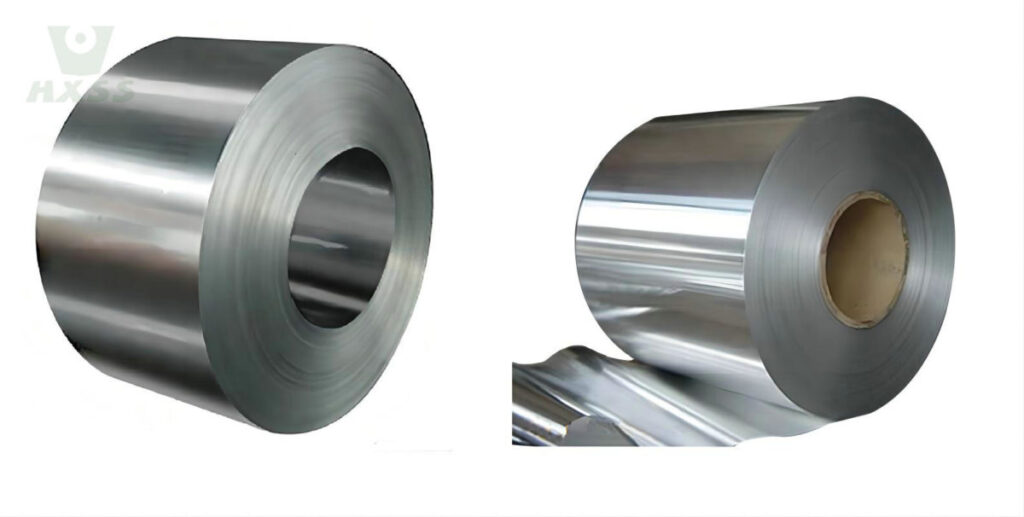
201 cold rolled stainless steel coil

What is 301 Stainless Steel?

301 stainless steel is a high-nickel austenitic stainless steel, whose main components include 16-18% chromium and 6-8% nickel. Due to the relatively high nickel content, 301 stainless steel has better corrosion resistance and toughness than 201 stainless steel. 301 stainless steel can be cold-worked to increase its strength and hardness, making it suitable for applications that require high strength and elasticity. It is commonly used to manufacture springs, metal plates, automotive parts, tableware, etc., and performs well in applications that require high mechanical properties.
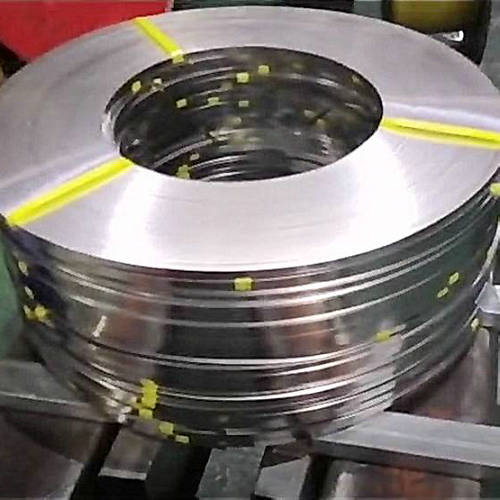
2b 301 Stainless Steel Strip

Difference Between 201 Stainless Steel Vs 301

201 Stainless Steel vs 301 Stainless Steel are two distinct grades of stainless steel, each with its unique properties and applications. This guide provides a detailed comparison of 201 vs 301 stainless steel, helping you select the right grade for your specific needs. Here’s a comparison of the two:

Chemical Composition:

The most important difference between 201 and 301 stainless steel lies in their chemical composition.

Element201 Stainless Steel301 Stainless Steel
Nickel (Ni)3.5 – 5.5%6.0 – 8.0%
Chromium (Cr)16 – 18%16 – 18%
Manganese (Mn)Higher (substitutes nickel)Lower
Carbon (C)≤ 0.15%≤ 0.15%
Nitrogen (N)Slightly higherLower
  • 201 Stainless Steel: It is an austenitic chromium-nickel-manganese stainless steel. It typically contains around 16-18% chromium, 3.5-5.5% nickel, and 5.5-7.5% manganese. It may also have small amounts of other elements like nitrogen and copper.
  • 301 Stainless Steel: It is also an austenitic stainless steel but with a higher carbon content compared to 201. It typically contains around 16-18% chromium and 6-8% nickel, along with 0.15% maximum carbon.

Corrosion Resistance:

301 stainless steel generally exhibits better corrosion resistance than 201 because of its higher nickel content, which strengthens the passive protective oxide layer on the surface..

  • 301 Stainless Steel: Due to its higher nickel content, 301 offers better overall corrosion resistance than 201, especially in mildly acidic and humid environments.

  • 201 Stainless Steel: Suitable for indoor or protected outdoor use. It is more prone to pitting corrosion if exposed to salt or harsh industrial chemicals over long periods.

Selection Tip: If your project involves long-term outdoor exposure, consider our 201 vs. 304 comparison for a safer choice.

Mechanical Properties & Work Hardening

Both grades are famous for their work-hardening capabilities (getting stronger when bent or rolled).

  • 301 Stainless Steel: Known for its exceptional elasticity and fatigue resistance. It is the gold standard for springs and high-tension components. It can reach extremely high tensile strengths in the “Full Hard” condition.

  • 201 Stainless Steel: Offers high initial yield strength but is slightly more brittle than 301 during extreme cold deformation.

PropertyGrade 201Grade 301
Tensile Strength (Annealed)≥ 515 MPa≥ 515 MPa
Yield Strength≥ 260 MPa≥ 205 MPa
Elongation40%60%

Applications:

  • 201 Stainless Steel: It is commonly used for less demanding applications such as kitchen utensils, sinks, cookware, and decorative trim. Its lower cost and good formability make it a popular choice for these purposes.
  • 301 Stainless Steel: It is often used in applications requiring higher strength and better corrosion resistance, such as automotive components, springs, metal stampings, and structural components.

Formability:

  • 201 Stainless Steel: It has excellent formability and is easy to work with. It can be bent and shaped easily.
  • 301 Stainless Steel: It is less formable than 201 due to its higher strength, but it can still be formed and shaped with the appropriate processes.

Cost:

  • 201 Stainless Steel is more cost-effective because of its lower nickel content.
  • 301 Stainless Steel is more expensive, but provides better performance in demanding environments.

For budget-sensitive projects, 201 is often chosen, while 301 is preferred where durability and reliability are critical.

In summary, the choice between 201 and 301 stainless steel depends on the specific requirements of your application. If you need higher strength and better corrosion resistance, 301 stainless steel may be the better choice. However, if cost-effectiveness and good formability are more important, 201 stainless steel might be suitable. Always consult with a materials expert or engineer to determine the best stainless steel grade for your particular project.

Corrosion Resistance: 301 > 201

Strength: 301 > 201 (after cold working)

Applications: 201 is mainly used in lower-cost applications, and 301 is used in situations requiring higher corrosion resistance and strength.

Price: 301 > 201 Stainless Steel

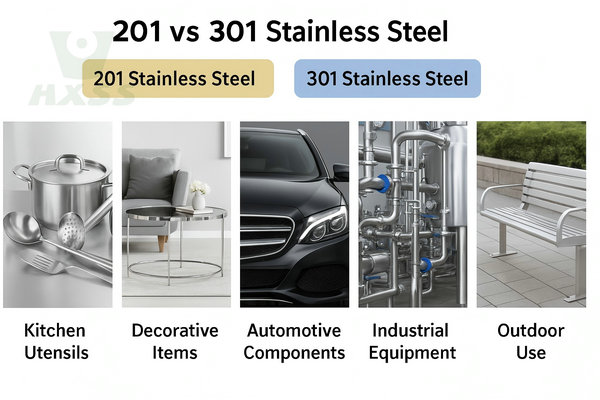
Material Selection Guide: Typical Applications of 201 and 301 Stainless Steel

Now that you understand its core properties, the next step is to match it to your specific application needs.

1. 201 Stainless Steel: Cost-Effective Industrial Applications

Due to its cost advantage, 201 stainless steel is widely used in industrial applications where corrosion resistance is less critical. It is commonly used to manufacture steel windows and doors, the inner lining of home appliances, tableware, and various industrial-grade stainless steel products such as strapping, clamps, and cable ties. If you’re looking for a cost-effective solution and your application doesn’t involve highly corrosive media, 201 stainless steel is an ideal choice.

2. 301 Stainless Steel: The Industrial Choice for High Performance and Demand

With its exceptional strength and fatigue resistance, 301 stainless steel is the preferred choice for applications requiring high mechanical properties. Typical applications include industrial springs, conveyor belts, electrical components, precision stampings, and even aircraft parts. These applications require extremely high durability and stability, and 301 stainless steel perfectly fulfils these requirements.

Typical Applications of 201 and 301 Stainless Steel

Why choose Huaxiao Metal Stainless Steel?

In the complex stainless steel procurement market, choosing a reliable supplier is crucial. Huaxiao Metal is more than just a material supplier; we are your strategic partner.

1. Professional Knowledge and Technical Support:

We understand that every project has its own unique requirements. We provide more than just products; we offer expert material selection advice based on precise data. Our team of experts can provide free technical consultation to help you resolve specific material selection challenges and ensure you make the right decisions.

2. Extensive Case Studies and Product Catalogs:

We use real-world case studies to demonstrate how we have helped our customers solve specific challenges and achieve project success. Furthermore, our catalogs and brochures serve as valuable technical references, allowing you to gain a more comprehensive understanding of our product line and find the solution that best suits your needs.

3. Excellent Customer Service:

We are committed to providing our customers with an excellent experience from inquiry to delivery. Through a streamlined inquiry process and prompt, expert responses, we ensure that every question you have receives a quick and professional answer, turning your interest into action.

FAQs About 201 vs 301 Stainless Steel

When selecting stainless steel, you may encounter some common questions. We are here to answer them one by one:

Yes. Due to lower nickel content, 201 is more likely to rust under harsh or humid conditions compared to 301.

Yes. 301 has higher nickel content, which increases cost but also improves performance.

301 stainless steel is stronger, especially after cold working, making it suitable for springs and automotive parts.

It’s suitable for mild environments, but for marine or highly corrosive settings, 301 is a safer choice.

201 stainless steel is commonly used for kitchen utensils and tableware due to its excellent formability and low cost. However, if you require higher-grade, more durable kitchenware, you may want to consider grades like 304 or 316.

From a mechanical perspective, 301 stainless steel, due to its higher yield strength and excellent fatigue resistance, is more durable in applications requiring high strength and repeated stress. 201 stainless steel, on the other hand, is more suitable for cost-effective general industrial applications.

Yes, for decorative and light structural applications where high elasticity (spring properties) isn’t required. 201 provides similar strength at a lower cost.

201 has a higher yield strength, meaning it requires more force to begin bending. However, 301 can be worked into more complex shapes due to its higher elongation (60%).

Conclusion: 201 Stainless Steel vs 301

Both 201 and 301 stainless steels are valuable materials, each with unique strengths.

  • Choose 201 stainless steel if you need a budget-friendly material for indoor, decorative, or household applications.

  • Choose 301 stainless steel if you require greater strength and corrosion resistance for automotive, industrial, or outdoor applications.

By understanding their differences, you can make an informed choice that balances cost, durability, and performance.

Choosing the right stainless steel material is a critical first step to ensuring a successful project. If, after reading this article, you still have questions about material properties, application suitability, or customized solutions, please don’t hesitate to contact us.

At Huaxiao Metal, we supply high-quality stainless steel materials, including both 201 and 301 grades. Contact us today to discuss your project needs and get professional guidance.

Facebook
Twitter
LinkedIn
Pinterest
Reddit

Table of Contents

We will answer your email in 24 hours!

Related Posts

Request a Quote

Fill out the form below, and we will be in touch shortly.