Call Us Today! +86-13761906384
Huaxiao Metal has 15+ years of experience exporting 201 stainless steel coils, sheets, plates, and strips worldwide. We supply all J1, J2, J3, J4 sub-grades with full EN 10204 3.1/3.2 MTC certification. Our 201 material (EN 1.4372) complies with ASTM A240 and EN 10088-2 standards, with MOQ as low as 1 ton and 12-hour quote response.
ISO 9001
EN 10204 3.1
MOQ 1 Ton
12h Quote
J1 / J2 / J3 / J4 Available
EN 1.4372 / ASTM A240
REACH/RoHS
Explore our full range of 201 stainless steel products. All products are available in J1, J2, J3, and J4 sub-grades with EN 10204 3.1 MTC certification.
We offer all standard surface finishes for 201 stainless steel products. The choice of surface finish affects both appearance and performance:
201 stainless steel is a high-manganese, low-nickel austenitic grade belonging to the 200 series. It contains 16-18% chromium, 1.0-1.5% nickel, and 5.5-7.5% manganese. By replacing expensive nickel with manganese, 201 offers comparable strength to 304 at 30-40% lower cost, with price stability unaffected by LME nickel volatility.
In international trade, 201 is classified into J1, J2, J3, J4 sub-grades based on copper content and Cr/Mn/Ni ratios \u2014 a classification system originated from Chinese mills (TISCO) that has become the standard language for 201 transactions worldwide, especially in India, Southeast Asia, and South America.
201 stainless steel is designated as AISI 201 (US), UNS S20100, EN 1.4372 (Europe), and JIS SUS 201 (Japan). It is governed by ASTM A240 and EN 10088-2 standards for flat-rolled products.
| Element | 201 (ASTM A240) | J1 Typical | J2 Typical | J3 Typical | 304 (Reference) |
|---|---|---|---|---|---|
| Carbon (C) | ≤0.15% | ≤0.10% | ≤0.12% | ≤0.15% | ≤0.08% |
| Manganese (Mn) Key | 5.5-7.5% | 5.5-6.5% | 6.0-7.0% | 6.5-7.5% | ≤2.0% |
| Silicon (Si) | ≤1.0% | ≤0.8% | ≤1.0% | ≤1.0% | ≤1.0% |
| Chromium (Cr) | 16.0-18.0% | 17-18% | 16-17% | 15-16% | 18-20% |
| Nickel (Ni) FIXED | 1.0-1.5% | 1.0-1.5% | 0.8-1.2% | 0.6-1.0% | 8-10.5% |
| Phosphorus (P) | ≤0.06% | ≤0.06% | ≤0.06% | ≤0.06% | ≤0.045% |
| Sulfur (S) | ≤0.03% | ≤0.03% | ≤0.03% | ≤0.03% | ≤0.03% |
| Copper (Cu) J-grade Key | — | 0.8-1.2% | 0.6-0.9% | 0.4-0.6% | — |
| Nitrogen (N) | ≤0.25% | ≤0.25% | ≤0.25% | ≤0.25% | ≤0.10% |
Note: J-grade values are typical commercial ranges. Exact composition is verified on each MTC (EN 10204 3.1).
201 stainless steel is available in multiple temper (hardness) conditions. The higher work hardening rate of 201 (compared to 304) means it strengthens more rapidly during cold forming — advantageous for structural applications but requiring attention during deep drawing.
| Property | Annealed (Soft) | 1/4 Hard | 1/2 Hard | 3/4 Hard | Full Hard |
|---|---|---|---|---|---|
| Tensile Strength (MPa) | ≥515 | 620-750 | 750-900 | 900-1100 | ≥1100 |
| Yield Strength (MPa) | ≥260 | 415-550 | 550-700 | 700-850 | ≥850 |
| Elongation (%) | ≥40 | 25-35 | 15-25 | 8-15 | 3-8 |
| Hardness (HV) | ≤210 | 230-280 | 280-340 | 340-400 | ≥400 |
201 has a higher yield strength than 304 (≥260 MPa vs ≥205 MPa in annealed condition), making it suitable for applications requiring structural stiffness.
In the international 201 stainless steel trade, J1, J2, J3, and J4 are the standard commercial sub-grades classified by copper (Cu) content and chromium/manganese/nickel ratios. Buyers in India, Southeast Asia, and South America typically ask “J1 or J2?” as their first question when inquiring about 201 material.
| Sub-Grade | Cu (%) | Cr (%) | Mn (%) | Ni (%) | Quality / Price | Best For |
|---|---|---|---|---|---|---|
| J1 | 0.8–1.2 | 17–18 | 5.5–6.5 | 1.0–1.5 | High quality, best deep drawing | Kitchenware, sinks, deep-drawn parts |
| J2 | 0.6–0.9 | 16–17 | 6.0–7.0 | 0.8–1.2 | Mid-range, best value, most common | Decorative panels, tubes, general use |
| J3 | 0.4–0.6 | 15–16 | 6.5–7.5 | 0.6–1.0 | Lowest cost, lower corrosion resistance | Budget tubes, low-end products |
| J4 | 1.0–1.5 | 17–18 | 5.5–6.5 | 1.2–1.5 | Highest quality & price | Premium kitchenware, export orders |
How to choose:
For deep drawing (sinks, cookware) → J1 or J4 (higher Cu = better formability).
For general fabrication (tubes, panels) → J2 (best value).
For budget projects in mild environments → J3 (lowest cost).
We stock J1 and J2 regularly; J3 and J4 available on order.
Note: J-grade is a commercial classification used in Chinese stainless steel trade (originated from TISCO), not an official ASTM/AISI designation. However, it is the most widely used classification in international 201 transactions.
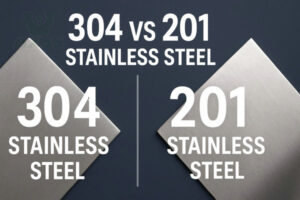
201 saves ~40% vs 304 — and price is NOT affected by LME nickel volatility
| Property | 201 | 304 | Winner |
|---|---|---|---|
| Nickel Content | 1.0-1.5% | 8-10.5% | 201 (cost) |
| Manganese Content | 5.5-7.5% | ≤2.0% | — |
| Chromium Content | 16-18% | 18-20% | 304 (corrosion) |
| Tensile Strength | ≥515 MPa | ≥515 MPa | Equal |
| Yield Strength | ≥260 MPa | ≥205 MPa | 201 (stronger) |
| Corrosion Resistance | Moderate | High | 304 |
| Formability | Good (J1/J4 better) | Excellent | 304 |
| Work Hardening Rate | High | Moderate | Depends |
| Magnetic (annealed) | Non-magnetic | Non-magnetic | Equal |
| Price Stability | High (low Ni) | Low (high Ni) | 201 |
| Cost vs 304 | — | +30-40% | 201 |
| Best For | Indoor, cost-sensitive | Outdoor, corrosion-critical | Depends |
When to choose 201: Indoor applications, kitchenware bodies, decorative trim, automotive non-critical parts, budget-conscious projects. Choose J1/J4 for deep drawing, J2 for general use.
When you must choose 304: Outdoor coastal areas, chemical processing, acidic food storage, medical equipment, marine environments.
201 stainless steel is widely used across multiple industries where cost efficiency meets adequate performance. The recommended J-grade varies by application:
| Industry | Typical Products | Recommended J-Grade |
|---|---|---|
| Kitchenware & Cookware | Sink bowls, pots, pans, utensils, cutlery handles | J1 or J4 (higher Cu for deep drawing) |
| Architectural Decoration | Elevator cabins, wall panels, trims, doors, column cladding | J2 (forming + cost balance) |
| Automotive Industry | Trim strips, exhaust shields, structural brackets, bus interiors | J2 (general use) |
| Industrial Applications | Conveyor belts, housings, machine guards, storage racks | J2 or J3 (budget dependent) |
| Daily Products | Baskets, containers, hardware fittings, bathroom accessories | J2 (best value) |
| Tubes & Pipes | Decorative tubes, welded pipes, handrails, furniture frames | J2 or J3 (budget tubes) |
For deep drawing applications (sink bowls, cookware), J1 or J4 grade is strongly recommended due to higher copper content (0.8-1.5% Cu) which significantly improves formability. J2 can handle moderate forming but may crack in complex deep drawing. 201 has a higher work hardening rate than 304, so intermediate annealing may be needed for multi-stage drawing operations. For the best results, request DDQ (Deep Drawing Quality) material with controlled grain size (ASTM 5-7).
201 has excellent weldability using standard austenitic methods (TIG, MIG, Resistance welding). Use ER308 or ER308L filler wire. Due to higher manganese content, 201 welds may have slightly different color matching compared to 304. Post-weld cleaning and passivation are important to maintain corrosion resistance at the weld zone.
201 can be bent, stamped, and rolled similarly to 304. The higher work hardening rate means 201 becomes harder faster during forming — plan tooling accordingly and allow for greater springback. For complex shapes or severe forming, J1/J4 is preferred. For simple bends and profiles, J2 performs well.
201 can be cut using all standard methods: shearing, laser cutting, waterjet, and plasma. For precision slitting (minimum 3mm width), we offer in-house slitting services with ±0.05mm tolerance. Work hardening during cutting may require slightly more force than 304.
We provide region-specific certification and documentation to meet your local import requirements:
Can’t find your answer? Contact us for personalized assistance within 12 hours.
201 uses manganese (5.5-7.5%) to replace most of the nickel found in 304 (Ni 1.0-1.5% vs 304’s 8-10.5%), making it 30-40% cheaper. 201 has slightly lower corrosion resistance and formability but higher work hardening rate. 201 is ideal for cost-sensitive indoor applications like kitchenware, decorative trim, and automotive parts where the full corrosion resistance of 304 is not required.
J1, J2, J3, and J4 are commercial sub-grades of 201 stainless steel classified by copper (Cu) content and Cr/Mn/Ni ratios.
J1 (Cu 0.8-1.2%) offers the best deep drawing performance for kitchenware.
J2 (Cu 0.6-0.9%) is the most common mid-range grade for general use.
J3 (Cu 0.4-0.6%) is the cheapest with lower corrosion resistance.
J4 (Cu 1.0-1.5%) has the highest quality and price.
These designations originate from Chinese mills (TISCO) and are the standard classification used in international 201 trade, especially in India, Southeast Asia, and South America.
Per ASTM A240: Carbon ≤0.15%, Manganese 5.5-7.5%, Phosphorus ≤0.06%, Sulfur ≤0.03%, Silicon ≤1.0%, Chromium 16.0-18.0%, Nickel 1.0-1.5%, Nitrogen ≤0.25%. The high manganese content replaces most of the nickel found in 304, significantly reducing cost. Composition varies by sub-grade: J1 has higher Cr (17-18%) and Cu, J3 has lower Cr (15-16%) and Cu.
201 is generally safe for indirect food contact applications like kitchenware bodies, sinks, and countertops. For acidic food contact or prolonged food storage, 304 or 316 is recommended. 201 complies with FDA and EU food contact regulations for designated applications. Always verify compliance with your specific local regulations.
201 provides adequate corrosion resistance for indoor and mild outdoor environments. In coastal, industrial, or high-humidity areas, 304 or 316 is recommended. With proper maintenance and regular cleaning, 201 products can last 5-10 years in typical indoor applications. The lower chromium (16-18% vs 304’s 18-20%) and nickel content slightly reduce corrosion resistance.
201 can replace 304 in cost-sensitive applications with mild environments: kitchenware bodies, decorative trim, indoor panels, automotive non-critical parts. 201 is NOT recommended for: outdoor coastal areas, chemical processing, food storage with acidic content, or applications requiring high corrosion resistance. For moderate deep drawing, choose J1 or J4 grade (higher copper improves formability). We recommend requesting a sample for testing before bulk production.
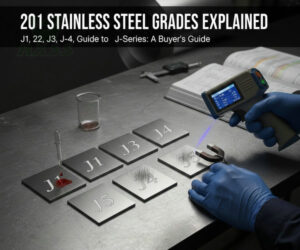
Since they look identical, the most reliable methods are:
1) Chemical Analysis using XRF (X-Ray Fluorescence) gun to detect manganese content — 201 has 5.5-7.5% Mn vs 304’s 2.0% max.
2) Stainless Steel Testing Liquid — 201 turns red faster due to high manganese.
3) Spark test — 201 produces longer sparks.
4) Density test — 201 is slightly lighter (7.93 g/cm³ vs 304’s 7.98 g/cm³).
For critical applications, always verify with XRF or lab chemical analysis.
MOQ is 1 ton with LCL consolidation supported for trial orders. Standard delivery: 7-15 days for stock items (common sizes: 0.3mm, 0.5mm, 0.8mm, 1.0mm in 1219mm width, J1 and J2 grades), 15-25 days for production orders. We respond to inquiries within 12 hours and provide detailed quotes including specification, price, and delivery terms.
Yes. EN 10204 3.1 MTC is provided as standard for all 201 products, including chemical composition and mechanical test results. The MTC will specify the exact J-grade (J1/J2/J3/J4). EN 10204 3.2 (third-party SGS/BV/TÜV) is available upon request. Our 201 material (EN 1.4372) is fully compliant with EN 10088-2 and we provide REACH/RoHS declarations for European customers.
TISCO/Baosteel direct supply chain
Ready to purchase 201 stainless steel? Contact Huaxiao Metal today!
Specify your J-grade, thickness, width, and quantity for an accurate wholesale price.
Fill out the form below and receive a detailed quote within 12 hours.
Fill out the form below, and we will be in touch shortly.