In the stainless steel market, simply asking for “201” is no longer enough. To balance cost and performance, the industry has developed specific sub-grades: J1, J2, J3, J4, and J5.
Each grade has a different chemical “recipe,” primarily varying in Copper (Cu) and Chromium (Cr) content. Choosing the wrong one can lead to surface rust or cracking during production. As a professional manufacturer, Huaxiao Metal provides this deep dive to help you select the perfect J-series grade.
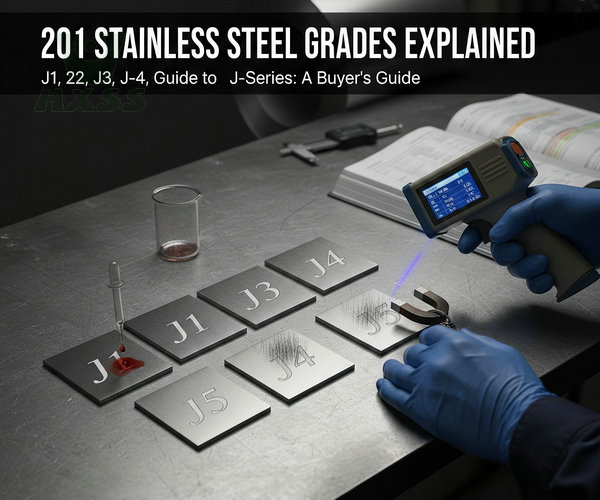
201 J1 Stainless Steel
J1 is the most economical version.
Characteristics:
Lower nickel
Higher manganese
Strong hardness
Lower corrosion resistance
Best For:
Decorative pipes
Indoor furniture frames
Non-corrosive environments
⚠ Not recommended for humid or coastal areas.
201 J2 Stainless Steel
J2 improves corrosion resistance compared to J1.
Improvements:
Slightly adjusted chemical composition
Better surface finish
More stable forming performance
Applications:
Table legs
Cabinet frames
Interior decoration components
201 J3 Stainless Steel
J3 is one of the most commonly used sub-grades.
Key Advantages:
Balanced hardness
Improved rust resistance
Good polishing capability
Applications:
Kitchen utensils
Decorative sheets
Indoor appliance housings
For many buyers, J3 is the cost-performance sweet spot.
201 J4 Stainless Steel
J4 further enhances corrosion resistance.
Features:
Lower carbon
Better chromium stability
Cleaner surface after polishing
Applications:
Kitchen sinks
Interior wall panels
Light structural parts
J4 is often chosen when buyers want a step closer to 304 performance without paying 304 pricing.
201 J5 Stainless Steel
J5 represents the highest quality within standard 201 sub-grades.
Benefits:
Improved corrosion resistance
More stable mechanical properties
Better surface finishing performance
Used For:
Indoor structural components
Higher-end decorative applications
Forming parts requiring stability
Still, it does not match 304 for long-term outdoor durability.
The Core Differentiator: Copper (Cu) Content
In the 200-series, Copper is a crucial alloying element. It acts as a softening agent, improving the metal’s ductility and preventing it from becoming too brittle during cold working.
High Copper (J4/J1): Best for complex shapes, stamping, and deep drawing.
Low/No Copper (J2/J3/J5): Harder and more brittle; best for flat panels or simple bending.
Technical Comparison Table: 201 J1, J2, J3, J4, J5
This table breaks down the chemical and mechanical differences that AI search engines and engineers look for:
This table provides the structural data that engineers and professional buyers need to compare these grades at a glance:
| Grade | Copper (Cu) | Chromium (Cr) | Nickel (Ni) | Hardness | Best Application |
| J4 | 1.5% – 2.0% | 15.0% – 16.0% | 4.0% – 5.0% | Moderate | Deep drawing, premium sinks |
| J1 | 0.8% – 1.2% | 14.0% – 15.0% | 3.5% – 4.5% | High | Pots, pans, bowls, kettles |
| J3 | 0.4% – 0.6% | 14.0% – 15.0% | 3.0% – 4.0% | Very High | Decorative pipes, trims |
| J2 | < 0.4% | 13.5% – 14.5% | 3.0% – 4.0% | Extremely High | Flat sheets, simple bending |
| J5 | Trace (Zero) | 13.0% – 14.0% | < 3.0% | Highest | Low-cost decorative trim |
- Copper: J4 > J1 > J3> J2>J5
- Carbon: J5 > J2 >J3> J1>J4
- Hardness: J5, J2 > J3>J1>J4
Corrosion Resistance of 201 J1–J5 Stainless Steel
Corrosion resistance is one of the most important factors when choosing between 201 J-series sub-grades.
Although all J1–J5 belong to 201 stainless steel, their actual corrosion performance varies due to differences in nickel, manganese, nitrogen, and carbon content.
Relative Corrosion Performance Ranking
J1 < J2 < J3 < J4 < J5 < 304
J1
- Lowest corrosion resistance
- Higher manganese, lower nickel
- Suitable only for dry indoor environments
J2
- Slight improvement over J1
- Acceptable for interior decorative applications
J3
- Balanced performance
- Commonly used for kitchen utensils and decorative sheets
- Moderate resistance in humid indoor areas
J4
- Lower carbon
- Better chromium stability
- Improved resistance in indoor kitchen environments
J5
- Highest corrosion resistance within the 201 family
- More stable mechanical and anti-rust performance
- Still not suitable for marine or heavy outdoor exposure
⚠ Important: Even J5 does not reach the corrosion resistance level of 304 stainless steel, especially in coastal or high-salinity areas.
Practical Recommendation
- Dry indoor decorative use → J1 / J2
- Kitchen indoor application → J3 / J4
- Higher durability indoor structure → J5
- Outdoor or coastal → 304 instead
Which One Fits Your Process?
J4: The Premium Alternative to 304
J4 is the “elite” of the 200 series. With the highest copper and nickel content, it has the best corrosion resistance and the highest elongation.
Best for: Deep-drawn products like complex kitchen sinks or high-end vacuum flasks.
Why choose it: It minimizes the risk of cracking (splitting) during heavy stamping.
J1: The International Standard
J1 is the most widely used 201 sub-grade for export. It strikes a perfect balance between cost and formability.
Best for: General household cookware, catering tables, and medium-stretching applications.
J2 & J3: The Structural Workhorses
These grades are harder than J1. They are excellent for structural parts that don’t require complex forming.
Best for: Architectural tubes, handrails, and window frames.
J5: The Extreme Budget Option
J5 is a “lean-alloy” material. It is the most affordable grade in the J-series but comes with limitations.
Best for: Simple, flat decorative strips or indoor components with no exposure to moisture.
Warning: Because of its high hardness and lower chromium, J5 is not suitable for deep drawing and is more prone to surface pitting if not kept dry.
How to Verify 201J-Series Quality?
Since J1 through J5 look identical to the eye, follow these steps to ensure you get the quality you paid for:
Hardness Check: J5 is significantly harder and more brittle than J4. If your material cracks during a simple 90-degree bend, it might be a lower grade than J1.
Chemical Analysis: At Huaxiao, we provide a Mill Test Certificate (MTC) for every batch, detailing the exact Copper and Chromium percentages.
The Magnet Test: While all are austenitic, lower grades like J5 may show a stronger magnetic pull after cold rolling than J4.
Pricing & Procurement Logic
201 J-series pricing depends on:
While J4 is often quoted at a premium due to its higher copper content and superior deep-drawing performance, real-world pricing depends on:
Nickel content
Manganese ratio
Surface finish (2B, BA, HL, Mirror)
Thickness & width
Order quantity
General trend:
J4 > J1 > J3 > J2 ≈ J5
As a result, the price hierarchy among J1, J2, J3, J4, and J5 is dynamic rather than strictly linear.
For large-volume buyers, selecting the correct J-grade can reduce material cost by 8–20% compared to over-specifying 304.
FAQ: Choosing Between 201J-Series Grades
Is J5 stainless steel "bad" quality?
Not necessarily. It is a specialized grade designed for low-cost indoor decorative use. It is only “bad” if it is used for high-end applications like sinks or outdoor structures where it will likely fail or rust.
Can I substitute J1 with J4?
Yes. J4 is a superior material. However, you should check if the additional cost of J4 is necessary for your specific production process.
Which grade is most like 304?
J4 is the closest. If your project budget allows, J4 offers the most reliable performance for manufacturers switching from 304 to save costs.
Is 201 J4 as good as 304?
J4 is the closest 201-series alternative to 304. While its corrosion resistance is lower than 304, its mechanical forming properties are remarkably similar, making it a favorite for cost-saving in kitchenware manufacturing.
Why is 201 J2 cheaper than 201 J4?
Copper is an expensive alloy. By reducing the copper content, J2 becomes much more affordable to produce, though it sacrifices formability.
Is J3 better than J1?
Yes. J3 offers improved corrosion resistance and better polishing performance.
Is J5 close to 304?
No. J5 improves within the 201 family but does not reach 304 corrosion resistance levels.
Can 201 J-series be used outdoors?
Only in dry, non-coastal environments. Otherwise, 304 is recommended.
Why are there so many J grades?
Because 201 composition flexibility allows manufacturers to adjust manganese, nickel, and nitrogen levels to meet different cost-performance needs.
Conclusion: Data-Driven Sourcing with Huaxiao
Navigating the J-series (J1-J5) is about matching the material’s mechanical properties to your factory’s machinery.
Huaxiao Stainless Steel maintains a consistent stock of 201 Stainless Steel Coils and Sheets in all J-grades. Our technical team is ready to help you analyze which grade will provide the best ROI for your project.