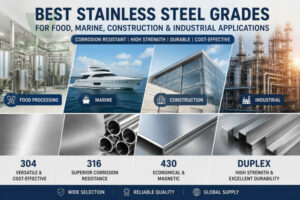
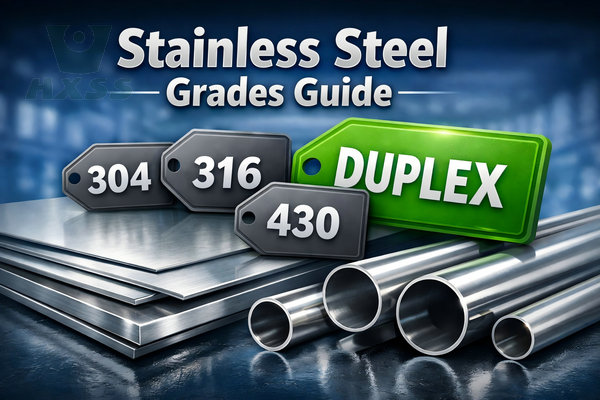
Stainless steel grades determine corrosion resistance, strength, and cost—making them critical for industrial material selection.
In this ultimate stainless steel grades guide, Huaxiao Metal explains:
- Types of stainless steel grades (200 / 300 / 400 / Duplex)
- Key differences between 304, 316, and 430
- How to choose the right grade for your project
- Real-world applications across industries
- Where to buy high-quality stainless steel at competitive prices
👉 Looking for stainless steel suppliers or pricing? Contact us anytime for fast quotation.
What Are Stainless Steel Grades?
Stainless steel grades are classification systems used to define the chemical composition, mechanical properties, and corrosion resistance of stainless steel materials.
Common standards include:
- AISI (American)
- ASTM
- EN (European)
- JIS (Japanese)
- GB (Chinese)
👉 Each grade (such as 304 or 316) is designed for specific environments and applications.
Main Types of Stainless Steel Grades
Austenitic Stainless Steel (200 & 300 Series)
Most widely used stainless steel type
Typical grades:
Key features:
- Excellent corrosion resistance
- Non-magnetic
- Good formability and welding
👉 Applications: kitchen equipment, pipelines, construction, food processing
Ferritic Stainless Steel (400 Series)
Typical grades:
Key features:
- Lower cost than 300 series
- Magnetic
- Moderate corrosion resistance
👉 Applications: appliances, automotive trim, decorative sheets
Martensitic Stainless Steel
Typical grades:
Key features:
- High strength and hardness
- Heat-treatable
👉 Applications: knives, tools, turbine parts
Duplex Stainless Steel (High-Performance Grades)
Duplex stainless steel combines austenitic + ferritic structures, offering superior performance.
Typical grades:
Why Duplex Stainless Steel Is Important
Compared with traditional grades:
| Property | 304 | 316 | 2205 Duplex |
|---|---|---|---|
| Strength | Medium | Medium | ⭐ High (2x) |
| Corrosion Resistance | Good | Better | ⭐ Excellent |
| Chloride Resistance | Low | Medium | ⭐ High |
Key Advantages
- 2x higher strength than 304/316
- Excellent resistance to chloride corrosion & pitting
- Longer service life in harsh environments
- Lower lifecycle cost
Applications
- Oil & Gas
- Offshore platforms
- Chemical processing
- Marine engineering
👉 If your project requires high strength + corrosion resistance, duplex stainless steel is often the best choice.
304 vs 316 vs 430 Stainless Steel
| Grade | Type | Corrosion Resistance | Price Level | Best Use |
|---|---|---|---|---|
| 304 | Austenitic | Good | Medium | General use |
| 316 | Austenitic | Excellent | High | Marine / chemical |
| 430 | Ferritic | Moderate | Low | Decorative |
Quick Selection Tip:
- Budget projects → 430
- General environment → 304
- Corrosive environment → 316
- Harsh industrial → ⭐ Duplex
How to Choose the Right Stainless Steel Grade?
When selecting a stainless steel grade, consider:
1️⃣ Corrosion Environment
- Indoor → 304
- Coastal / chemical → 316
- Extreme → Duplex
2️⃣ Strength Requirements
- Standard → 304
- High strength → Duplex
3️⃣ Budget
- Low cost → 430
- Balanced → 304
- High performance → 316 / Duplex
4️⃣ Application Type
- Food → 304
- Marine → 316
- Oil & Gas → Duplex
👉 Not sure which grade to choose?
When Stainless Steel Is Not Enough
In extreme conditions such as high temperature or aggressive corrosion, even duplex stainless steel may not be sufficient.
In such cases, advanced materials like nickel-based alloys (Inconel, Monel, Hastelloy) are recommended.
👉 Learn more: Nickel Alloys vs Stainless Steel (Guide)
Stainless Steel Applications by Industry
- Construction & architecture
- Food processing
- Chemical industry
- Energy & oil
- Automotive
👉 Different industries require different grades—selection is critical.
Why Choose Huaxiao Metal as Your Supplier
- Full range: 200 / 300 / 400 / Duplex stainless steel
- Sheets, coils, pipes, custom cutting
- Large stock & fast delivery
- Competitive factory prices
- Export experience worldwide
FAQ
What is the most common stainless steel grade?
304 stainless steel is the most widely used due to its balanced performance and cost.
Which stainless steel grade is best for corrosion resistance?
316 stainless steel and duplex stainless steel offer excellent corrosion resistance.
What is duplex stainless steel used for?
Duplex stainless steel is used in oil & gas, marine, and chemical industries due to its high strength and corrosion resistance.
Is duplex stainless steel better than 316?
Yes, duplex stainless steel offers higher strength and better resistance to chloride corrosion than 316.