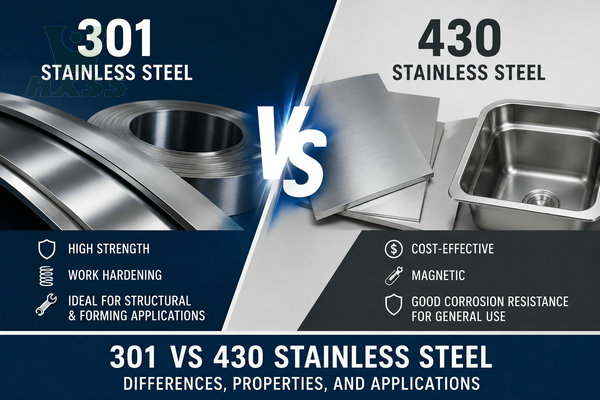
301 stainless steel offers high strength and excellent work-hardening ability, while 430 stainless steel provides better corrosion resistance than carbon steel at a lower cost but with lower strength and no nickel content.
To make a quick procurement or engineering decision:
Choose 301 stainless steel when high strength, flexibility, and forming performance are required.
Choose 430 stainless steel when cost efficiency, moderate corrosion resistance, and magnetic properties are acceptable.
301 is more suitable for structural and dynamic applications, while 430 is widely used in appliances and decorative environments.
When comparing 301 vs 430 stainless steel, the key differences lie in chemical composition, mechanical properties, corrosion resistance, and cost structure. Both materials are widely used in industrial and commercial applications, but they serve very different engineering purposes.
301 vs 430 Stainless Steel: Key Differences
| Property | 301 Stainless Steel | 430 Stainless Steel |
|---|---|---|
| Alloy Type | Austenitic | Ferritic |
| Main Alloys | Chromium + Nickel | Chromium (Zero Nickel) |
| Tensile Strength | Very high after cold working | Moderate |
| Corrosion Resistance | Good; suitable for general industrial use | Moderate (better than carbon steel, weaker than 304/316) |
| Magnetism | Non-magnetic (annealed); partially magnetic after forming | Strongly Magnetic (in all conditions) |
| Formability | Excellent (after annealing) | Good for shallow forming & bending |
| Cost Structure | Higher; influenced by global nickel pricing | Lower; highly cost-effective |
| Typical Applications | Springs, structural parts, automotive components | Home appliances, kitchen equipment, decorative panels |
Quick Sourcing Guide:
If your project demands high flexibility, extreme tensile strength, or premium weldability, 301 stainless steel is the optimal choice.
If your project is budget-sensitive and requires magnetic attraction or basic indoor rust prevention, 430 stainless steel is the definitive choice.
📩 Unsure which grade fits your manufacturing process? Request an Instant 301/430 Price Comparison from Huaxiao Metal’s sales team today!
What is 301 Stainless Steel?
301 stainless steel is an austenitic chromium-nickel stainless steel known for its:
- High tensile strength
- Excellent work-hardening capability
- Good ductility after annealing
- Non-magnetic condition in annealed state
It is widely used in applications requiring high strength and flexibility, especially after cold working.
What is 430 Stainless Steel?
430 stainless steel is a ferritic stainless steel containing chromium but no nickel. It is characterized by:
- Moderate corrosion resistance
- Magnetic properties
- Good formability for shallow drawing
- Lower cost compared to austenitic grades
It is commonly used in decorative and household applications.
Typical Applications: Matching Grade to Project
When to Use 301 Stainless Steel:
High-strength springs, clips, and electronic stampings
Automotive structural parts and train car body panels
Conveyor belts requiring high fatigue resistance
Explore our premium inventory: Certified 301 Stainless Steel Sheets & Coils.
When to Use 430 Stainless Steel:
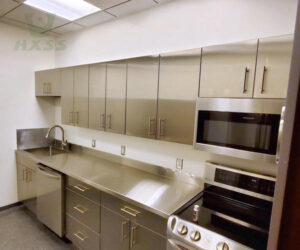
Household appliances (refrigerator panels, washing machine drums)
Kitchenware, utensils, and indoor catering equipment
Automotive trim and exhaust system parts (low-corrosion zones)
Architectural moldings and panels where budget is limited
Chemical Composition Comparison
The fundamental differences in performance and pricing between 301 and 430 stainless steel are governed entirely by their chemical compositions, specifically the presence or absence of Nickel (Ni).
301 Stainless Steel (Austenitic): Contains 16.0%–18.0% Chromium (Cr) and 6.0%–8.0% Nickel (Ni). Nickel is an expensive and volatile alloying element that stabilizes the austenitic crystal structure. It gives 301 its signature high ductility and exceptional work-hardening capabilities.
430 Stainless Steel (Ferritic): Contains 16.0%–18.0% Chromium (Cr) but 0% Nickel (Ni). Because it contains no nickel, 430 maintains a ferritic crystal structure. From a procurement standpoint, the absence of nickel makes 430 a much lower-cost and raw-material-price-stable option compared to 301.
| Grade | Chromium (Cr) | Nickel (Ni) | Manganese (Mn) | Carbon (C) | Structure |
|---|---|---|---|---|---|
| AISI 301 | 16.0% – 18.0% | 6.0% – 8.0% | ≤ 2.0% | ≤ 0.15% | Austenitic |
| AISI 430 | 16.0% – 18.0% | 0% | ≤ 1.0% | ≤ 0.12% | Ferritic |
Corrosion Resistance Comparison
Although both grades share a similar Chromium content (which forms the protective passive film), their corrosion resistance in real-world industrial environments differs drastically due to 301’s nickel content.
301 Corrosion Performance: Thanks to the Cr-Ni synergetic effect, 301 provides reliable protection against indoor moisture, mild atmospheric exposure, and intermittent freshwater contact. In automotive structural parts or outdoor train body panels, it resists rusting while maintaining structural integrity.
430 Corrosion Performance: Lacking nickel, 430 is highly vulnerable to pitting and crevice corrosion when exposed to aggressive media. If deployed in outdoor architectural cladding or coastal salt sprays, it will develop cosmetic brown rust patches quickly. However, it performs flawlessly in dry, indoor environments—such as household kitchen appliances, washing machine drums, and indoor decorative trims—where it only encounters non-aggressive cleaning agents.
Procurement Rule: 430 stainless steel provides better corrosion resistance than carbon steel at a lower cost, making it perfect for appliances. However, if your application involves high humidity or chloride exposure, upgrading to 301 Stainless Steel Sheet & Coil is mandatory to prevent premature failure.
Mechanical Property Comparison
The mechanical profiles of 301 and 430 dictate how they behave under operational stress and during workshop fabrication. The cross-reference table below showcases the critical mechanical and processing differences between these two grades:
| Mechanical Property | 301 Stainless Steel (Annealed) | 301 Stainless Steel (Full Hard) | 430 Stainless Steel (Annealed) |
|---|---|---|---|
| Tensile Strength (MPa) | ≥ 515 | ≥ 1240 | 450 – 550 |
| Yield Strength (MPa) | ≥ 205 | ≥ 1030 | 240 – 350 |
| Elongation (% in 50mm) | ≥ 40% | ≤ 9% | ≥ 22% |
| Hardness (Rockwell) | ≤ 92 HRB | ≥ 41 HRC | ≤ 89 HRB |
| Work-Hardening Rate | Extremely High | Already Hardened | Low |
| Weldability | Excellent | Limited (Loss of Temper) | Limited (Brittle HAZ) |
Forming & Welding Comparison
Formability and welding performance are critical factors when selecting stainless steel for manufacturing and fabrication projects.
Forming Performance of 301 Stainless Steel
301 stainless steel offers excellent ductility and work-hardening capability, making it highly suitable for:
- Deep drawing
- Roll forming
- Springs and clips
- Automotive structural components
After cold working, 301 can achieve very high strength while maintaining good flexibility.
Forming Performance of 430 Stainless Steel
430 stainless steel provides good formability for light forming operations and decorative applications.
It is commonly used for:
- Appliance panels
- Kitchen equipment
- Interior decorative parts
However, compared with 301 stainless steel, 430 has lower ductility and is less suitable for complex deep-drawing applications.
Welding Comparison
| Property | 301 Stainless Steel | 430 Stainless Steel |
|---|---|---|
| Weldability | Good | Moderate |
| Deep Drawing Capability | Excellent | Moderate |
| Cold Forming | Excellent | Limited |
| Risk of Cracking | Lower | Higher in complex forming |
Manufacturing Recommendation
- Choose 301 stainless steel for applications requiring high-strength forming, flexibility, and repeated mechanical loading
- Choose 430 stainless steel for cost-sensitive decorative and appliance applications with simpler forming requirements
Cost Difference: 301 vs 430 Stainless Steel
301 stainless steel is more expensive due to its nickel content and higher performance characteristics.
430 stainless steel is more cost-effective and widely used in mass production industries where extreme corrosion resistance is not required.
FAQs About 430 vs 301 Stainless Steel
When selecting stainless steel, you may encounter some common questions. We are here to answer them one by one:
Does 430 stainless steel rust easier than 301?
Yes. Although both grades contain similar amounts of Chromium (approx. 16-18%), 301 stainless steel performs better in humid or slightly chemical environments due to its nickel content. 430 stainless steel is prone to pitting corrosion if exposed to outdoor environments, coastal salt spray, or harsh chemicals. It is strictly recommended for dry, indoor applications.
Is 301 stainless steel completely non-magnetic?
In its fully annealed (softened) state, 301 is non-magnetic. However, due to its unstable austenite structure, cold working (such as rolling, bending, or stamping) transforms part of the structure into martensite, causing it to become partially magnetic. If your application requires absolute zero magnetism even after heavy forming, you should consider 316L instead.
Why is 430 stainless steel preferred for kitchen appliances over 301?
Cost and magnetism are the two main reasons. 430 is highly economical for large-surface appliances like refrigerators and dishwashers. Furthermore, consumers prefer 430 because its magnetic nature allows them to stick kitchen magnets and notes to the appliance doors, which is impossible with standard annealed 301 or 304 steels.
Can Huaxiao Metal provide dual-certified materials and custom processing?
Absolutely. Huaxiao Metal specializes in high-precision metal processing. We provide Mill Test Certificates (MTC) confirming the exact hardness (1/4H, 1/2H, FH) and surface finishes (2B, BA, No.4, Mirror) for both 301 and 430 series. Contact our engineers to verify your specifications.
Conclusion
Balancing material cost and engineering performance is the key to successful procurement. Over-specifying to 301 can waste your budget if 430 can do the job; conversely, under-specifying to 430 in a high-stress environment can lead to product failure.
📩 Ready to get started? Whether you need the ultra-high elasticity of Precision 301 Stainless Steel Strip or the commercial economy of 430 coils, contact Huaxiao Metal today for a fast, free, and competitive wholesale quote!