Stainless steel grades are international classification systems used to identify the chemical composition, corrosion resistance, mechanical properties, and applications of stainless steel materials.
The most widely used stainless steel standards include:
- AISI (American Iron and Steel Institute)
- ASTM (American Society for Testing and Materials)
- EN (European Standard)
- JIS (Japanese Industrial Standard)
- GB (China National Standard)
This stainless steel equivalent guide helps engineers, buyers, and industrial manufacturers compare global stainless steel grades, including 304, 316, 430, 410, and duplex stainless steels across AISI, ASTM, EN, JIS, and GB standards.
In this guide, you’ll learn:
- Stainless steel equivalent charts
- Differences between international standards
- Common stainless steel grade conversions
- How to identify equivalent materials worldwide
- Tips for international stainless steel procurement
As a professional stainless steel supplier and exporter, Huaxiao Metal provides certified stainless steel sheets, coils, and pipes. Contact our experts today for a free grade cross-reference consultation or a quick quote on your international project.

Common Stainless Steel Classification Systems
| Standard | Organization / Region | Example Grade | Description |
|---|---|---|---|
| AISI | American Iron and Steel Institute (USA) | 304, 316, 430 | Traditional naming system (numbers) |
| ASTM | American Society for Testing and Materials (USA) | ASTM A240 304, A276 316 | Defines chemical & mechanical requirements |
| EN / DIN | European Norm / German Standard | EN 1.4301 (304), 1.4401 (316) | Uses numerical codes |
| JIS | Japanese Industrial Standards | SUS304, SUS316 | “SUS” denotes stainless steel |
| GB | Chinese National Standard | 06Cr19Ni10 (304), 022Cr17Ni12Mo2 (316L) | Composition-based naming |
Huaxiao Metal can supply materials meeting any of these standards, ensuring global compliance for your projects.
Stainless Steel Family Overview
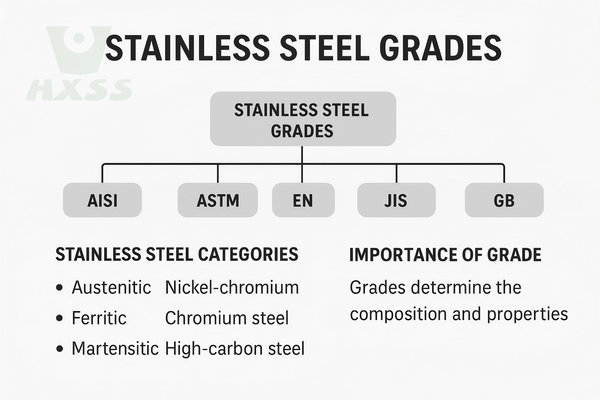
Stainless steels are categorized by their crystal structure and composition:
| Type | Main Grades | Characteristics | Typical Applications |
|---|---|---|---|
| Austenitic | 304, 304L, 316, 316L, 321 | Non-magnetic, excellent corrosion resistance | Food, chemical, marine, architectural |
| Ferritic | 409, 410, 430 | Magnetic, moderate corrosion resistance | Automotive exhaust, appliances |
| Martensitic | 420, 431, 440C | High hardness, heat-treatable | Knives, valves, surgical instruments |
| Duplex | 2205, 2507 | High strength, chloride resistance | Offshore, chemical industry |
| Precipitation Hardening (PH) | 17-4PH, 15-5PH | Very high strength after aging | Aerospace, precision equipment |
If you’re unsure which stainless steel family suits your application, Huaxiao Metal’s technical team can help recommend the best grade.
Equivalent Grades Across Standards
The following chart compares common stainless steel grades in AISI, EN, JIS, and GB standards:
| AISI | EN / DIN | JIS | GB | Description |
|---|---|---|---|---|
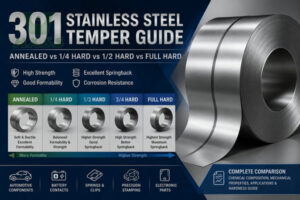
| 301 | 1.4310 | SUS301 | 12Cr17Ni7 | High strength, good formability |
| 304 | 1.4301 | SUS304 | 06Cr19Ni10 | Most common stainless steel |
| 304L | 1.4307 | SUS304L | 022Cr19Ni10 | Low carbon version of 304 |
| 316 | 1.4401 | SUS316 | 06Cr17Ni12Mo2 | Added molybdenum for improved corrosion resistance |
| 316L | 1.4404 | SUS316L | 022Cr17Ni12Mo2 | Low carbon version of 316 |
| 321 | 1.4541 | SUS321 | 06Cr18Ni11Ti | Titanium stabilized for high-temp use |
| 430 | 1.4016 | SUS430 | 12Cr17 | Ferritic stainless steel, magnetic |
| 201 | 1.4372 | SUS201 | 12Cr15Mn9Ni4 | Economical alternative to 304 |
Tip: When exporting or importing stainless steel, always check both the AISI number and EN/GB equivalent to ensure compliance with regional standards.
How Stainless Steel Grades Work Globally
Stainless steel grades are standardized systems used to classify stainless steels based on their chemical composition, mechanical strength, and corrosion resistance.
However, these grades are not universal — different regions use different naming systems for the same or similar materials.
For example:
- AISI (USA): Common industrial naming system such as 304, 316, and 430
- ASTM (USA): Defines material standards, testing methods, and chemical requirements
- EN (Europe): Uses numerical codes such as 1.4301 (equivalent to 304)
- JIS (Japan): Uses SUS system such as SUS304
- GB (China): Uses chemical-based naming such as 06Cr19Ni10
Because different standards may refer to equivalent materials using different codes, understanding cross-standard equivalence is essential for:
- International procurement
- Engineering design consistency
- Material substitution decisions
- Global supply chain coordination
How to Identify Stainless Steel Grades
Huaxiao Metal recommends several methods to identify or verify stainless steel grades:
Marking Inspection – Check for standard or supplier engraving.
Magnet Test – Austenitic (304, 316) is non-magnetic; ferritic/martensitic (430, 410) is magnetic.
Chemical Analysis – Use spectrometers or XRF analyzers.
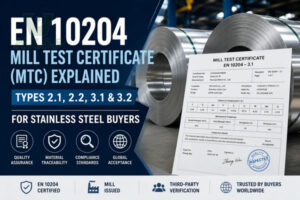
Certificate Review – Request MTC (Mill Test Certificate) according to ASTM A240/A480.
Surface & Finish Check – Grade often correlates with application-specific finish (BA, 2B, HL, etc.).
Huaxiao Metal supplies all stainless steels with material certificates and clear labeling for full traceability.
Mechanical Properties of Major Grades
| Grade | Tensile Strength (MPa) | Yield Strength (MPa) | Elongation (%) | Hardness (HB) |
|---|---|---|---|---|
| 304 | 520 | 215 | 40 | ≤187 |
| 304L | 485 | 170 | 40 | ≤183 |
| 316 | 530 | 240 | 40 | ≤187 |
| 430 | 450 | 205 | 22 | ≤183 |
| 410 | 480 | 275 | 20 | ≤183 |
Applications of Different Grades
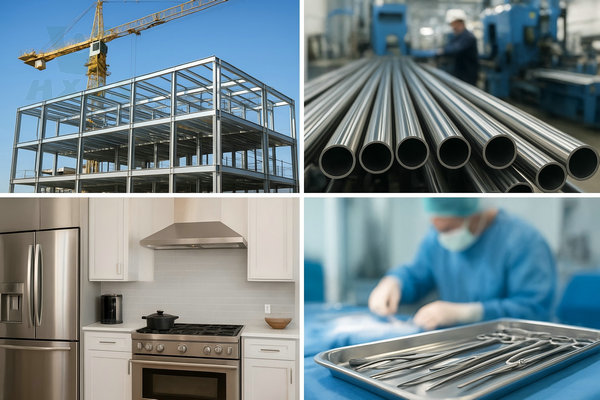
Huaxiao Metal supplies stainless steel for multiple industries:
Construction: Beams, facades, roofing (304, 316, 430)
Food Processing: Tanks, utensils (304, 316L)
Chemical & Marine: Pressure vessels, pipelines (316, 321, 2205)
Automotive: Exhaust systems, trim (409, 430)
Medical: Surgical instruments (420, 440C)
Energy: Heat exchangers, boilers (310S, 347)
Huaxiao Metal provides customized cutting, surface finishing, and packaging for all stainless steel products.
How to Choose the Right Stainless Steel Grade
When selecting a stainless steel grade, it is important to consider both the application environment and performance requirements.
Key factors include:
Corrosion Resistance
- 304: General purpose environments
- 316: Molybdenum-bearing steel for marine and chloride environments
- Duplex: Highly corrosive industrial environments
Mechanical Strength
- 304 / 316: Standard strength applications
- Duplex stainless steel: Higher strength requirements
Cost Efficiency
- 430: Low-cost decorative applications
- 304: Balanced cost and performance
- 316: Premium corrosion resistance
Weldability & Fabrication
- 304L / 316L: Better welding performance
- 430: Limited weldability in some conditions
For international projects, always cross-check equivalent grades (AISI, EN, JIS, GB) before final material selection.
Equivalent Standard Conversion Table
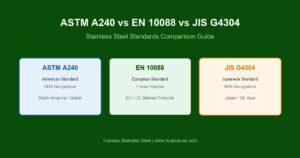
| Region | Standard Body | Typical Stainless Steel Standard |
|---|---|---|
| USA | ASTM / AISI | ASTM A240, A276, A312 |
| Europe | EN / DIN | EN 10088, EN 10216 |
| Japan | JIS | JIS G4303, G4304, G4305 |
| China | GB | GB/T 3280, GB/T 4237 |
Why Choose Huaxiao Metal
As a leading stainless steel supplier and exporter, Huaxiao Metal offers:
Full range of grades (AISI, ASTM, EN, JIS, GB)
Mill Test Certificates (EN 10204 3.1)
Global export service to 80+ countries
Surface finishes: 2B, BA, No.4, HL, Mirror, PVD Color
Cutting, slitting, and packaging customization
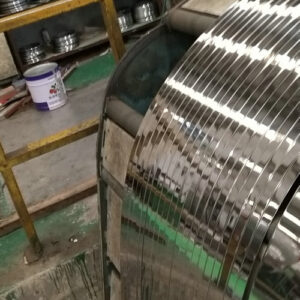
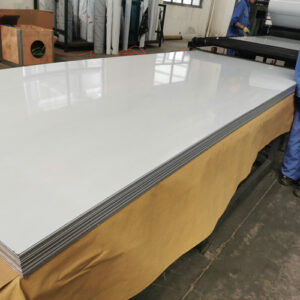
Whether you are purchasing 304 stainless steel coil, 316L sheet, or 430 strip, Huaxiao Metal ensures competitive prices, international standard quality, and on-time delivery.
FAQ – Stainless Steel Grades & Standards
What is the difference between AISI and ASTM stainless steel grades?
While often used interchangeably, AISI (e.g., AISI 304) focuses on the classification and naming of the steel based on its chemical composition. ASTM (e.g., ASTM A240) defines the specific technical standards, testing methods, and manufacturing requirements. In short: AISI tells you what it is, ASTM tells you how it must perform.
Are EN and DIN stainless steel standards the same?
EN standards (European Norm) are the current unified European system, while DIN refers to the older German national standards. In most modern stainless steel applications, EN has replaced DIN.
For example, the common grade 1.4301 was originally defined by DIN 17440 and is now standardized under EN 10088. While they are essentially the same material, specifying the current EN standard ensures better compliance for international projects.
Is GB 06Cr19Ni10 the same as AISI 304?
Yes. GB 06Cr19Ni10 is the Chinese equivalent of AISI 304 stainless steel. They have very similar chemical compositions and performance characteristics, although minor differences may exist depending on manufacturing standards.
👉 This equivalence is widely used in international stainless steel procurement.
Can stainless steel be supplied according to AISI, ASTM, EN, JIS, and GB standards?
Yes. Stainless steel materials can be manufactured and supplied according to different international standards such as AISI, ASTM, EN, JIS, and GB, depending on project requirements and regional specifications.
Huaxiao Metal supports multi-standard stainless steel supply for global engineering and industrial applications.
Why are stainless steel equivalent standards important in global procurement?
Different countries use different stainless steel classification systems, so understanding equivalents ensures correct material selection, compliance, and cost efficiency in international trade.
What is the EN equivalent of S32205 (Duplex 2205)?
The EN equivalent of ASTM S32205 (Duplex 2205 stainless steel) is EN 1.4462.
EN 1.4462 is a duplex stainless steel grade with a mixed austenitic-ferritic structure, offering higher strength and excellent corrosion resistance compared to standard 300-series stainless steels such as 304 and 316.
It is widely used in:
- Chemical processing equipment
- Marine and offshore structures
- Oil and gas applications
- High-chloride environments
Conclusion
Understanding stainless steel grades and their international equivalent standards is essential for accurate material selection, global procurement, and engineering consistency.
By comparing AISI, ASTM, EN, JIS, and GB standards, buyers and engineers can ensure the correct material is selected for performance, compliance, and cost efficiency across different markets.
As a professional stainless steel supplier and exporter, Huaxiao Metal provides full support for global material sourcing, including equivalent grade confirmation, technical specifications, and competitive pricing for international projects.
If you are sourcing stainless steel materials such as 304, 316, 430, or duplex grades, contact us for:
- Material grade equivalence consultation
- Technical datasheets (MTC)
- Global standard compliance support
- Competitive quotation for bulk orders