
In the global industrial and manufacturing landscape, stainless steel stands as the material of choice for its unmatched durability, corrosion resistance, and aesthetic versatility. Yet, beneath the polished surface lies a critical technical decision that dictates product quality, longevity, and overall project cost-efficiency: the selection of the appropriate metal gauge. Specifically, the debate between 18 vs 20 gauge stainless steel is one that procurement managers, product designers, and fabricators face daily. Understanding this core difference is paramount for achieving optimal results in everything from commercial catering equipment to precision medical devices.
At Huaxiao Metal, a leading international manufacturer and supplier of high-quality stainless steel coils, sheets, and plates, we recognize that the term “gauge” can often be counter-intuitive. In the metal industry’s traditional system, a lower gauge number signifies a thicker material, and vice versa. Therefore, a definitive answer to the question, which is thicker 18 or 20 gauge stainless steel, is that 18 gauge stainless steel is thicker than 20 gauge stainless steel. This seemingly small difference in thickness translates into massive variations in physical properties, workability, end-use performance, and, crucially, prices.
This deep-dive technical guide is engineered to be your authoritative resource. We will meticulously analyze the characteristics, benefits, drawbacks, and ideal applications of both 18 gauge vs 20 gauge stainless steel and 20 gauge vs 18 gauge stainless steel. Our goal is to equip you with the knowledge to make an informed, strategic choice that minimizes risks and maximizes return on investment for your critical projects. We will cover precise thickness measurements (how thick is 18 gauge stainless steel and how thick is 20 gauge stainless steel), fabrication dynamics, sector-specific uses, and a robust guide to navigating the complexities of material stock and global suppliers.
As a trusted partner to industries worldwide, Huaxiao Metal leverages decades of expertise to provide materials that adhere to the most rigorous international quality standards. We invite you to utilize this information and, ultimately, to contact us to discuss your specific requirements and obtain a competitive, transparent quote.
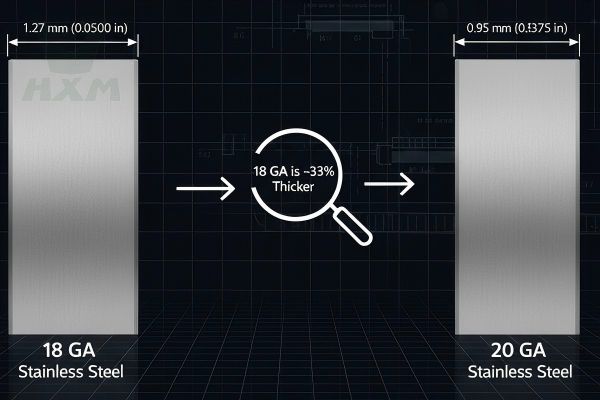
Understanding the Stainless Steel Gauge System and Exact Thickness
The gauge system, often referred to as the U.S. Standard Gauge or Manufacturers’ Standard Gauge for Sheet Steel, is a historical measurement that has endured despite the global adoption of metric and imperial (inch) units. It is an inverse system: the larger the gauge number, the thinner the metal sheet. This system originated in the weight-per-area calculation for different materials, making a direct conversion to metric or imperial units challenging without a specific conversion chart for stainless steel.
The Precision of 18 Gauge Stainless Steel
The 18 Gauge is arguably the most common and versatile choice in stainless steel for applications demanding a balance of strength and formability.
Exact Thickness Specifications: How thick is 18 gauge stainless steel?
For stainless steel, the 18 Gauge measurement corresponds to the following precise thickness values:
Imperial (Inches): Approximately 0.0478 inches
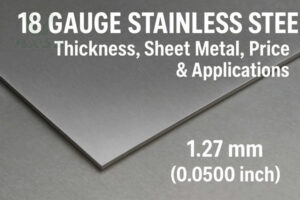
Metric (Millimeters): Approximately 1.27 mm
This thickness is what grants 18 Gauge its reputation for robust durability. It provides a substantial rigidity that resists flex, vibration, and minor impacts, making it the “gold standard” for many high-use consumer and commercial products.
Physical Characteristics and Structural Implications
Weight & Mass: Being significantly thicker than 20 Gauge, 18 Gauge adds considerable mass, which enhances structural integrity but increases material prices and transportation costs per unit area.
Rigidity: The 1.27 mm thickness provides superior inherent stiffness, which is crucial for large panels or unsupported structures where flatness and stability are required.
Thermal Properties: Its greater mass acts as a better heat sink. While this can slow initial heat-up, it often leads to more stable temperature regulation in devices like commercial holding cabinets.
The Efficiency of 20 Gauge Stainless Steel
The 20 Gauge represents the thinner end of the spectrum for most heavy-duty commercial or high-quality residential applications, but it is often the perfect choice when cost and workability are prioritized.
Exact Thickness Specifications: How thick is 20 gauge stainless steel?
The 20 Gauge thickness for stainless steel is precisely defined as:
Imperial (Inches): Approximately 0.0375 inches
Metric (Millimeters): Approximately 0.95 mm
This roughly 25% reduction in thickness compared to 18 Gauge makes it a lighter and more cost-effective material. It is ideal for non-structural cladding, enclosures, and internal components where the full rigidity of 18 Gauge is not necessary.
Physical Characteristics and Structural Implications
Weight & Mass: The reduced thickness directly translates to less material per unit area, dramatically lowering the overall mass. This is a significant factor in reducing both material prices and logistical expenses for large-volume international suppliers like Huaxiao Metal.
Formability: Its thinness makes 20 Gauge exceptionally pliable, lending itself well to complex forming operations, deep drawing, and tight-radius bending.
Vulnerability: Conversely, 20 Gauge is more susceptible to “oil canning” (visible buckling or warping) on large, unsupported flat sections, and is more prone to denting or deformation under heavy impact.
The Definitive Comparison: 18 Gauge vs 20 Gauge Stainless Steel Thickness Chart
To clarify the fundamental difference and definitively answer which is thicker 18 or 20 gauge stainless steel, the table below provides the essential standard conversion values:
| Gauge Number | Imperial Thickness (Inches) | Metric Thickness (mm) | Thickness Difference |
| 18 Gauge | ≈0.0478 in | ≈1.27 mm | +33.7% (Thicker) |
| 20 Gauge | ≈0.0375 in | ≈0.95 mm | Base Reference (Thinner) |
| 16 Gauge (Reference) | ≈0.0625 in | ≈1.59 mm | +67.4% (Much Thicker) |
(Note: Thicknesses are based on general stainless steel standards. Huaxiao Metal ensures production to stringent ASTM/EN tolerances.)


18 vs 20 Gauge Stainless Steel: Performance, Durability, and Fabrication Dynamics
The true differentiation between 18 vs 20 gauge stainless steel lies in the real-world performance metrics that matter most to manufacturers and end-users: longevity, structural integrity, resistance to wear, and ease of processing. This section provides an in-depth, technical comparison.
Durability and Structural Integrity
Impact Resistance and Denting
18 Gauge Advantage: Due to the 33% greater thickness, 18 Gauge exhibits significantly higher resistance to localized impact and denting. In high-traffic environments, such as commercial kitchens, hospitals, or industrial assembly lines, this superior dent resistance translates directly into a longer product lifespan and fewer costly replacements. For instance, a heavy pot dropped into an 18 gauge stainless steel sink is far less likely to cause a permanent deformation than it would in a 20 Gauge equivalent.
20 Gauge Vulnerability: While still a robust material, 20 Gauge is noticeably more prone to denting and flexing. It is best suited for applications where the metal is well-supported or where impact is minimal. Its reduced durability is a major trade-off for its lower prices and reduced weight.
Rigidity, Flex, and Vibration Damping
Stiffness Factor: The stiffness of a sheet metal increases exponentially with thickness. 18 Gauge is dramatically stiffer than 20 Gauge. This rigidity is essential for large, unsupported panels or surfaces like commercial countertops or industrial machine casings, preventing the undesirable “flimsy” or “tinny” feel.
Noise Reduction (Acoustics): In applications like sinks, the added mass of 18 Gauge acts as a superior sound dampener. When water hits the surface, the thicker steel vibrates less, resulting in a significantly quieter operation. This is why high-end residential and commercial sinks almost exclusively use 18 Gauge or thicker material. 20 Gauge often requires additional spray-on dampening undercoats to achieve acceptable noise levels.
Corrosion and Life Cycle
Corrosion Penetration: It is important to note that the Gauge number itself (18 or 20) does not determine the quality of the corrosion resistance (which is determined by the stainless steel grade, such as 304 or 316). However, the thickness does impact the material’s lifespan. A thicker 18 Gauge sheet offers a larger buffer against localized corrosion or pitting over time. The 1.27 mm of 18 Gauge provides a longer material life before any through-wall corrosion can occur compared to the 0.95 mm of 20 Gauge.
Fabrication and Manufacturing Considerations
The choice between 18 gauge vs 20 gauge stainless steel fundamentally alters the manufacturing process, tooling requirements, and production speed.
Formability and Bending
20 Gauge Efficiency: Since 20 Gauge is thinner and softer, it requires less force for bending and forming. This reduces wear and tear on press brake tooling and allows for faster cycle times, leading to lower fabrication costs. Deep drawing (creating complex 3D shapes) is generally easier and less prone to tearing or cracking with 20 Gauge.
18 Gauge Requirements: Working with 18 Gauge requires more powerful machinery and robust tooling. While it is still highly formable, the increased stiffness demands higher tonnage presses, which increases both energy consumption and capital expenditure for manufacturers.
Welding Dynamics
18 Gauge Reliability: Welding 18 Gauge is generally more forgiving. The greater mass acts as a heat sink, making it easier to control the weld pool, minimize warpage, and avoid “burn-through,” especially in high-speed automated welding processes.
20 Gauge Challenges: Welding 20 Gauge demands a higher level of skill and precision. Lower heat settings and faster travel speeds are necessary to prevent the thin material from melting away. This sensitivity can slow down production and increase the rate of defects if the welding equipment or operator is not highly skilled. Huaxiao Metal ensures all our stock materials are consistently uniform, which is crucial for successful 20 Gauge welding.
Finish and Surface Quality
Both 18 Gauge and 20 Gauge can be supplied with the full range of finishes (e.g., 2B, BA, No. 4, Hairline, Mirror). However:
Finishing on 18 Gauge: The greater thickness of 18 Gauge allows it to better withstand aggressive surface preparation techniques, such as heavy grinding or polishing, which may be required to achieve a flawless finish on structural components.
Finishing on 20 Gauge: Due to its lack of rigidity, 20 Gauge sheets can be more difficult to maintain flatness during large-area polishing, requiring more specialized handling.
Application: 18 Gauge and 20 Gauge
The optimal gauge selection is always dictated by the end-use environment. This section details the key industry applications for both 18 gauge vs 20 gauge stainless steel.
18 Gauge: The Choice for Strength, Longevity, and Commercial Use
The primary applications for 18 Gauge are found where durability, stiffness, and resistance to deformation are non-negotiable.
Commercial and Industrial Catering Equipment
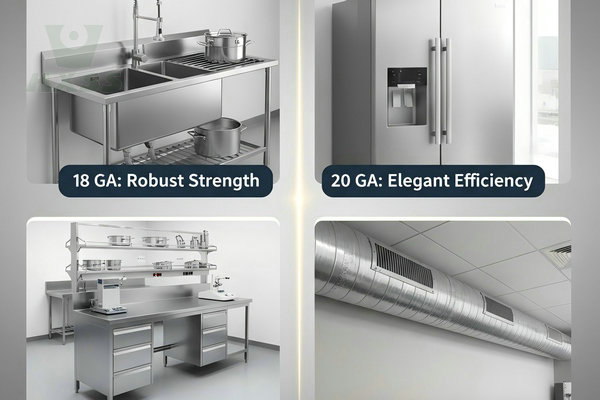
Commercial Sinks & Wash Stations: 18 gauge stainless steel is the absolute minimum standard. Its strength minimizes flex under the weight of commercial dish racks and dampens noise in high-volume settings. This application answers the common question: which is thicker 18 or 20 gauge stainless steel? The answer, 18 Gauge, is chosen precisely for its extra strength.
Commercial Countertops & Prep Tables: In constant use, 18 Gauge provides the rigid, dent-resistant surface required to withstand heavy cutting, chopping, and the movement of heavy machinery.
Oven and Cabinetry Frames: Used in the structural components of commercial ovens, smokers, and refrigerated cabinets where the frame must maintain shape under thermal stress or heavy loading.
Healthcare and Laboratory Environments
Surgical Sinks and Scrub Stations: Rigidity and the ability to maintain perfect flatness for hygiene and installation are critical. 18 Gauge is preferred to prevent pooling and ensure easy sterilization.
Laboratory Bench Tops: Used in chemistry and biology labs where the surface must withstand heavy equipment, chemical spills, and frequent, aggressive cleaning without warping.
Architecture and Infrastructure (High-Stress Areas)
Elevator Car Panels: In high-traffic public elevators, 18 Gauge provides superior resistance to vandalism and constant minor impacts.
Structural Cladding & Kick Plates: Used in high-wear areas of public buildings to protect walls from carts, pedestrian traffic, and luggage.
20 Gauge: The Choice for Cost-Efficiency, Aesthetics, and Light Fabrication
The 20 Gauge material offers the ideal balance of cost-effectiveness and the inherent benefits of stainless steel (corrosion resistance and easy cleaning).
Home Appliances and Electronics Enclosures
Appliance Skins: 20 gauge stainless steel is widely used for the exterior skins of refrigerators, dishwashers, and washing machines. Here, the material provides a sleek, modern finish while minimizing weight and material cost. The underlying structure usually supports the load, making 20 Gauge sufficient for the aesthetic cladding.
Electronic Cabinets and Computer Chassis: Used for server racks, control panels, and outdoor electrical enclosures where the threat of heavy impact is low, but light weight and a strong corrosion barrier are necessary.
Architectural and Decorative Finishes (Low-Stress Areas)
Decorative Paneling: Wall panels, interior column wraps, and trim pieces that are purely decorative and non-load-bearing. The superior formability of 20 Gauge allows for complex, intricate designs.
HVAC Ductwork and Vents: Used in lighter gauge ducting where airflow integrity and corrosion resistance are key, but structural loading is non-existent.
Application Summary: Choosing the Right Gauge
| Gauge Number | Primary Advantage | Key Applications | Key Specification Driver |
| 18 Gauge | Superior Strength, Rigidity, Durability | Commercial Sinks, Prep Tables, Hospital Equipment, Industrial Panels | Structural Integrity, Impact Resistance |
| 20 Gauge | Cost-Efficiency, Lightweight, Formability | Appliance Skins, Decorative Trim, Electronic Enclosures, Light Cladding | Cost Control, Weight Reduction, Aesthetics |
The Business of Stainless Steel: Prices, Suppliers, Stock, and Procurement Strategy
For international buyers and businesses, the decision between 18 vs 20 gauge stainless steel directly impacts the bottom line, logistical planning, and overall supply chain stability.
Price Analysis: Quantifying the Cost Difference
The prices for stainless steel material are fundamentally driven by weight. Since 18 gauge stainless steel (≈1.27 mm) is roughly 33% thicker than 20 gauge stainless steel (≈0.95 mm), the material cost per square meter will be approximately 33% higher for the 18 Gauge, assuming the same steel grade (e.g., 304 vs 304).
Understanding Total Cost of Ownership (TCO)
While 20 gauge stainless steel prices are lower upfront, a strategic procurement approach requires TCO analysis:
Material Price: 20 Gauge is cheaper initially.
Fabrication Cost: 20 Gauge is generally cheaper to process (faster bending, less tool wear).
Shipping Cost: 20 Gauge is lighter, leading to reduced freight charges, a critical factor for global suppliers like Huaxiao Metal.
Life Cycle Cost: If the application demands 18 Gauge strength, choosing 20 Gauge to save costs will lead to early failure, denting, and costly replacement or maintenance, making the 18 Gauge the cheaper option in the long run.
The key to navigating the 18 vs 20 gauge stainless steel prices is alignment with the application: Never sacrifice required performance for minimal upfront savings.
Selecting World-Class Stainless Steel Manufacturers and Suppliers
The quality of the final product—whether it’s 18 gauge or 20 gauge—is only as good as the raw material provided by the suppliers. Huaxiao Metal is positioned as a market leader due to our commitment to precision and global service.
The Huaxiao Metal Advantage in Manufacturing
Precision Rolling: We strictly control the rolling process to ensure both how thick is 18 gauge stainless steel and how thick is 20 gauge stainless steel are within stringent international tolerance standards (e.g., ASTM A480/A480M). This consistency is vital for our client’s automated fabrication lines.
Comprehensive Stock: We maintain a substantial stock of both 18 gauge and 20 gauge stainless steel in all major grades (304, 316, 430, etc.), finishes, and dimensions, ensuring minimal lead times for high-volume international orders.
Customization: We offer tailored slitting, leveling, and cutting-to-length services, delivering material exactly how our clients’ manufacturers need it.
Global Logistics and Risk Mitigation
Supply Chain Stability: As a direct manufacturer and exporter, we offer greater control over the supply chain compared to simple traders, ensuring predictable delivery and quality.
Packaging Expertise: We utilize specialized, robust packaging optimized for international sea freight, protecting the material—particularly the more delicate 20 Gauge—from damage during transit.
Stock and Inventory Management (A Key Differentiator)
Effective inventory management of both 18 gauge and 20 gauge stainless steel stock is critical for large-scale projects.
Just-In-Time (JIT) Supply: Our ability to supply high-volume JIT orders for standard 18 gauge vs 20 gauge stainless steel requirements allows clients to minimize their own costly warehouse inventory.
Specialty Stock: We also manage stock of specialized widths, lengths, and non-standard alloys in both gauges to meet unique project demands.
FAQ: 18 vs 20 Gauge Stainless Steel
Which is thicker 18 or 20 gauge stainless steel, and what are the exact measurements?
18 gauge stainless steel is thicker than 20 gauge. As the gauge number decreases, the thickness increases. How thick is 18 gauge stainless steel is approximately 1.27 mm (0.0478 in), while how thick is 20 gauge stainless steel is approximately 0.95 mm (0.0375 in).
Does the choice between 18 gauge vs 20 gauge stainless steel significantly affect the cost?
Yes, it does. Since stainless steel prices are largely based on weight, the 18 gauge material will have a higher price per unit area because it is about 33% heavier than 20 gauge. Choosing the correct gauge is crucial for cost-effective procurement.
Is 20 gauge stainless steel durable enough for residential kitchen sinks?
While 20 gauge stainless steel can be used for budget residential sinks, 18 gauge stainless steel is strongly recommended. The extra thickness of 18 Gauge provides superior durability, greater resistance to denting, and significantly better noise dampening, offering a much longer-lasting and higher-quality product experience.
How does Huaxiao Metal ensure the quality of their 18 and 20 gauge stainless steel stock?
As an established stainless steel manufacturer and supplier, Huaxiao Metal implements stringent quality control at every stage, from hot rolling to cold working. We use advanced measuring tools to ensure that the thickness of both 18-gauge and 20-gauge stainless steel meets strict international tolerances, ensuring material consistency throughout your manufacturing process.
Should I worry about welding burn-through when using 20 gauge vs 18 gauge stainless steel?
Yes, 20 Gauge is more prone to burn-through during welding due to its thinness. It requires lower heat, faster travel speeds, and greater operator skill compared to the more forgiving 18 Gauge. This is an important consideration for manufacturers selecting material for high-volume automated welding lines.
Conclusion: 18 vs 20 Gauge Stainless Steel
A comprehensive analysis of 18 gauge and 20 gauge stainless steel confirms a fundamental truth in materials science and procurement: the best choice isn’t always the thicker stainless steel, but rather the stainless steel that perfectly matches the project’s performance specifications, manufacturing capabilities, and budget constraints.
We’ve determined that 18-gauge stainless steel is the clear choice for applications requiring extreme durability, structural rigidity, and impact resistance, from commercial cookware to high-quality architectural components. Conversely, 20-gauge stainless steel offers a valuable economical solution for non-load-bearing applications, such as appliance housings and decorative panels, where lightweighting, excellent formability, and competitive pricing are key. The key to answering the question, “Which is thicker, 18 or 20 gauge stainless steel?” is that 1.27 mm (18-gauge) provides 33% more material, which directly translates to greater physical strength.
Huaxiao Metal stands ready to be your committed global partner. As a professional manufacturer and supplier, we not only maintain an extensive inventory of standard 18 gauge and 20 gauge stainless steel coil and sheet, but also provide the technical consultation necessary for final material selection. We ensure our products meet the precise specifications for 18-gauge or 20-gauge stainless steel thicknesses required by your global market.
Don’t let guesswork compromise product quality or increase project costs. Take advantage of Huaxiao Metal’s expertise. We offer globally competitive pricing, exceptional quality control, and ample inventory to ensure a robust and reliable supply chain.