14 gauge stainless steel—this seemingly simple term—connotes strength, durability, and versatility in industrial, architectural, and commercial applications. Whether you’re a purchasing manager, engineer, or manufacturer seeking reliable material, understanding the thickness, properties, and applications of 14 gauge stainless steel is crucial. As an experienced 14 gauge stainless steel supplier and manufacturer, Huaxiao Metal understands our customers’ need for quality and expertise. This article provides a comprehensive, in-depth guide to 14 gauge stainless steel in all its forms, including sheet and wire, ensuring you make the most informed purchasing decision.
Understanding the "Gauge" System and Steel Thickness
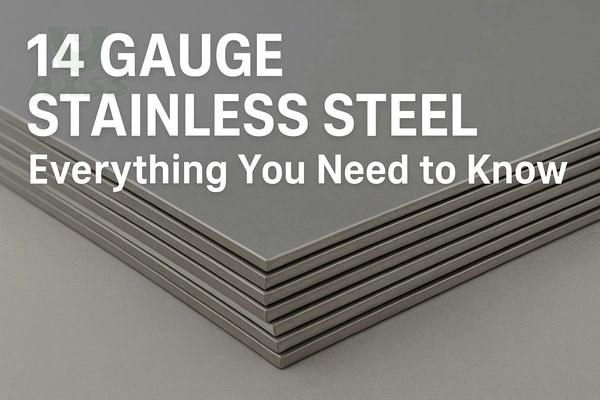
In the world of steel, “Gauge” is an inverse measurement system. This means the smaller the gauge number, the thicker the material. For 14 gauge stainless steel, it represents a specific thickness that achieves an excellent balance between structural integrity and cost-effectiveness.
1. 14 Gauge Stainless Steel Thickness: The Exact Measurement
One of the most frequent questions we receive is: how thick is 14 gauge stainless steel? Or what is the thickness of 14 gauge stainless steel?
The exact thickness can vary slightly depending on the material (stainless steel, galvanized steel, aluminum) and the specific standard used (e.g., AWG/BWG or specific steel plate gauges). However, within the stainless steel industry, we follow a recognized standard.
Here is the common reference for 14 ga stainless steel thickness, providing you with precise metrics:
| Material | Gauge | Inches (In) | Millimeters (mm) | Note |
| Stainless Steel | 14 Ga | 0.078125″ | 1.9844 mm | Standard Industry Thickness |
| Galvanized Steel | 14 Ga | 0.0747″ | 1.897 mm | Slightly thinner |
| Aluminum | 14 Ga | 0.0641″ | 1.628 mm | Significantly thinner |
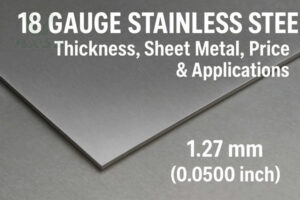
The Conclusion: When we discuss 14 gauge stainless steel thickness, the nominal dimension is approximately 0.078125 inches or 1.98 millimeters. This thickness provides excellent structural integrity while retaining enough ductility for various fabrication processes.
2. Thickness Comparison: Why Choose 14 Ga?
To fully appreciate the benefits of 14 ga stainless steel thickness, it helps to compare it with common adjacent specifications:
Compared to Thinner Gauges (e.g., 16 Ga, 18 Ga): 14 gauge stainless steel offers superior strength, greater rigidity, and better load-bearing capacity. It is the preferred choice for heavy-duty applications where impact or stress is expected, such as industrial sinks, heavy-duty workbenches, or structural support components.
Compared to Thicker Gauges (e.g., 12 Ga, 10 Ga): The 14 Ga specification offers significant advantages in cost and weight. Thicker steel is stronger but is more expensive, harder to fabricate, and heavier. 14 gauge stainless steel provides an ideal sweet spot, meeting the requirements of most medium-to-heavy-duty applications without the excessive overhead of thicker material.


Key Properties and Advantages of 14 Gauge Stainless Steel
Choosing 14 gauge stainless steel means selecting more than just a thickness; it means adopting the inherent benefits of the material itself.
1. Exceptional Corrosion Resistance
Stainless steel’s renowned corrosion resistance stems from the chromium oxide protective layer (passive layer) that forms on its surface. Different grades offer varying levels of resistance.
Most Common Grades: 304 and 316.
14 Gauge 304 Stainless Steel: This is the most common choice, offering excellent corrosion resistance in freshwater, food processing, and general industrial environments.
14 Gauge 316 Stainless Steel: Known as “marine grade,” the addition of molybdenum provides superior resistance to pitting and crevice corrosion in environments containing chlorides (saltwater, marine climates) and stronger acids.
2. Strength, Rigidity, and Durability
Thanks to the robust thickness of 14 ga stainless steel, the material excels in structural integrity.
High Yield Strength: It can withstand significant loads and pressure without permanent deformation.
Impact Resistance: Suitable for environments prone to physical impact, such as commercial kitchens, hospitals, and laboratories.
Long Lifespan: The durability of 14 gauge stainless steel translates to lower maintenance costs and a longer replacement cycle, making it an ideal long-term investment.
3. Hygiene and Ease of Cleaning
The smooth, non-porous surface of stainless steel makes it one of the most sanitary materials available.
Bacteria Resistance: It is easy to clean and sanitize, meeting the strictest hygiene standards.
Key Applications: This characteristic makes 14 gauge stainless steel sheet the material of choice for the food and beverage processing, medical device, and pharmaceutical industries.
Common Grades and Applications of 14 Gauge Stainless Steel
The uses for 14 gauge stainless steel are incredibly diverse, but the specific application often hinges on the alloy grade.
1. 14 Gauge 304 Stainless Steel (Austenitic)
| Property | Application |
| Best Balance of corrosion resistance, weldability, and formability. | Commercial Kitchen Equipment: Sinks, worktables, cabinetry. |
| Cost-Effective: Most widely used grade, offering excellent value. | Architecture: Interior finishes, handrails in general environments. |
| Industrial Equipment: Tanks, piping, pump casings. |
2. 14 Gauge 316/316L Stainless Steel (Austenitic)
| Property | Application |
| Superior Corrosion Resistance, especially against chlorides. | Marine Environments: Boat fittings, coastal structures. |
| High Temperature Resistance: Maintains strength in high-pressure vessels. | Chemical/Pharmaceutical: Reactors, storage vessels, piping systems. |
| 316L (Low Carbon): Preferred for thick-section welding to prevent intergranular corrosion. | Medical: Operating tables, high-specification lab equipment. |
3. 14 Gauge 430 Stainless Steel (Ferritic)
| Property | Application |
| Magnetic: One of the few magnetic stainless steel grades. | Appliances: Refrigerator panels, some kitchen utensils. |
| Lower Cost: Nickel-free, making it cheaper than 300 series. | Decorative Use: Indoor applications where high corrosion resistance is not critical. |
| Note: Less corrosion resistant than 304/316. |
Mechanical Properties of 14 Gauge Stainless Steel
Material performance relies on its mechanical properties. Below is a professional comparison of the two most popular grades available in 14 gauge stainless steel sheet.
| Property | Unit | 14 Ga 304 Stainless Steel | 14 Ga 316 Stainless Steel | Significance for 14 Ga |
| Tensile Strength | MPa (psi) | 515 min (75,000) | 515 min (75,000) | Measures the ultimate breaking point. |
| Yield Strength (0.2% Offset) | MPa (psi) | 205 min (30,000) | 205 min (30,000) | Measures the point of permanent deformation. |
| Elongation | % | 40 min | 40 min | Material’s ductility and formability. |
| Hardness (Rockwell B) | HRB | ≤92 | ≤95 | Resistance to indentation and surface wear. |
Expert Insight: While the 14 ga stainless steel thickness provides the physical dimension, the grade defines the chemical and mechanical performance. 316 offers identical structural strength to 304 but with superior corrosion resistance due to the addition of Molybdenum.
Fabrication & Manufacturing: Working with 14 Gauge Stainless Steel
For manufacturers, the ability to process the material efficiently is key. 14 gauge stainless steel is known for its excellent workability, but its thickness requires specific attention in welding and forming.
1. Welding 14 Gauge Stainless Steel
This thickness offers superb weldability. The most common methods are:
| Method | Grade Suitability | Consideration for 1.98 mm |
| Gas Tungsten Arc Welding (GTAW / TIG) | Excellent for all grades | Offers precise control and high-quality, clean welds, ideal for visible or hygienic joints. |
| Gas Metal Arc Welding (GMAW / MIG) | Good for all grades | Faster welding speeds, better for long seams and structural joints where aesthetics are less critical. |
| Critical Tip (316): | 316L (Low Carbon) is preferred for welding 14 Ga and thicker material to mitigate the risk of sensitization (carbide precipitation), which can lead to intergranular corrosion near the weld zone. |
2. Forming, Bending, and Cutting
Bending Radius: Due to the 14 ga stainless steel thickness, a slightly larger internal bend radius is typically required compared to 16 Ga to prevent cracking or excessive thinning on the outside of the bend. Consult the technical specifications for the specific alloy’s minimum radius (often 1.5 to 2 times the thickness).
Cutting Methods:
Laser Cutting: Highly precise, fast, and cost-effective for complex patterns in 14 gauge stainless steel sheet.
Waterjet Cutting: Best for high-precision, burr-free cuts, especially for materials sensitive to heat (though less critical for 14 Ga).
Primary Product Forms and Specifications for 14 Gauge
14 gauge stainless steel is not limited to just sheet form; it comes in multiple shapes to suit various manufacturing needs.
1. 14 Gauge Stainless Steel Sheet (Plate/Coil)
This is the most common form, widely used in metal fabrication, stamping, cutting, and bending.
Dimensions and Stock: As a professional 14 gauge stainless steel supplier, [Huaxiao Metal] maintains a substantial in stock inventory of standard size sheets and coils. We also offer custom widths and lengths for your 14 gauge stainless steel sheet requirements.
Surface Finishes: Common finishes include 2B (cold rolled, bright annealed, matte), BA (bright annealed, highly reflective), and various brushed/polished finishes (e.g., No.4, HL). The finish affects appearance, cleanability, and corrosion resistance.
2. 14 Gauge Stainless Steel Plate (Heavier Gauge)
While 14 Ga is often classified as a light to medium sheet, its strength allows it to serve applications typically reserved for lighter-gauge Plate. This thickness ensures excellent flatness and rigidity.
3. 14 Gauge Stainless Steel Wire
14 gauge stainless steel wire is primarily used for mesh, screens, tie wire, and small component manufacturing.
Diameter: The 14 gauge wire thickness refers to its diameter, which is approximately 2.032 mm (0.080 in).
Uses: BBQ grills, cages, sieves, springs, and fasteners.
4. Other Forms (Tubing, Shapes)
The 14 Ga thickness is also frequently used to manufacture square tubes, round tubes, and custom profiles, providing robust support for furniture, brackets, and structural frames.
Cost Analysis and Purchasing Advice: 14 Gauge Stainless Steel Price
The 14 gauge stainless steel price is a central element of any purchasing decision. Several factors significantly influence the final cost.
1. Key Price Influencers
| Factor | Explanation |
| Alloy Grade | 316 (Molybdenum) > 304 (Nickel) > 430 (Nickel-free). 316/316L typically commands the highest price. |
| Raw Material Costs | Stainless steel price heavily correlates with LME Nickel price fluctuations. |
| Surface Finish | Specialized finishes (e.g., mirror 8K, custom patterns) increase processing costs. |
| Order Quantity | Bulk purchases generally secure a more competitive 14 gauge stainless steel price. |
| Processing Requirements | Custom services like cutting, bending, or welding add to the final cost. |
2. Huaxiao Metal Purchasing Advantage
As an experienced, direct 14 gauge stainless steel manufacturer and supplier, [Huaxiao Metal] offers the following advantages to international customers:
Direct Factory Pricing: By eliminating middle layers, we ensure you receive a highly competitive 14 gauge stainless steel price.
Quality Control: From raw material sourcing to final dispatch, we rigorously control every process, ensuring the thickness, composition, and mechanical properties of your 14 gauge stainless steel sheet comply fully with international standards (such as ASTM/JIS/EN).
Customization Services: Whether you need custom sizes, specific surface treatments, or complex pre-fabrication services (like laser cutting or bending), we provide a one-stop solution.
Global Supply Chain: Our specialized logistics team ensures your in stock orders and custom products are delivered safely and quickly to any port worldwide.
The Applications: Why 14 Gauge is the Standard
The robustness of 14 gauge stainless steel makes it indispensable in sectors where failure is not an option. Here, we delve into specific applications that drive demand for this thickness.
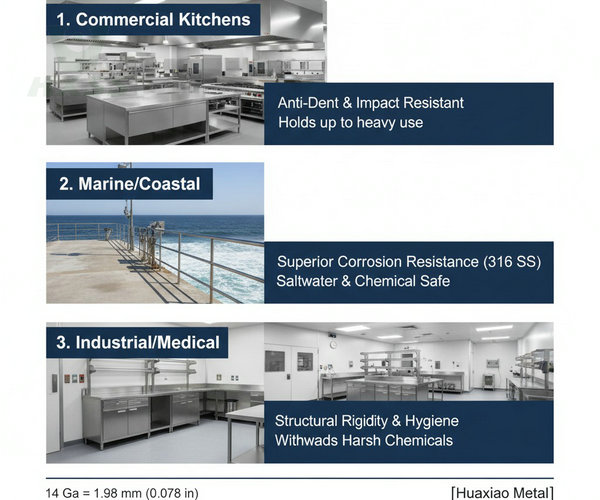
1. Commercial Food Service and Sanitation
The Problem: Commercial kitchens require surfaces that withstand heavy loads, frequent impacts, and constant chemical cleaning without denting.
The Solution: 14 gauge 304 stainless steel is the minimum thickness for high-volume commercial kitchen sinks and countertops. The thickness of 14 ga stainless steel prevents the bottom of the sink from bulging or denting from heavy pot drops, maintaining a level and sanitary surface.
2. Chemical Processing and Pharmaceuticals
The Problem: Equipment must resist aggressive corrosive media while maintaining structural integrity under pressure.
The Solution: 14 gauge 316L stainless steel is widely used for smaller pressure vessels, laboratory fume hoods, cleanroom cabinetry, and piping brackets. Its superior anti-pitting resistance protects against failure from harsh cleaning agents and corrosive chemicals.
3. Architecture and Heavy Construction
The Problem: Exterior and high-traffic architectural elements need aesthetic appeal combined with structural longevity.
The Solution: 14 gauge stainless steel is commonly used for exterior cladding panels, robust handrails, balustrades, and structural anchors. Its rigidity ensures large panels remain flat and resists distortion from high wind loads, providing a reliable and durable finish.
FAQ About 14 Ga Stainless Steel
How thick is 14 gauge stainless steel in millimeters?
The standard industry approximation for 14 gauge stainless steel thickness is 1.9844 mm. You can also remember it as 0.078125 inches. This thickness provides the durability and strength required of 14 ga stainless steel, making it ideal for medium-heavy-duty applications.
What is the main difference between 14 gauge 304 and 14 gauge 316 stainless steel?
The 14 gauge stainless steel has the same thickness, but the alloy content differs. 316 stainless steel contains Molybdenum, which gives it significantly higher corrosion resistance in environments containing chlorides (like saltwater), making it more expensive. 304 suits general and food-grade applications, while 316 is preferred for marine, chemical, and high-corrosion environments.
Where can I find a reliable 14 gauge stainless steel supplier with a competitive price?
Huaxiao Metal is a professional 14 gauge stainless steel supplier and manufacturer. We provide direct factory supply, offering both in stock and custom 14 gauge stainless steel sheet with guaranteed quality and a highly competitive price. With years of international export experience, we are your reliable global sourcing partner.
How do I calculate the weight of a 14 gauge stainless steel sheet?
To calculate the weight of a 14 gauge stainless steel sheet, you can use the following formula:
The density for stainless steel (like 304/316) is approximately 7.93 g/cm3 or 7930 kg/m3. You can also use our online calculator tool on the [Huaxiao Metal] website to quickly determine the weight of your specific size of 14 ga stainless steel thickness.
Is 14 ga stainless steel thickness suitable for outdoor use?
Yes, the 14 ga stainless steel thickness is very suitable for outdoor use. Its gauge provides excellent structural strength. The key is selecting the correct grade: for general outdoor use, 14 gauge 304 stainless steel is usually adequate; however, for coastal or heavily polluted industrial areas, the superior corrosion resistance of 14 gauge 316 stainless steel is strongly recommended.
What is the exact thickness of 14 ga stainless steel and its tolerance?
The nominal 14 gauge stainless steel thickness is 1.9844 mm (0.078125 inches). At Huaxiao Metal, we guarantee strict adherence to the minimum ± tolerance specified in ASTM A480/A480M to ensure material consistency for your structural and assembly needs.
Is 14 gauge stainless steel difficult to weld compared to thinner material?
While 14 Ga is thicker, it welds very well. The key difference is managing heat input to prevent distortion and, for 316, using the low-carbon 316L variant to avoid weld decay (intergranular corrosion). TIG and MIG welding are the industry standards for this thickness.
Conclusion: Your 14 Gauge Stainless Steel Partner—Huaxiao Metal
You now possess a comprehensive and in-depth understanding of 14 gauge stainless steel—from its precise thickness (how thick is 14 ga stainless steel) to its critical properties, grades, and vast applications. The unique combination of strength, durability, and corrosion resistance offered by this material makes it an essential choice for your next demanding project.
As a dedicated 14 gauge stainless steel supplier and manufacturer focused on international client service, Huaxiao Metal understands the importance of both quality and delivery schedule. We don’t just supply high-quality in stock 14 gauge stainless steel sheet and wire; we provide customized solutions at a highly competitive 14 gauge stainless steel price. Our expert team is ready to offer technical support and the optimal grade and fabrication services tailored precisely to your needs.
Don’t let material uncertainty slow down your project. If you are looking for reliable, high-quality 14 gauge stainless steel, or have any questions about the thickness of 14 ga stainless steel, please contact us immediately!