The development of hydrogen energy technology is accelerating globally, and Proton Exchange Membrane Fuel Cells (PEMFCs) have become one of the most promising clean energy solutions.
At the core of PEM fuel cells is a critical component known as the bipolar plate, which plays a key role in:
- Conducting electrons between cells
- Distributing hydrogen and oxygen gases
- Managing heat and water
- Providing mechanical support to the fuel cell stack
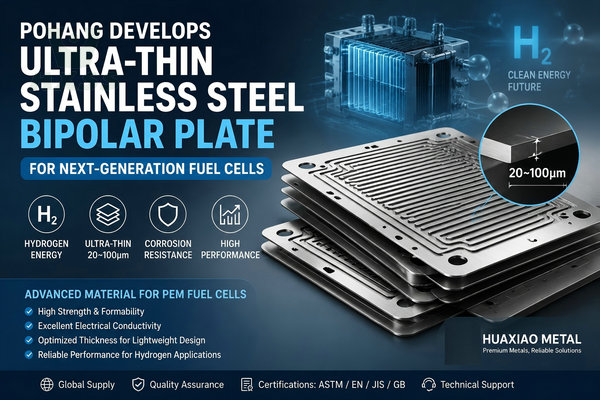
Recently, the industry has shifted toward ultra-thin stainless steel bipolar plates, typically ranging from 100 μm down to as low as 20–50 μm, to achieve higher energy density and lower system cost.
As a global stainless steel supplier, Huaxiao Metal provides stainless steel materials suitable for fuel cell applications, including high-precision ultra-thin sheets for advanced manufacturing.
What Is a Bipolar Plate in a PEM Fuel Cell?
A bipolar plate is a key structural and functional component inside a PEM fuel cell stack.
It performs four essential functions:
1. Electrical Conductivity
Transfers electrons between adjacent fuel cells.
2. Gas Distribution
Evenly distributes hydrogen and oxygen across the membrane.
3. Thermal Management
Helps dissipate heat generated during electrochemical reactions.
4. Mechanical Support
Provides structural stability for the fuel cell stack.
Because of these functions, bipolar plates must combine high conductivity, corrosion resistance, and mechanical strength.
Why Stainless Steel Is Used for Bipolar Plates
Traditionally, bipolar plates were made from graphite. However, stainless steel is now widely used due to its superior manufacturability and cost efficiency.
Material Comparison
| Material | Advantages | Disadvantages |
|---|---|---|
| Graphite | Excellent corrosion resistance | Brittle, heavy, expensive to machine |
| Stainless Steel | Strong, thin, low cost, mass-producible | Requires surface coating |
| Titanium | Excellent corrosion resistance | Very high cost |
Why Stainless Steel?
Stainless steel offers:
- Excellent mechanical strength
- Good formability for stamping
- Compatibility with ultra-thin processing
- Lower manufacturing cost at scale
Common grades used:
- 304 / 304L
- 316 / 316L
- Ferritic stainless steels (for cost reduction)
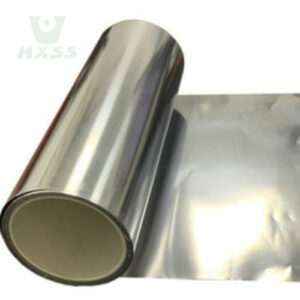



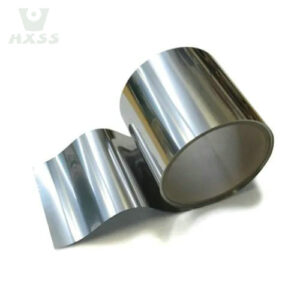
Ultra-Thin Trend in Bipolar Plates (20–100 μm)
The global fuel cell industry is moving toward thinner stainless steel bipolar plates to improve performance and reduce weight.
Typical Thickness Evolution
- Early generation: 200–300 μm
- Current mainstream: 100 μm
- Advanced designs: 50 μm
- Research frontier: 20–30 μm
Why thinner materials matter:
- Higher power density
- Lighter fuel cell stacks
- Improved vehicle efficiency
- Reduced material cost
However, ultra-thin stainless steel also introduces challenges in forming and coating.
Manufacturing Challenges of Ultra-Thin Stainless Steel Bipolar Plates
Producing ultra-thin bipolar plates requires advanced manufacturing control.
Key Challenges:
1. Stamping and Forming Difficulty
Ultra-thin sheets are prone to deformation and cracking.
2. Springback Effect
Precision control is required to maintain channel geometry.
3. Surface Oxidation
Oxidation reduces conductivity and must be controlled.
4. Coating Requirements
Protective coatings are needed to enhance corrosion resistance.
5. Dimensional Accuracy
Micron-level precision is required for flow field channels.
Stainless Steel vs Other Bipolar Plate Materials
Performance Comparison
| Property | Stainless Steel | Graphite | Titanium |
|---|---|---|---|
| Strength | High | Low | High |
| Cost | Low | Medium | Very high |
| Corrosion Resistance | Medium–High | High | Very high |
| Manufacturability | Excellent | Poor | Medium |
👉 Stainless steel remains the most scalable solution for mass production PEM fuel cells.
Industrial Applications of Bipolar Plates
Ultra-thin stainless steel bipolar plates are widely used in:
1. Hydrogen Fuel Cell Vehicles (FCEVs)
Used in automotive fuel cell stacks for clean transportation.
2. Hydrogen Drones
Lightweight fuel cell systems for long endurance flight.
3. Stationary Power Systems
Backup power and grid stabilization systems.
4. Portable Energy Devices
Military and remote-area power supply systems.
5. Industrial Energy Storage
Integration with renewable energy systems.
Material Requirements for Fuel Cell Bipolar Plates
To be suitable for PEMFC applications, stainless steel must meet:
✔ High Corrosion Resistance
To withstand acidic fuel cell environment.
✔ High Electrical Conductivity
To reduce internal resistance losses.
✔ Excellent Formability
For micro-channel stamping.
✔ Mechanical Stability
For long-term stack durability.
✔ Cost Efficiency
For large-scale commercialization.
Why Ultra-Thin Stainless Steel Is a Key Trend in Hydrogen Energy
The shift toward ultra-thin stainless steel bipolar plates is driven by:
- Global hydrogen energy expansion
- Automotive fuel cell commercialization
- Demand for lightweight systems
- Cost reduction pressure
- Mass production scalability
This makes stainless steel one of the most critical engineering materials in next-generation energy systems.
Huaxiao Metal Material Supply Capability
As a global stainless steel supplier, Huaxiao Metal supports the hydrogen energy industry with:
Stainless steel sheets and coils for advanced applications
Custom thickness control (including ultra-thin materials)
ASTM / EN / JIS / GB standard compliance
Mill Test Certificates (MTC)
Third-party inspection (SGS, BV, TÜV)
Global export service

Frequently Asked Questions
What is a bipolar plate in a fuel cell?
A bipolar plate is a key component in PEM fuel cells that distributes gases, conducts electricity, and supports the fuel cell structure.
Why is stainless steel used for bipolar plates?
Because it offers good strength, manufacturability, cost efficiency, and compatibility with mass production.
What is the typical thickness of stainless steel bipolar plates?
Modern designs typically range from 20 μm to 100 μm depending on performance requirements.
What is the main challenge of ultra-thin stainless steel?
The main challenges include stamping precision, corrosion protection, and maintaining structural integrity.
Can Huaxiao Metal supply stainless steel for fuel cell applications?
Yes, Huaxiao Metal supplies stainless steel materials suitable for PEM fuel cell and industrial applications worldwide.
In Conclusion
Ultra-thin stainless steel bipolar plates represent a critical material innovation in the hydrogen energy industry.
As PEM fuel cell technology continues to evolve, the demand for high-performance, ultra-thin, corrosion-resistant stainless steel will continue to grow rapidly.
With strong mechanical properties, excellent manufacturability, and scalable cost advantages, stainless steel remains the most practical solution for mass-market fuel cell systems.
For global buyers and manufacturers, selecting the right stainless steel material is essential for achieving performance, efficiency, and long-term reliability.
👉 Huaxiao Metal provides reliable stainless steel solutions for next-generation energy applications worldwide.