When structural steel plates fail, the problem is rarely visible on the surface.
In most catastrophic failures, lamellar tearing caused by through-thickness stress is the real culprit.
This is exactly why Z Direction Steel Plates have become a mandatory material choice for offshore platforms, high-rise buildings, pressure vessels, and heavy welded structures.
In this guide, Huaxiao Metal explains:
What Z-direction steel plate really is
How Z15 / Z25 / Z35 differ
Which grades are commonly used worldwide
When buyers must specify Z-grade steel
How to source certified Z-direction steel plates reliably in 2026
What Is Z Direction Steel Plate?
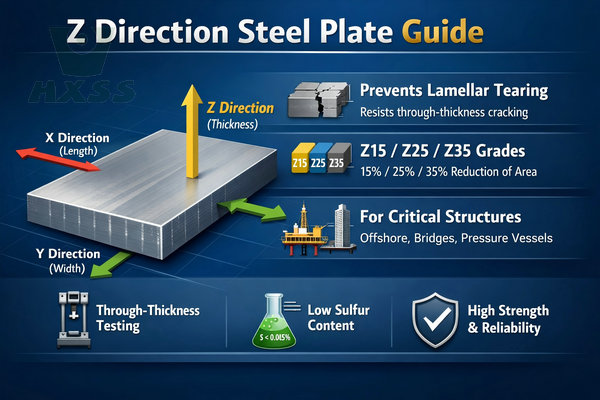
Z Direction Steel Plate is a structural steel plate specifically tested and certified for through-thickness (Z-axis) tensile performance.

Figure 2: Z direction steel plate diagram explaining through-thickness (Z-axis) performance for Z15, Z25 and Z35 grades used in critical welded structures.
Unlike ordinary steel plates that are only evaluated in:
Length (X direction)
Width (Y direction)
Z-direction steel plates are tested perpendicular to the plate surface, ensuring resistance to:
Lamellar tearing
Through-thickness cracking
Weld-induced shrinkage stress
This performance is achieved through:
Low sulfur content
Controlled rolling
Vacuum degassing (VD / VOD)
Special Z-direction tensile testing
Why Z Direction Performance Matters (Real Engineering Risk)
In thick welded steel structures, stress does not act only horizontally.
Typical high-risk applications include:
T-joints and cruciform welded joints
Box columns and node connections
Offshore jacket nodes
Thick base plates under dynamic load
Without Z-direction control:
Non-metallic inclusions elongate during rolling
Weld shrinkage pulls the plate apart internally
Cracks form inside the plate, invisible until failure
📌 Z-grade steel is not an upgrade — it is risk control.
Z15 vs Z25 vs Z35: What’s the Difference?
| Z Grade | Min Reduction of Area (Z-direction) | Typical Application |
|---|---|---|
| Z15 | ≥ 15% | General building structures |
| Z25 | ≥ 25% | Heavy welded joints, bridges |
| Z35 | ≥ 35% | Offshore, nuclear, critical load structures |
Rule of thumb for buyers:
If thickness ≥ 40 mm → Z25 recommended
If offshore / fatigue load → Z35 required
Common Z Direction Steel Grades (Global Standards)
Z-direction performance is added on top of base steel grades, such as:
EN / European Standards
S355J2 + Z15 / Z25 / Z35
S355NL + Z-grade
China GB / Low Alloy Structural Steel
Q355B Z15 / Z25 / Z35
Q345R Z-direction (pressure vessels)
Offshore & High-Strength
EH36 Z35
FH36 Z35
Customized TMCP steel plates with Z-grade
At Huaxiao Metal, we supply Z-direction steel plates across:
Offshore & pressure vessel grades
👉 Full product details:
🔗 Z Direction Steel Plate – Huaxiao Metal
How Z Direction Steel Plates Are Tested
Z-direction performance is verified using through-thickness tensile tests, usually according to:
EN 10164
GB/T 5313
Customer-specified third-party standards
Test results are shown as:
Reduction of area (%) in Z direction
Multiple specimens per heat/plate
📄 Mill Test Certificate (MTC) must clearly state Z-grade results
📄 Third-party inspection (SGS / BV / TUV) strongly recommended for Z25+
Typical Applications of Z Direction Steel Plate
Z-direction steel is widely used in:
- Offshore oil & gas platforms
- Wind power foundations
- Heavy steel bridges
- High-rise steel buildings
- Pressure vessels and reactors
- Large welded machinery bases
If your project includes:
- Thick plates
- Complex welding
- Dynamic or cyclic loads
➡ Z-grade steel should be specified from the RFQ stage.
Z Direction Steel Plate Price: What Affects Cost?
Z-direction steel plates are more expensive than standard plates, due to:
Extra refining processes
Lower sulfur control
Additional mechanical testing
Lower yield per heat
Price factors include:
Base steel grade (Q355 vs offshore grade)
Z grade level (Z15 < Z25 < Z35)
Plate thickness
Inspection requirements
💡 Using non-Z-grade steel and repairing failures later is far more expensive than specifying Z-grade upfront.
Why Engineers & Buyers Choose Huaxiao Metal
Huaxiao Metal is an experienced supplier of Z Direction Steel Plates for global projects, offering:
Full Z15 / Z25 / Z35 certification
Stable Chinese & international mill sources
Customized thickness & dimensions
Third-party inspection coordination
Export-ready packaging & documentation
We understand:
Engineering drawings
Welding requirements
International standards compliance
FAQ: Z Direction Steel Plate
Is Z-grade mandatory for all thick steel plates?
No. Z-grade is required when through-thickness stress exists, especially in welded joints.
Can Z-grade be added after production?
No. Z-direction performance must be controlled during steelmaking and rolling.
Is Z35 always better than Z25?
Not necessarily. Z35 is for critical structures. Over-specifying increases cost without benefit.
How do I specify Z-direction steel in RFQ?
Include:
- Base grade (e.g., Q355B)
- Z grade (Z15 / Z25 / Z35)
- Standard (EN 10164 / GB/T)
- Inspection requirement
- Quantity
Final Advice for 2026 Buyers
If your structure cannot afford internal cracking, then the Z Direction Steel Plate is not optional.
Choosing the right Z-grade early:
Prevents failure
Reduces welding risk
Protects project timelines
Huaxiao Metal helps you select, source, and deliver certified Z-direction steel plates with confidence.