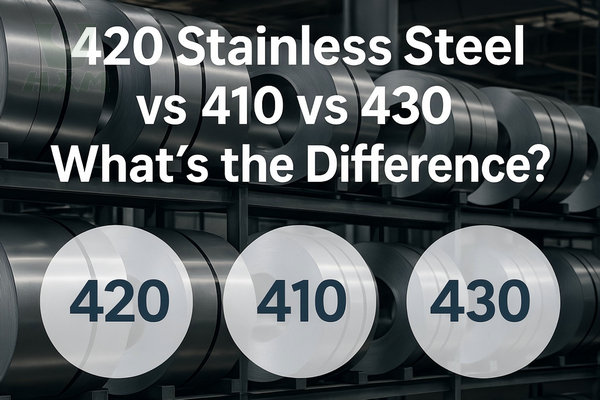
420 Stainless Steel vs 410 vs 430 – What’s the Difference?
Fern Wang
Published on:
Choosing the right material is one of the most critical decisions in any manufacturing or construction project. When it comes to stainless steel, the sheer number of grades can be overwhelming. In the popular 400 series, three grades often come up for comparison: 420 Stainless Steel vs 410 vs 430. While they may sound similar, their properties are distinct, making each suitable for very different applications.
As a leading stainless steel supplier, we at Huaxiao Metal want to provide clarity on this topic. This guide will break down the key differences between these three common stainless steel grades to help you make an informed and cost-effective decision for your business needs.
Key Differences: 420 Stainless Steel vs 410 vs 430
For a quick overview, here is a table summarizing the fundamental differences:
Feature
410 Stainless Steel
420 Stainless Steel
430 Stainless Steel
Alloy Family
Martensitic
Martensitic
Ferritic
Corrosion Resistance
Good
Fair to Good
Excellent
Hardness
High (Hardenable)
Very High (Hardenable)
Moderate (Not Hardenable)
Strength
High
Very High
Moderate
Magnetic
Yes
Yes
Yes
Cost
Low
Low-to-Moderate
Low
Primary Advantage
Versatility & Strength
Hardness & Wear Resistance
Corrosion Resistance & Formability
Definition: 420 Stainless Steel vs 410 vs 430
What is 410 Stainless Steel?
410 stainless steel is the foundational, general-purpose martensitic stainless steel. Think of it as the versatile workhorse of the group. Being martensitic means it can be hardened through heat treatment, allowing for a wide range of mechanical properties.
420 stainless steel is essentially a higher-carbon version of 410. This increase in carbon content is its defining feature. The primary purpose of adding more carbon is to significantly increase the steel’s hardness and strength after heat treatment.
Unlike 410 and 420, 430 stainless steel is a non-hardenable, ferritic alloy. This fundamental difference in its crystal structure gives it a unique set of properties, with its primary advantage being superior corrosion resistance and formability.
The 400 series stainless steels are ferritic and martensitic alloys. They offer good strength, moderate corrosion resistance, and affordability, making them ideal for a wide range of industrial and consumer applications.
Grade
Type
Magnetic
Hardenable
Chromium (%)
Typical Use
410
Martensitic
Yes
Yes
11.5–13.5
Cutlery, valves
420
Martensitic
Yes
Yes
12–14
Surgical tools, knives
430
Ferritic
Yes
No
16–18
Appliances, automotive trim
Chemical Composition Comparison
Element
410 Stainless Steel
420 Stainless Steel
430 Stainless Steel
Carbon (C)
0.08–0.15%
0.15–0.40%
≤0.12%
Chromium (Cr)
11.5–13.5%
12–14%
16–18%
Nickel (Ni)
≤0.75%
≤0.75%
≤0.75%
Manganese (Mn)
≤1%
≤1%
≤1%
420 contains more carbon than 410, which gives it higher hardness after heat treatment. 430 has the highest chromium content, enhancing corrosion resistance but reducing hardenability.
👉 Need help choosing the right stainless steel grade? Contact Huaxiao Metal for a material recommendation and pricing.
420 stainless steel is the hardest of the three due to its high carbon content and can achieve a Rockwell hardness of up to 50 HRC when properly heat-treated.
430 stainless steel cannot be heat-treated but is easier to form and weld.
Heat Treatment Behavior
Grade
Heat Treatment Response
Practical Impact
410
Moderate
Balanced strength
420
Excellent
Extreme hardness possible
430
None
Mechanical properties remain unchanged
👉 If your design relies on heat treatment to reach final performance, 420 is the most reliable option.
Corrosion Resistance
430 stainless steel offers better corrosion resistance in mildly corrosive environments due to its higher chromium content.
420 stainless steel has moderate corrosion resistance, especially after polishing.
410 offers the least corrosion resistance and requires protective coating or regular maintenance in wet or acidic environments.
🔍 If corrosion resistance is your top priority, 430 may be the best choice. Consult us at Huaxiao Metal for expert advice and competitive pricing.
420 stainless steel is widely used for cutting tools, while 430 is perfect for decorative and appliance applications.
Hardness Potential: Why 420 Clearly Stands Out
420 Stainless Steel – Designed for High Hardness
420 stainless steel contains significantly higher carbon content than 410, which directly determines its ability to reach very high hardness after heat treatment.
Maximum hardness: HRC 50+
Excellent wear resistance
Good fatigue resistance under repeated stress
Maintains strength at sharp edges
Typical uses include:
Industrial knives & blades
Cutting tools
Surgical instruments
Precision wear parts
🔗 For high-hardness applications, many buyers choose 👉 420 Stainless Steel for stamping, cutting, and further heat treatment.
410 stainless steel can also be heat-treated, but its lower carbon content limits its hardness ceiling.
Maximum hardness: ~HRC 35–40
Better impact resistance than 420
Easier machining and forming
Lower overall material cost
410 is often selected when:
Some hardness is required
Shock resistance is important
Cost control is a priority
Common applications:
Fasteners
Valve components
Turbine parts
430 Stainless Steel – Not Suitable for Hardness
430 stainless steel cannot be hardened by heat treatment.
Ferritic structure
Good corrosion resistance in indoor environments
Excellent formability
Lowest cost among the three
Best suited for:
Kitchen equipment
Home appliances
Decorative panels
❌ Not recommended for cutting, wear-resistant, or load-bearing applications.
How to Choose: 410 vs 420 vs 430
So, which grade is right for your project? Here’s a simple decision framework:
Choose 410 if: You need a strong, cost-effective, all-purpose steel that can be heat-treated for various levels of hardness. It’s ideal for mechanical fasteners and structural components.
Choose 420 if: Your absolute top priority is maximum hardness and wear resistance. If you are manufacturing anything that needs to cut or withstand abrasion, 420 is the superior choice.
Choose 430 if: Your application requires excellent corrosion resistance, a highly polished finish, and good formability, while high tensile strength is not a primary concern. It’s the go-to for decorative and automotive trim.
At Huaxiao Metal, we supply all three grades with customizable dimensions and finishes. Whether you’re producing kitchen equipment, automotive parts, or industrial tools, we can provide the right material solution.
Professional 410/420/430 stainless steel supplier
Custom thickness, width, and surface finish
Mill Test Certificate (EN 10204 3.1)
Competitive factory-direct pricing
We offer global delivery, full traceability, and technical support. Contact us now to get a free sample or price quote!
You can source high-quality stainless steel from Huaxiao Metal, a professional supplier and manufacturer offering global delivery.
Final Conclusion
While 410 and 430 stainless steel each have their place, 420 stainless steel is the clear choice for high-hardness and wear-resistant applications. Understanding how carbon content, heat treatment, and real-world performance interact is key to selecting the correct material.
📩 Need technical advice or pricing support?
Contact Huaxiao Metal today for expert guidance on 420 stainless steel coils and sheets.