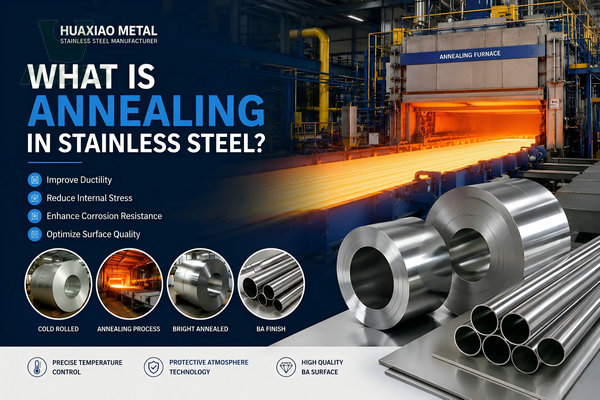
Annealing is a critical heat treatment process used in stainless steel manufacturing to soften the material, improve ductility, reduce internal stress, and restore corrosion resistance after cold working or welding.
In stainless steel processing, annealing is commonly applied to cold rolled coils, strips, sheets, and tubes to improve formability and surface quality. Depending on the stainless steel grade and application requirements, manufacturers may use bright annealing, solution annealing, or stress relief annealing processes.
Proper annealing can significantly improve the performance, appearance, and fabrication efficiency of stainless steel products used in industrial, decorative, automotive, food processing, and architectural applications.
At Huaxiao Metal, advanced annealing technology is used in the production of BA finish stainless steel coils, strips, sheets, and tubes for global customers requiring high surface quality, stable mechanical performance, and reliable corrosion resistance.
Why Is Annealing Important for Stainless Steel?
Cold rolling, welding, stamping, and forming processes can increase the hardness and internal stress of stainless steel materials. Without proper heat treatment, stainless steel may become brittle, difficult to process, or more prone to cracking during fabrication.
Annealing helps restore the original ductility and workability of stainless steel by modifying its internal microstructure through controlled heating and cooling processes.
For stainless steel manufacturers and fabricators, proper annealing is essential for improving product quality, forming performance, corrosion resistance, and surface appearance.
Main Benefits of Annealing Stainless Steel
- Improves ductility and flexibility
- Reduces internal stress after cold working
- Enhances formability for bending and stamping
- Restores corrosion resistance
- Improves welding performance
- Optimizes surface quality
- Reduces the risk of cracking during fabrication
Annealed stainless steel is widely used in industrial processing, decorative applications, kitchen equipment, automotive components, and precision stainless steel tubing.
Types of Annealing Used in Stainless Steel Manufacturing
Different stainless steel products require different annealing methods depending on the material grade and application requirements.
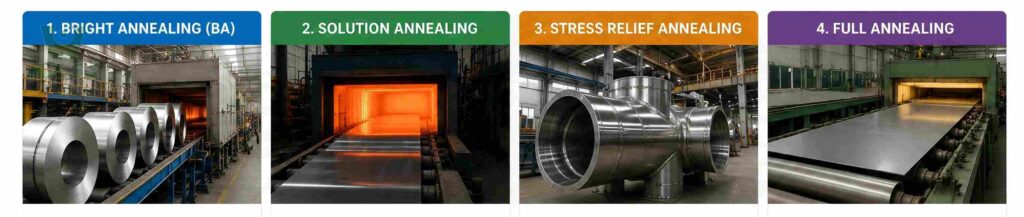
Bright Annealing (BA)
Bright annealing is performed in a protective atmosphere furnace, usually using hydrogen or inert gas, to prevent oxidation during heating.
This process produces a bright, smooth, and reflective stainless steel surface without heavy oxide scale.
Advantages of Bright Annealing
- Excellent surface brightness
- Minimal oxidation
- Improved corrosion resistance
- Better surface cleanliness
- Reduced need for pickling
Typical Applications
- Decorative stainless steel tubes
- Elevator panels
- Kitchen equipment
- Automotive trim
- Precision tubing
- Architectural decoration
Bright annealed stainless steel is widely used in products requiring high surface quality and decorative appearance.
Solution Annealing
Solution annealing is commonly used for austenitic stainless steel grades such as 304, 304L, and 316L.
This process dissolves carbide precipitates and restores corrosion resistance after welding or hot working.
Common Applications
- Chemical equipment
- Pressure vessels
- Food processing equipment
- Marine applications
- Pharmaceutical equipment
Stress Relief Annealing
Stress relief annealing reduces residual stress caused by machining, welding, bending, or forming operations.
This process helps reduce distortion and cracking during later fabrication.
Full Annealing
Full annealing softens stainless steel materials and improves ductility and machinability.
It is often used before deep drawing or complex forming processes.
Bright Annealing vs Normal Annealing
| Item | Bright Annealing | Normal Annealing |
|---|---|---|
| Surface Finish | Bright and smooth | Oxidized surface |
| Protective Atmosphere | Yes | Usually no |
| Pickling Required | Usually no | Often required |
| Surface Oxidation | Minimal | Higher |
| Appearance | Decorative quality | Industrial finish |
| Cost | Higher | Lower |
| Typical Applications | BA tubes, decorative sheets | General industrial use |
Bright annealing is particularly important for stainless steel products requiring premium appearance and clean surface quality.
Annealing Temperature for Common Stainless Steel Grades
Different stainless steel grades require different annealing temperatures.
| Stainless Steel Grade | Typical Annealing Temperature |
|---|---|
| 304 Stainless Steel | 1010–1120°C |
| 316L Stainless Steel | 1040–1150°C |
| 430 Stainless Steel | 760–815°C |
| 201 Stainless Steel | 1010–1120°C |
| 410 Stainless Steel | 730–800°C |
Proper temperature control is critical for achieving stable mechanical performance and corrosion resistance.
Common Problems During Annealing
Improper annealing conditions may cause various quality problems in stainless steel products.
Surface Oxidation
Excess oxygen inside the furnace may cause oxide scale and discoloration on the stainless steel surface.
Uneven Surface Finish
Poor temperature uniformity can result in inconsistent surface appearance and flatness.
Warping and Distortion
Improper cooling rates may cause deformation, especially in thin stainless steel strips and sheets.
Reduced Corrosion Resistance
Incorrect annealing temperatures or atmosphere conditions may negatively affect the corrosion resistance of stainless steel materials.
Professional furnace atmosphere control and process management are essential for maintaining stable product quality.
Applications of Annealed Stainless Steel
Annealed stainless steel materials are widely used across multiple industries because of their excellent formability, corrosion resistance, and surface quality.
Common Applications Include
- Stainless steel kitchenware
- Food processing equipment
- Decorative panels
- Automotive components
- Precision stainless steel tubing
- Industrial tanks and vessels
- Medical equipment
- Construction materials
- Elevator decoration panels
Bright annealed stainless steel products are especially popular in decorative and architectural applications.
Why Manufacturers Choose Bright Annealed Stainless Steel
Bright annealed stainless steel provides several advantages compared with standard annealed materials.
Advantages of BA Stainless Steel
- Better surface appearance
- Improved reflectivity
- Reduced surface contamination
- Excellent cleanliness
- Lower post-processing costs
- Better corrosion performance
BA finish stainless steel coils and tubes are commonly used in high-end industrial and decorative projects worldwide.
Huaxiao Metal Stainless Steel Annealing Capabilities
Huaxiao Metal supplies various annealed stainless steel products for industrial and decorative applications worldwide.
Available Products
- Stainless steel coils
- Stainless steel strips
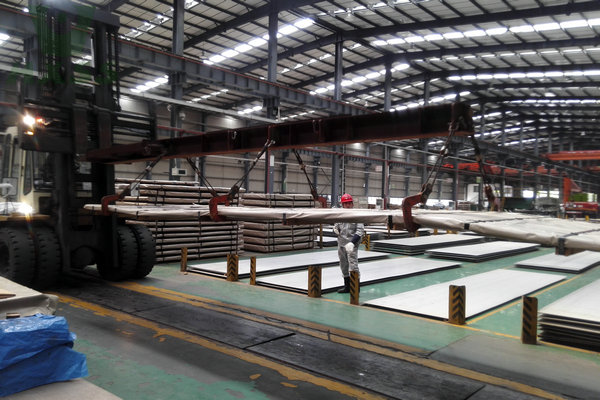
- Stainless steel sheets
- Bright annealed stainless steel tubes
- Cold rolled stainless steel products
Available Stainless Steel Grades
- 201
- 304
- 304L
- 316L
- 430
- 410
Available Surface Finishes
- BA
- 2B
- No.4
- HL
- Mirror finish
Processing Services
- Slitting
- Cutting
- Surface polishing
- Protective film coating
- Custom packaging
Our stainless steel products are widely exported for fabrication, industrial processing, decoration, and manufacturing projects worldwide.
How to Choose the Right Annealed Stainless Steel Material
Selecting the correct annealed stainless steel material depends on several factors.
Important Factors to Consider
- Stainless steel grade
- Corrosion resistance requirements
- Surface finish requirements
- Thickness tolerance
- Forming performance
- Welding requirements
- Application environment
Choosing the proper annealing process can significantly improve fabrication efficiency and final product quality.
FAQ About Stainless Steel Annealing
Does annealing make stainless steel softer?
Yes. Annealing reduces hardness and improves ductility, making stainless steel easier to bend, stamp, and fabricate.
Does annealing improve corrosion resistance?
Proper annealing can improve corrosion resistance by restoring the stainless steel microstructure and reducing internal stress.
What is bright annealed stainless steel?
Bright annealed stainless steel is heat-treated in a protective atmosphere furnace to maintain a bright, smooth, and oxidation-free surface.
Is annealing required after cold rolling?
In many cases, yes. Cold rolling increases hardness and internal stress, so annealing is often necessary to restore workability.
What is the difference between annealing and heat treatment?
Annealing is one type of heat treatment mainly used to soften metal, relieve stress, and improve ductility.
Contact Huaxiao Metal
Looking for high-quality annealed stainless steel coils, strips, sheets, or bright annealed stainless steel tubes?
Huaxiao Metal provides customized stainless steel solutions for industrial, decorative, and fabrication applications worldwide.
Contact our technical team today for:
- Product catalogs
- Technical consultation
- Surface finish recommendations
- Processing solutions
- Competitive quotations
We welcome global distributors, manufacturers, fabricators, and project contractors to cooperate with us.