
The choice between aluminum and stainless steel as construction materials has long been discussed. Both materials offer distinct advantages and find applications in various industries. In this analysis, we will compare the properties of aluminum or stainless steel to help you understand their respective strengths and weaknesses. By examining factors such as strength, durability, corrosion resistance, weight, heat conductivity, and aesthetics, we aim to comprehensively understand which material may be more suitable for different applications.
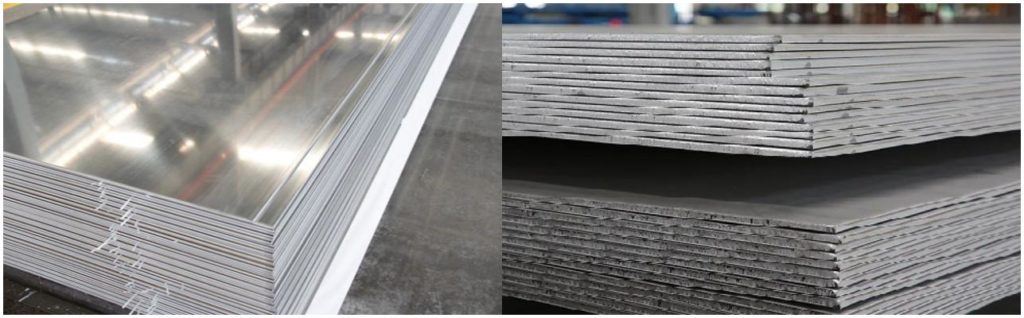
At Huaxiao Metal, we supply both high-quality stainless steel and aluminum alloys, helping global clients select the right materials for their unique needs.
👉 Explore Stainless Steel Products
👉 Explore Aluminum Metal Products
Overview: Aluminum and Stainless Steel
What Is Aluminum?
Aluminum is a lightweight, silvery-white metal known for its excellent corrosion resistance, ductility, and high thermal conductivity. It’s widely used in transportation, construction, packaging, and electronics. Common alloys include 6061, 6063, 3003, and 5052 aluminum.
Huaxiao Metal offers a comprehensive range of aluminum sheets, coils, strips, and bars, providing precise cutting and surface finishing services tailored to meet various industry needs.
👉 View Aluminum Alloy Stock
What Is Stainless Steel?
Stainless steel is an iron-based alloy containing at least 10.5% chromium, which forms a passive layer that protects it from corrosion. Grades like 304, 316, 430, and 201 are among the most popular.
Huaxiao Metal offers stainless steel sheets, coils, tubes, and profiles, available in multiple surface finishes such as BA, 2B, No.4, and Mirror (8K), making them ideal for both structural and decorative applications.
👉 Browse Stainless Steel Products
Core Material Properties Comparison: Weight, Strength, and Physical Traits
The first step in selecting a metal is understanding the fundamental differences in its physical and mechanical properties. This directly impacts how the material performs under load, heat transfer, and in light-weighting applications.
| Property Dimension | Stainless Steel | Aluminum Alloy | Key Engineering Priority |
| Density/Weight | High (approx. 7.85cm^3). High weight provides stability and structural rigidity. | Low (approx. 2.7 cm^3). Significant advantage for light-weighting. | Lightweight/Mobility: Choose Aluminum Alloy |
| Absolute Strength/Hardness | High. Excellent yield strength and tensile strength, ideal for heavy loads and high-pressure environments. | Medium. Strength depends on the specific alloy (e.g., 7075 is very high), but is generally lower than Stainless Steel. | Extreme Load Bearing: Choose Stainless Steel |
| Strength-to-Weight Ratio | Moderate. | Extremely High. Preferred in aerospace and high-performance automotive industries. | Efficiency: Choose Aluminum Alloy |
| Thermal Conductivity | Low. An excellent thermal barrier, suitable for insulating applications. | Extremely High. Excellent heat dissipation material, ideal for heat exchangers and heatsinks. | Heat Dissipation/Exchange: Choose Aluminum Alloy |
| Electrical Conductivity | Moderately Low. | Extremely High. An excellent electrical conductor. | Electrical Conduction: Choose Aluminum Alloy |
While Stainless Steel’s Absolute Strength is generally higher, its high density often makes it less favorable in efficiency-driven projects. Aluminum Alloy’s superior Specific Strength means that a structure built with it can achieve the same required strength while being significantly lighter. This is the critical factor why alloys like 6061 and 7075 are the primary choice for structures in the aerospace, high-speed rail, and automotive industries where weight reduction is paramount.
Corrosion Resistance: The Passivation Layer of Stainless Steel and Aluminum Alloy
In moist, acidic, or chloride-rich environments, a material’s corrosion resistance is paramount. Both metals rely on a passivation layer to resist corrosion, though the mechanism and effectiveness differ.
Stainless Steel’s Superior Corrosion Advantage
Stainless Steel’s resistance to corrosion stems from its minimum 10.5% Chromium content. When exposed to oxygen, the Chromium forms a dense, self-healing layer of Chromium Oxide on the surface—the passivation layer.
304 Stainless Steel: The most common grade, suitable for daily use and non-aggressive industrial environments. It offers good resistance to oxidation and common corrosion.
316/316L Stainless Steel: Contains Molybdenum, an element that significantly enhances its resistance to pitting and crevice corrosion, especially in chloride environments (such as marine, saltwater, and chemical processing). Consequently, 316 Stainless Steel is the gold standard for food processing, medical devices, and maritime engineering.
201 Stainless Steel: Lower nickel and higher manganese content result in a lower initial cost, but its corrosion resistance is weaker than 304/316 in humid or coastal areas, making it better suited for dry indoor use.
Aluminum Alloy’s Corrosion Characteristics
Aluminum also quickly forms a natural, robust layer of Aluminum Oxide in the air, which effectively prevents further oxidation.
Acid/Alkali Resistance: Aluminum Alloy is resistant to most neutral environments, but its resistance to strong alkaline environments (like concrete, alkaline cleaners) and certain strong acids is inferior to 300-series Stainless Steel.
5083 Aluminum Alloy: Known as the “marine-grade” aluminum, this alloy excels in saltwater corrosion and low-temperature performance, making it an excellent choice for shipbuilding and cryogenic equipment.
Conclusion: When facing high-salinity, high-chloride, or extremely acidic environments, Molybdenum-containing 316 Stainless Steel offers an irreplaceable advantage.
Manufacturing and Economic Considerations: Cost, Welding, and Machinability
From an engineering economics perspective, a material’s initial cost and its processing cost collectively determine the final product price.
Raw Material Cost vs. Processing Efficiency
Stainless Steel Cost: The initial material cost is typically higher, especially for 304/316 grades, as their prices are subject to market fluctuations of rare metals like Nickel and Chromium.
Aluminum Alloy Cost: Aluminum’s machinability is excellent; it can be machined quickly with easy chip control, which significantly reduces production time and tool wear. This superior ease of fabrication means that for high-volume production, complex machining, or extrusion forming, the Total Manufacturing Cost of Aluminum Alloy is often more competitive than Stainless Steel.
Welding and Forming Characteristics
Stainless Steel Welding: Can be done using established methods like TIG/MIG. However, for certain grades (like 304), careful heat input control is necessary to prevent intergranular corrosion (sensitization near the weld seam).
Aluminum Alloy Welding: This presents challenges due to its high thermal conductivity and oxide layer, often requiring specialized equipment (like AC-TIG or pulse MIG). Nevertheless, Aluminum Alloy’s excellent properties for casting and extrusion are its greatest forming advantages, allowing complex profiles and structural components to be manufactured at a lower cost.
Is Aluminum or Stainless Steel Better?
When comparing aluminum and stainless steel, several key factors come into play. Stainless steel exhibits superior strength and durability, making it less susceptible to deformation and structural damage. In contrast, aluminum is lighter and softer, but also more prone to dents, scratches, and deformation. In terms of corrosion resistance, stainless steel is highly reliable, mainly when it contains higher levels of chromium and nickel. Aluminum possesses natural corrosion resistance but may require additional protective coatings for certain environments.
Weight is a crucial consideration in many applications. Aluminum’s lightweight nature makes it ideal for industries where weight reduction is paramount, such as aerospace, automotive, or transportation. Stainless steel, although denser and heavier, offers enhanced stability and strength in applications where weight is not a critical factor.
The heat conductivity of these materials is also worth noting. Aluminum excels in thermal conductivity, facilitating efficient heat transfer. This property is beneficial in applications that require rapid heat dissipation, such as cookware and heat sinks. In contrast, stainless steel has lower thermal conductivity, limiting its effectiveness in heat transfer. However, stainless steel is preferred for applications necessitating heat resistance or insulation.
Aesthetics play a role in material selection as well. Stainless steel exhibits a sleek and shiny appearance, providing a modern and stylish look. It is frequently employed in appliances, architectural designs, and decorative applications. Aluminum, while not as lustrous, can be polished or anodized to enhance its appearance. It offers a more matte or brushed finish and is often chosen for its lightweight and contemporary aesthetic.
FAQ — Aluminum and Stainless Steel
Which has higher strength, stainless steel or aluminum alloy?
In terms of absolute strength (e.g., yield strength), stainless steel generally outperforms aluminum alloys. However, considering weight, aluminum alloys have a better strength-to-weight ratio (specific strength), which is why they are favored in the aerospace industry.
How do 304 stainless steel and 6061 aluminum alloy compare in terms of cost?
In terms of initial raw material costs, 304 stainless steel is generally more expensive, especially considering the fluctuations in nickel prices. However, aluminum alloys are easier to machine, significantly improving production efficiency, so in some mass production applications, their total manufacturing cost may be lower than that of stainless steel.
Should stainless steel or aluminum alloy be chosen for marine environments?
316/316L stainless steel is strongly recommended, as its molybdenum content gives it excellent resistance to pitting corrosion in chloride (sea salt) environments. If aluminum alloys must be used, 5083 marine grade aluminum alloy should be chosen.
What grades of stainless steel and aluminum alloys does Huaxiao Metal primarily offer?
Huaxiao Metal offers a full range of stainless steel (such as 201, 304, 316L, etc.) and aluminum alloys (such as 1000 series pure aluminum, 5000 series rust-proof aluminum, 6061 T6, 7075 high-strength aerospace aluminum) products, covering plates, tubes, bars and profiles, and provides customized cutting and surface treatment services.
Can aluminum and stainless steel be used together?
They can, but direct contact should be avoided to prevent galvanic corrosion. Proper insulation or coatings are recommended.
In Conclusion
In conclusion, the choice between aluminum and stainless steel depends on the specific requirements of the application. Stainless steel boasts superior strength, durability, and corrosion resistance, making it suitable for demanding environments. On the other hand, aluminum’s lightweight nature, excellent thermal conductivity, and contemporary aesthetic make it a preferred choice in weight-sensitive applications where heat dissipation is crucial. By considering the unique properties of each material, you can make an informed decision regarding its suitability for your particular needs.