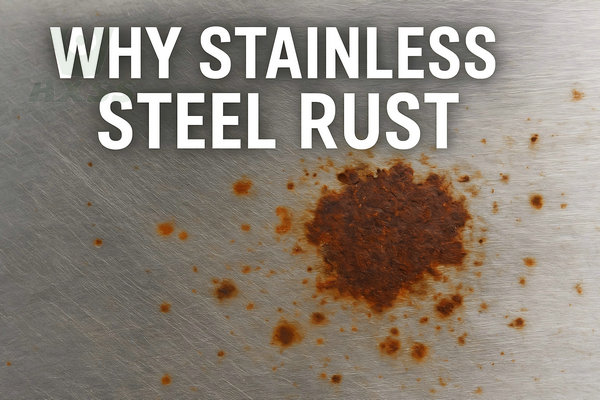
You might have heard it before: “Stainless steel never rusts.” While this phrase is commonly used, it’s not entirely accurate. As a leading manufacturer and supplier of stainless steel products at Huaxiao Metal, we often get asked, “Why does stainless steel rust?” The simple answer is that while it is highly resistant to corrosion, it is not immune. Understanding why stainless steel rust is crucial for proper material selection, maintenance, and extending the lifespan of your products.
This comprehensive guide will debunk the myth and provide a detailed explanation of the science behind stainless steel rust, the types of corrosion, the factors that accelerate it, and most importantly, how to prevent it. We’ll also share our professional insights to help you make informed decisions for your projects, ensuring you get the most out of your stainless steel investment.
Explanation of “Why Stainless Steel Rusts”
First. Definition
“Stainless steel” is just a general term. The standard name is “acid and alkali-resistant steel”. Stainless steel is a steel product made by adding metal elements such as chromium and nickel based on ordinary steel. The content of metal elements such as nickel, molybdenum, and titanium The higher the quality, the better the quality of stainless steel.
Second, the characteristics of stainless steel
Stainless steel has the ability to resist atmospheric oxidation- that is, non-rust- and corrosion resistance in media containing acid, alkali, and salt. However the size of its anti-corrosion ability varies with the chemical composition of the steel itself, the state of mutual addition, the conditions of use, and the type of environmental media.
For example, 304 steel pipe has an excellent anti-corrosion ability in a dry and clean atmosphere, but when it is moved to a coastal area, it will quickly rust in sea fog containing a lot of salt; while 316 steel pipe has performance good.
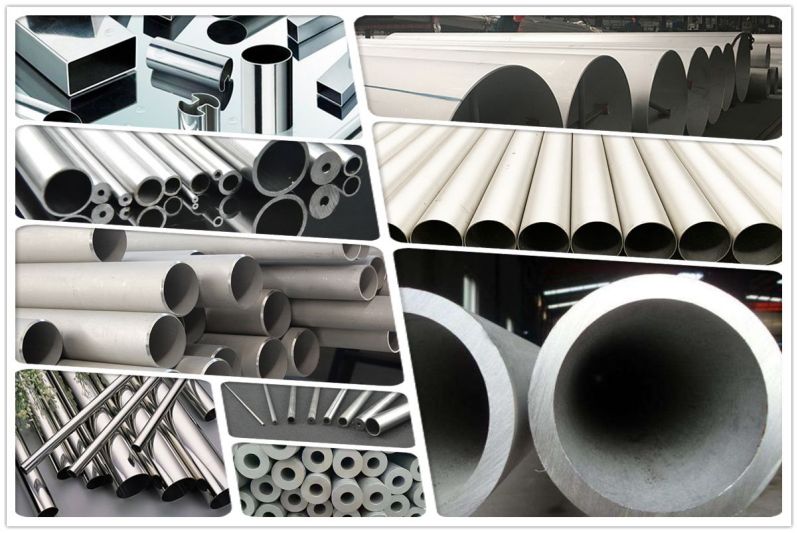
Therefore, it is not any kind of stainless steel that can resist corrosion and rust in any environment.
Three, the cause of stainless steel rust
Stainless steel relies on a very thin, strong, dense, and stable chromium-rich oxide film (protective film) formed on its surface to prevent oxygen atoms from continuing to penetrate and continue to oxidize, thereby obtaining the ability to resist corrosion. Once for some reason, this film is continuously destroyed, oxygen atoms in the air or liquid will continue to infiltrate or iron atoms in the metal will continue to separate, forming loose iron oxide, and the metal surface will continue to be rusted. There are many forms of damage to this surface film, and the following are more common in daily life:
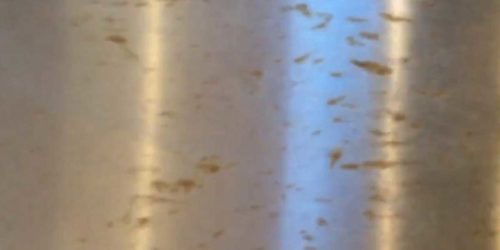
Stainless Steel Rust
1. The surface of stainless steel has accumulated dust containing other metal elements or attachments of foreign metal particles. In humid air, the condensation between the attachments and stainless steel connects the two into a micro battery, which initiates an electrochemical reaction. , The protective film is damaged, which is called electrochemical corrosion.
2. The surface of stainless steel adheres to the organic juice (such as melon, vegetable, noodle soup, sputum, etc.), which forms organic acid in the presence of water and oxygen, and the organic acid will corrode the metal surface for a long time.
3. The surface of stainless steel adheres to containing acid, alkali, and salt substances (such as alkaline water and lime water splashing on the decoration wall), causing local corrosion.
4. In polluted air (such as the atmosphere containing a large amount of sulfide, carbon oxide, and nitrogen oxide), it will form sulfuric acid, nitric acid, and vinegar when it encounters condensed water.
Fourth, the form of rust
There are mainly the following forms: stress corrosion cracking, pitting corrosion, intergranular corrosion, crevice corrosion, and general corrosion
1. Stress corrosion cracking (SCC): refers to a kind of mutual failure of stress-bearing alloys due to the expansion of streaks in a corrosive environment
2. Pitting corrosion: Pitting corrosion refers to a high degree of local corrosion that does not corrode or is slightly corroded on the surface of metal materials. The size of common corrosion spots is less than 1.00mm, and the depth is often greater than the surface aperture. The lighter ones have shallower corrosion. Pit, serious, or even perforation.
3. Intergranular corrosion: selective corrosion damage, which is different from general selective corrosion in that the locality of corrosion is on the microscopic scale.
4. Crevice corrosion: It refers to spot-like or ulcer-shaped macroscopic corrosion pits in the gaps of metal components. It is a form of local corrosion. It may occur in the gaps where the solution stagnates or in the shielded surface. Such gaps can be formed at the junction of metal and metal or metal and non-metal.
5. Comprehensive corrosion: it is used to describe the corrosion that occurs on the entire alloy surface in a relatively uniform manner
Five, the principle of no rust
Stainless steel can not rust because it contains chromium. Usually, the content of chromium must reach 13-25% (weight ratio) to change the oxidation of the steel surface.
Principle: After adding chromium and other elements to steel, the properties of steel can be changed. For example, the molecular structure of steel is more uniform, and it is easier to form a dense oxide protective film on the surface of the steel, thereby greatly improving the corrosion resistance of stainless steel.
Therefore, stainless steel can resist the corrosion of fire, water, acid, alkali, and various solutions, and does not rust. Scientists found that the more uniform the internal structure of steel, the more closely the various components are connected, the more difficult it is for corrosion products to invade, and that there is a layer of oxide protective film attached to the surface, just like putting armor on steel. It will not rust easily.
Six. Problems that should be paid attention to in use
1. Protect the chromium-rich oxide film (protective film). Avoid damage caused by scratches, deposits, and bleach, otherwise, stainless steel will rust.
2. Pay attention to small pits and cracks on the surface, because this is the beginning of rust.
3. Use appropriate tools. Do not use steel wipes, wire brushes, or scrapers.
4. Use chlorinated alkali detergent according to the recommended strength
5. Wipe off the suspended detergent and residual moisture immediately, otherwise it will eventually cause rust if it stays on the stainless steel for a long time
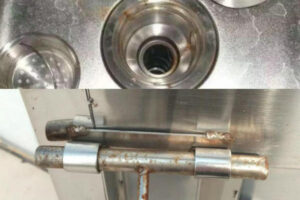
What Makes Stainless Steel “Stainless”?
The Role of Chromium
The key to stainless steel’s corrosion resistance is its chromium content. Stainless steel typically contains 10.5% or more chromium, which reacts with oxygen in the air to form a thin, invisible passive layer of chromium oxide.
This passive film acts as a barrier, preventing oxygen and moisture from penetrating the surface and causing rust.
In most environments, this protective film self-heals if scratched or damaged.
Other Alloying Elements
Besides chromium, stainless steel often contains nickel, molybdenum, and nitrogen, which enhance resistance to specific types of corrosion:
Nickel: Improves toughness and resistance to acidic environments.
Molybdenum: Enhances pitting resistance in chloride-rich conditions.
Nitrogen: Improves strength and reduces susceptibility to localized corrosion.
Will Stainless Steel Rust in Different Environments?
| Environment | Risk of Rust | Explanation |
|---|---|---|
| Indoor (Dry Air) | Very Low | Oxygen keeps the passive film intact |
| Outdoor (Urban) | Low | Minimal pollutants, but cleaning helps |
| Marine (Coastal Areas) | High | Chloride attack from salt spray |
| Industrial (Chemical) | High | Exposure to acids and pollutants |
| Soil or Buried Service | Medium–High | Oxygen-deprived conditions promote rust |
How to Prevent Stainless Steel from Rusting: Expert Tips from Huaxiao Metal
Prevention is always better than a cure. At Huaxiao Metal, we not only supply high-quality stainless steel but also provide expert advice on its proper care and maintenance. Here’s how to prevent stainless steel from rusting:
1. Select the Right Grade
Choose the right grade for the right environment:
304 stainless steel: General-purpose, indoor use.
316 stainless steel: Marine and chloride-rich environments.
430 stainless steel: Decorative, low-cost applications.
2. Regular Cleaning
Wash surfaces with mild soap and water.
Avoid harsh abrasives that may damage the passive layer.
3. Avoid Contact with Iron
Use dedicated stainless steel tools.
Prevent contamination during fabrication.
4. Passivation Treatment
Chemical passivation (nitric or citric acid) enhances the protective layer.
5. Protective Coatings
In extreme environments, applying a coating can provide additional protection.
How to Remove Rust from Stainless Steel
If rust does occur, it can often be removed without compromising the material’s integrity.
Methods for Rust Removal
Mild Cleaning: Use a mixture of baking soda and water with a soft cloth.
Vinegar Solution: Effective for light rust stains.
Commercial Rust Removers: Non-chloride-based cleaners designed for stainless steel.
Mechanical Cleaning: Non-abrasive pads for stubborn stains.
Avoid using steel wool, as it can introduce more iron particles and worsen the rusting problem.
How to Clean Rust Off Stainless Steel – Step by Step
Wash with warm, soapy water and dry thoroughly.
Apply a non-chloride cleaner or vinegar to the rusted area.
Gently rub with a nylon brush or soft sponge.
Rinse thoroughly and dry to prevent water spots.
Apply passivation treatment if necessary for long-term protection.
Why Would Stainless Steel Rust More Quickly in Some Applications?
Kitchen Equipment: Exposure to salt, acidic foods, and cleaning chemicals.
Outdoor Railings: Urban pollution and chloride in rainwater.
Marine Hardware: Continuous salt spray and immersion.
Medical Equipment: Frequent sterilization at high temperatures.
Comparison of Stainless Steel Rust Resistance by Grades
| Stainless Steel Grade | Composition Highlights | Rust Resistance | Typical Applications |
|---|---|---|---|
| 304 | 18% Cr, 8% Ni | Good in mild environments | Kitchenware, architecture |
| 316 | 16% Cr, 10% Ni, 2% Mo | Excellent in chloride-rich conditions | Marine, chemical equipment |
| 430 | 17% Cr, no Ni | Fair, less resistant to chlorides | Decorative, appliances |
| Duplex 2205 | 22% Cr, 5% Ni, 3% Mo | Superior pitting resistance | Offshore, oil & gas |
| 904L | 20% Cr, 25% Ni, 4.5% Mo | Outstanding corrosion resistance | Pharmaceutical, seawater applications |
Common Questions about Stainless Steel Rust (FAQ)
Why does stainless steel rust?
Stainless steel rusts when its protective chromium oxide film is damaged by chlorides, contamination, or lack of oxygen.
Why would stainless steel rust after I cleaned it?
This is a very common issue. It’s often due to surface contamination. If you used a cleaning tool (like a wire brush) that had previously been used on carbon steel, tiny particles from that tool could have transferred to the stainless steel surface, causing them to rust. Always use dedicated cleaning tools for your stainless steel.
Is it normal for stainless steel to have a brown stain?
This is often a sign of corrosion, typically surface rust from embedded iron particles or chemical exposure. It’s not a normal feature of clean, high-quality stainless steel. It’s important to identify the cause and clean the stain promptly to prevent further damage.
Why doesn’t stainless steel rust in most cases?
Because it forms a passive chromium oxide layer that protects it from oxygen and moisture.
Will stainless steel rust in saltwater?
Yes, prolonged exposure to saltwater can cause pitting corrosion, especially in grades like 304. For marine use, 316 stainless steel is recommended.
How to remove rust from stainless steel?
Use vinegar, baking soda, or a commercial rust remover. Avoid steel wool to prevent further contamination.
How to clean rust off stainless steel safely?
Use non-abrasive tools and rinse thoroughly after cleaning to restore the passive film.
Conclusion: Choose Huaxiao Metal for Your Stainless Steel Needs
Understanding why stainless steel rusts is the first step toward preventing it. From selecting the right grade to ensuring proper handling and maintenance, every detail matters. As a professional stainless steel supplier with decades of experience, Huaxiao Metal is dedicated to providing not only top-tier products but also the expert knowledge you need to succeed.
We offer a wide range of stainless steel grades, including 304, 316, and more, to meet the most demanding project requirements. Our commitment to quality, coupled with our professional processing and passivation services, ensures that your products will stand the test of time.
If you have any questions about stainless steel, need advice on material selection, or are looking for a reliable partner for your next project, don’t hesitate to contact us.