When selecting stainless steel for industrial, engineering, or manufacturing applications, hardness is one of the most critical mechanical properties to consider. Stainless steel hardness directly affects wear resistance, machinability, formability, service life, and overall performance in real-world applications.
However, many buyers, engineers, and procurement professionals encounter confusion when facing different hardness units such as HB (Brinell Hardness), HR (Rockwell Hardness), and HV (Vickers Hardness).
This comprehensive guide explains the difference between stainless steel hardness HB, HR, and HV, how each test works, when to use them, and how to select the correct hardness requirement for your stainless steel order.
At Huaxiao Metal, we help global customers specify, test, and verify stainless steel hardness accurately to ensure stainless steel grades meet project requirements and international standards.
Introduction to Hardness:
Hardness refers to the ability of a material to resist the pressing of hard objects into its surface. It is one of the important performance indicators of metal materials. Generally, the higher the hardness, the better the wear resistance. Commonly used hardness indicators are Brinell hardness, Rockwell hardness, and Vickers hardness.
1. Brinell hardness (HB) Press a hardened steel ball of a certain size (usually 10mm in diameter) into the surface of the material with a certain load (usually 3000kg), keep it for a period of time, after removing the load, the ratio of the load to the indentation area, Is the Brinell hardness value (HB), the unit is kilogram-force/mm2 (N/mm2).
2. Rockwell hardness (HR) When HB>450 or the sample is too small, the Brinell hardness test cannot be used and the Rockwell hardness measurement can be used instead. It uses a diamond cone with an apex angle of 120° or a steel ball with a diameter of 1.59 and 3.18mm, which is pressed into the surface of the material to be tested under a certain load, and the hardness of the material is obtained from the depth of the indentation.
According to the hardness of the test material, it can be expressed in three different scales:
HRA: It is the hardness obtained with a 60kg load and a diamond cone indenter. It is used for extremely hard materials (such as cemented carbide, etc.).
HRB: It is the hardness obtained by using a 100kg load and a hardened steel ball with a diameter of 1.58mm, which is used for materials with lower hardness (such as annealed steel, cast iron, etc.).
HRC: It is the hardness obtained with a load of 150kg and a diamond cone indenter. It is used for materials with high hardness (such as hardened steel, etc.).
3 Vickers hardness (HV) A diamond square cone indenter with a load of 120kg or less and an apex angle of 136° is pressed into the surface of the material. The surface area of the material indentation pit is divided by the load value to obtain the Vickers hardness HV value. (kgf/mm2).
Common Stainless Steel Hardness Testing Standards
Stainless steel hardness testing is governed by international standards, including:
ASTM E10 – Brinell Hardness Test
ASTM E18 – Rockwell Hardness Test
ASTM E384 – Vickers Hardness Test
ISO 6506 / ISO 6507 / ISO 6508
These standards ensure test accuracy, repeatability, and comparability across different laboratories and suppliers.
Brinell Hardness (HB) – Overview and Applications
What Is Brinell Hardness (HB)?
The Brinell hardness test measures hardness by pressing a hardened steel or carbide ball into the surface of the material under a fixed load. The diameter of the indentation is then measured to calculate the hardness value.
Key Characteristics of HB Testing
Large indentation area
Suitable for relatively soft to medium-hard stainless steels
Provides an average hardness over a wider surface area
Typical Applications
Hot-rolled stainless steel plates
Annealed stainless steel bars
Thick sections where surface irregularities exist
Advantages
Stable and reliable for bulk materials
Less sensitive to surface finish
Limitations
Not suitable for thin sheets or precision components
Leaves a visible indentation
Rockwell Hardness (HR) – Overview and Applications
What Is Rockwell Hardness (HR)?
The Rockwell hardness test measures the depth of penetration under a minor and major load using a diamond cone or steel ball indenter. Results are displayed directly without complex calculations.
Common Rockwell Scales for Stainless Steel
HRB – Softer stainless steels (annealed condition)
HRC – Hardened or heat-treated stainless steels
Key Characteristics of HR Testing
Fast and efficient
Minimal surface damage
Ideal for production-line testing
Typical Applications
Stainless steel strips and sheets
Machined stainless steel components
Quality inspection during mass production
Advantages
Quick test results
Easy to operate
Widely accepted by buyers and manufacturers
Limitations
Sensitive to surface condition
Less suitable for very thin or very thick materials
Vickers Hardness (HV) – Overview and Applications
What Is Vickers Hardness (HV)?
The Vickers hardness test uses a diamond pyramid indenter and measures the diagonal length of the indentation. It provides extremely precise hardness values across a wide range of materials.
Key Characteristics of HV Testing
High accuracy and repeatability
Suitable for thin materials and coatings
Can test micro-hardness areas
Typical Applications
Stainless steel foils and thin strips
Weld zones and heat-affected areas
Precision components and research applications
Advantages
One scale for all hardness ranges
Ideal for metallurgical analysis
Limitations
Requires skilled operation
Slower and more costly than HR testing
Key Hardness Testing Methods: HB, HR, and HV
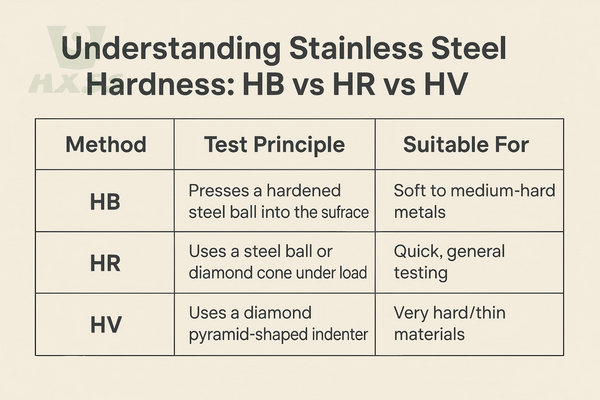
| Method | Full Name | Test Principle | Suitable For | Units |
|---|---|---|---|---|
| HB | Brinell Hardness | Presses a hardened steel or tungsten ball into the surface | Soft to medium-hard metals | HBW |
| HR | Rockwell Hardness | Uses a steel ball or a cone-shaped diamond under load | Quick, general testing | HRC, HRB, etc. |
| HV | Vickers Hardness | Uses a diamond pyramid-shaped indenter | Very hard/thin materials | HV |
Differences Between HB, HR, and HV
1. Brinell Hardness (HB)
Large indentation area, suitable for coarse materials.
Common in structural applications (e.g., stainless steel plates).
Slower test, but more accurate for rough surfaces.
Applications: Stainless steel bars, forged components, heavy equipment.
2. Rockwell Hardness (HR)
Fastest method, often used in manufacturing lines.
Several Rockwell scales (A, B, C) exist based on the indenter and load.
Less destructive than Brinell.
Applications: Stainless steel sheets, coils, and precision parts.
3. Vickers Hardness (HV)
Microhardness testing, suitable for very thin materials and surface coatings.
High accuracy, used in labs or R&D.
Applications: Stainless steel foil, thin strip, high-precision parts.
4. Stainless Steel Hardness Conversion (Reference Only)
Hardness values cannot be converted exactly, but approximate comparisons are commonly used in engineering practice.
| HB | HRB | HRC | HV |
|---|---|---|---|
| 150 | 80 | – | 160 |
| 200 | 90 | 20 | 220 |
| 250 | – | 25 | 270 |
| 300 | – | 32 | 320 |
Note: Hardness conversion tables are for reference only. Final acceptance should always follow the specified test method.
How to Choose the Right Hardness Test?
| Scenario | Recommended Test |
|---|---|
| Thick and heavy components | Brinell (HB) |
| Fast factory testing | Rockwell (HR) |
| Thin materials or microstructure analysis | Vickers (HV) |
Still unsure? Contact Huaxiao Metal for expert guidance on the right stainless steel grade and hardness test method for your project.
Why Hardness Matters in Stainless Steel Procurement
Hardness refers to a material’s resistance to deformation, indentation, scratching, or wear. For stainless steel products, hardness plays a crucial role in:
Wear resistance and surface durability
Machining and cutting performance
Cold forming and bending capability
Fatigue resistance
Product consistency and quality control
In procurement and engineering, hardness is often specified to ensure performance consistency across batches and suppliers. Incorrect hardness selection may lead to premature failure, poor machinability, or excessive tool wear.
At Huaxiao Metal, our stainless steel products come with certified hardness reports so you can trust what you’re buying. We supply a full range of stainless grades like 304, 316, 430, and duplex stainless steels with reliable mechanical properties.
Why Hardness Certification Matters in Stainless Steel Procurement
For international buyers, hardness certification is essential for:
Ensuring material consistency
Meeting project specifications
Passing third-party inspections
Reducing disputes and quality risks
At Huaxiao Metal, we provide:
Mill Test Certificates (MTC / EN 10204 3.1)
Custom hardness testing (HB / HR / HV)
Third-party inspection support upon request
Typical Hardness Ranges for Common Stainless Steel Grades
| Grade | Condition | Hardness Range |
|---|---|---|
| 304 / 304L | Annealed | HRB 70–90 |
| 316 / 316L | Annealed | HRB 70–95 |
| 430 | Annealed | HRB 80–90 |
| 410 | Hardened | HRC 35–45 |
| 420 | Hardened | HRC 48–55 |
Hardness values may vary depending on processing method, thickness, and heat treatment.
Stainless Steel Hardness in Real Applications
Food industry: 304 SS with moderate HRB values for corrosion and shaping.
Automotive: 430 SS with higher HRC for wear resistance.
Chemical industry: 316L SS with HV data for pressure handling.
Why Choose Huaxiao Metal as Your Stainless Steel Supplier?
Wide range of stainless steel grades and forms
Accurate hardness testing and certification
Stable quality control and traceability
Global export experience and fast response
📩 Need stainless steel with specific hardness requirements?
Tell us your application, preferred hardness (HB / HR / HV), and quantity.
Our technical team will provide a professional quotation within 24 hours.
Request Stainless Steel with Specific Hardness Requirements
Looking for custom hardness levels for your stainless steel order? Huaxiao Metal supports both standard and customized mechanical property requirements.
✅ In-stock grades
✅ Mill test certificates
✅ Global delivery
✅ Expert engineering support
👉 Contact Us for a Quote today and get the best stainless steel with verified hardness levels!
FAQ
What hardness test should I request for stainless steel sheets?
Rockwell hardness (HRB) is commonly used for stainless steel sheets and strips.
Can HB, HR, and HV values be converted directly?
No exact conversion exists. Conversion tables provide approximate values only.
Does higher hardness always mean better performance?
Not necessarily. Higher hardness improves wear resistance but may reduce formability.
Can I request a custom hardness range for my order?
Yes. Huaxiao Metal supports customized hardness requirements based on application needs.
Conclusion
Understanding the differences between HB, HR, and HV hardness is key when evaluating stainless steel materials. Each method serves different testing needs and offers unique advantages.
At Huaxiao Metal, we not only supply high-quality stainless steel materials but also provide technical support to help you choose the right product.