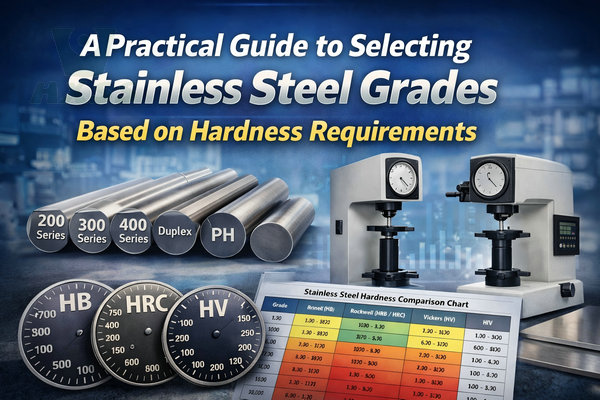
Stainless steel hardness directly affects machinability, wear resistance, forming performance, and production cost.
- Softer grades such as 304 and 316 are ideal for welding and forming
- Harder grades such as 420 and 440C provide superior wear resistance
- Duplex and precipitation-hardening stainless steels offer high strength for industrial applications
Selecting the correct hardness level (measured in HRC, HB, or HV) is critical for ensuring product durability, manufacturability, and cost-efficiency. For buyers, engineers, and procurement professionals, understanding how hardness affects the following factors is essential for making informed purchasing decisions:
- Machining and forming performance
- Wear resistance and fatigue strength
- Tooling requirements and production efficiency
- Material lifespan and maintenance costs
This guide explains how hardness influences stainless steel grade selection, what practical factors should be considered during procurement, and how hardness requirements translate into real-world product specifications.
As a professional stainless steel supplier, Huaxiao Metal supports global procurement projects with stainless steel grade selection, hardness verification, certified Mill Test Certificates (MTC), and customized processing solutions tailored to your industrial requirements.
Why Hardness Matters in Stainless Steel Procurement
Hardness is one of the most important mechanical properties affecting stainless steel performance, manufacturability, and total procurement cost.
Selecting the appropriate hardness level helps balance wear resistance, machining efficiency, product lifespan, and production expenses across different industrial applications.
Wear Resistance
Harder stainless steel grades are better suited for high-friction, high-abrasion, and heavy-duty operating environments where surface wear resistance is critical.
Machinability & Forming
Softer grades allow easier cutting, bending, stamping, and rolling, while higher-hardness materials may require specialized tooling, slower machining speeds, or additional processing costs.
Service Life & Reliability
Proper hardness selection ensures stainless steel components can withstand operational stress, impact, fatigue, and repeated mechanical loading over long-term use.
Cost Optimization
Over-specifying hardness may increase manufacturing complexity and tooling expenses unnecessarily. Selecting the right balance between hardness and application requirements helps optimize total project cost.
By understanding these factors, buyers, engineers, and procurement professionals can reduce material waste, avoid production delays, and improve long-term project reliability.
Hardness and Stainless Steel Grade Selection: Practical Guidelines
Selecting the appropriate stainless steel grade based on hardness requires balancing application requirements, manufacturing processes, and overall cost efficiency.
Consider the Application Environment
Different operating environments require different hardness levels:
- High-wear applications (valves, shafts, cutting tools): Harder grades such as 420 and 440C provide better wear resistance.
- Forming and deep drawing applications (pipes, sheets, kitchen equipment): Softer grades such as 304 and 316 are preferred for better ductility and reduced cracking risk.
- Outdoor and architectural applications: Balanced hardness grades such as 304 and 430 are commonly used for both durability and surface quality.
Match Hardness with Manufacturing Processes
Hardness directly affects manufacturability and production efficiency:
- Machining: Softer stainless steel grades reduce tool wear and improve cutting efficiency.
- Cold forming and stamping: Lower hardness improves formability and reduces the risk of cracking.
- Heat-treated components: Hardness must be controlled to achieve the required strength without sacrificing corrosion resistance.
Optimize Cost vs Performance
Hardness selection has a direct impact on production cost and lifecycle performance:
- Higher hardness grades: Increased tool wear, longer processing time, and higher manufacturing cost, but better wear resistance.
- Softer grades: Easier processing and lower cost, but reduced resistance to abrasion and mechanical stress.
For procurement decisions, the optimal choice depends on balancing operational stress, service life requirements, and total production cost.
Stainless Steel Grade Hardness Chart
| Series | Grade | Condition | Brinell (HB) | Rockwell (HRB/HRC) | Vickers (HV) | Typical Applications |
|---|---|---|---|---|---|---|
| 200 Series Stainless Steel | ||||||
| 200 | 201 | Annealed | 120–150 | HRB 70–85 | 130–160 | Appliances, light corrosion resistance |
| 200 | 202 | Annealed | 130–160 | HRB 75–88 | 140–170 | Kitchen equipment, automotive trim |
| 300 Series Stainless Steel | ||||||
| 300 | 304 | Annealed | 140–190 | HRB 70–95 | 150–200 | Food processing, chemical equipment |
| 300 | 316 | Annealed | 140–190 | HRB 70–95 | 150–200 | Marine, chemical industry |
| 300 | 321 | Annealed | 140–190 | HRB 70–95 | 150–200 | High-temperature applications |
| 400 Series Stainless Steel | ||||||
| 400 | 410 | Annealed | 170–200 | HRB 80–90 | 180–210 | Cutlery, valves |
| 400 | 420 | Hardened | 200–280 | HRC 38–48 | 210–290 | Cutting tools, surgical instruments |
| 400 | 430 | Annealed | 140–180 | HRB 75–88 | 150–200 | Decorative, appliances |
| Duplex Stainless Steel | ||||||
| Duplex | 2205 | Annealed | 290–330 | HRB 95–98 / HRC 25–30 | 300–350 | Chemical, offshore structures |
| Duplex | 2507 | Annealed | 300–350 | HRC 28–32 | 320–360 | Extreme corrosion resistance |
| Precipitation Hardening Stainless Steel Series | ||||||
| PH | 17-4 | Annealed / Solution Treated | 180–220 | HRC 25–35 | 190–240 | Aerospace, pumps, valves |
| PH | 17-4 | H900 Hardened | 440–480 | HRC 40–45 | 450–500 | High-strength, corrosion-resistant parts |
| PH | 17-7 | Solution Treated | 170–200 | HRB 80–90 | 180–210 | Aerospace springs, high-strength components |
| PH | 17-7 | H900 / H1000 Hardened | 400–460 | HRC 38–42 | 420–480 | Heat-treated spring applications |
Hardness Considerations Across Different Stainless Steel Forms
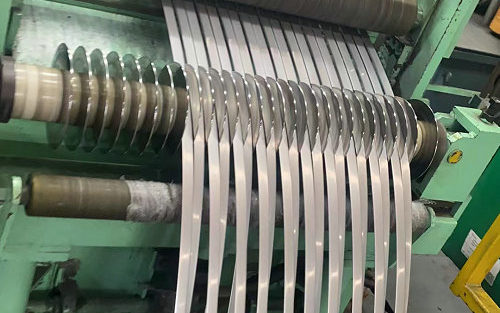
Sheets & Strips
Softer grades are easier to bend and roll.
Used in appliances, automotive panels, and decorative applications.
Bars & Rods
Higher hardness grades are suitable for shafts, fasteners, and high-stress components.
Procurement must consider machining and forming limitations.
Plates & Structural Components
Thick plates often require uniform hardness across thickness.
Important for construction, heavy machinery, and pressure vessels.
Precision Components
High-hardness stainless steels may require specialized machining equipment.
Critical for aerospace, automotive, and medical industries.
Products
Application Scenarios
Different industries require different stainless steel grades based on hardness, corrosion resistance, and forming performance. Selecting the correct grade ensures optimal durability, manufacturability, and cost efficiency.
Chemical Industry
- Recommended Grade: 316L
- Requirement: Requires moderate hardness and excellent corrosion resistance to support the forming of pipes, tanks, and chemical storage equipment.
- Procurement Tip: Always request Mill Test Certificates (MTC) to verify hardness, chemical composition, and corrosion resistance compliance.
Food Processing Industry
- Recommended Grade: 304 / 304L
- Requirement: Balanced hardness for forming kitchen equipment, storage tanks, and hygienic surfaces.
- Procurement Tip: Select grades with good ductility to avoid cracking during bending and forming processes.
Automotive Components
- Recommended Grade: 410 / 420
- Requirement: High hardness and wear resistance for shafts, fasteners, and precision mechanical parts.
- Procurement Tip: Specify heat-treatment condition and required hardness range to ensure machinability and performance consistency.
Architectural Applications
- Recommended Grade: 430
- Requirement: Moderate hardness suitable for decorative panels, structural components, and surface-finish-focused applications.
- Procurement Tip: Consider both hardness and surface finish quality to achieve the desired aesthetic performance.
Buyer’s Checklist: Specifying Hardness for Stainless Steel Procurement
To ensure accurate stainless steel grade selection and cost-effective procurement, buyers should follow a structured hardness specification process.
Define Application Stress and Wear Requirements
Clearly identify mechanical stress levels, wear conditions, and operational environment to determine required hardness performance.
Select Suitable Stainless Steel Grade
Choose appropriate grades based on hardness suitability, corrosion resistance, and application requirements (e.g., 304 for forming, 420 for wear resistance).
Specify Manufacturing Process Constraints
Communicate processing requirements such as bending, machining, stamping, or welding, as these directly affect acceptable hardness levels.
Define Hardness Tolerance Requirements
Specify acceptable hardness range (HB, HRB, HRC, or HV) to ensure consistent material performance and avoid production variation.
Request Mill Test Certificates (MTC)
Always require Mill Test Certificates or third-party inspection reports to verify hardness, chemical composition, and compliance with international standards.
Consult Supplier Technical Support
Work with material suppliers to optimize grade selection based on hardness, cost efficiency, and application performance.
Properly following this procurement checklist helps ensure reliable performance, reduced manufacturing risk, and optimized material cost in stainless steel applications.
FAQ – Stainless Steel Hardness and Grade Selection
How do I choose a stainless steel grade based on hardness?
Consider the application’s wear, forming, and corrosion requirements, then select a grade that matches the needed hardness while balancing cost and machinability.
Can I request custom hardness levels for my order?
Yes. Huaxiao Metal supports customized hardness ranges based on project requirements.
What does hardness mean in stainless steel selection?
Hardness in stainless steel refers to the material’s resistance to deformation, wear, and indentation. It directly affects machinability, durability, and suitability for different industrial applications.
Which stainless steel grades are commonly used for high-hardness applications?
Grades such as 410, 420, and heat-treated 440C are preferred for high-wear components.
How does hardness affect stainless steel performance?
Higher hardness improves wear resistance and strength but may reduce machinability and formability. Lower hardness improves bending, stamping, and welding performance but may reduce wear resistance in heavy-duty applications.
Which stainless steel grades have high hardness?
Among the commonly used industrial grades, martensitic stainless steels like 440C and 420 offer the highest hardness. After appropriate heat treatment (quenching and tempering), 440C can achieve a hardness of up to 58-60 HRC (Rockwell C), making it ideal for bearings, cutting blades, and high-wear components.
Does higher hardness reduce the corrosion resistance of stainless steel?
Generally, yes. To achieve high hardness, grades like 420 and 440C contain higher carbon levels and lower nickel levels. While heat treatment maximizes their mechanical strength and wear resistance, their corrosion resistance is lower than that of austenitic grades like 304 or 316. For both high hardness and high corrosion resistance, precipitation-hardening steels (like 17-4 PH) or Duplex grades are often preferred.
What is the typical hardness of standard 304 and 316 stainless steel?
In their standard annealed (softened) state, 304 and 316 stainless steels have a relatively low hardness, typically around 70-92 HRB (or approx. 150-200 HB). However, they can be significantly hardened through cold working (cold rolling or drawing), which increases their tensile strength and hardness for structural use.
How does material hardness affect stainless steel machining costs?
Harder stainless steel grades (such as martensitic or duplex steels) cause significantly faster tool wear and require slower cutting speeds, which increases machining time and tooling costs. To optimize production costs, procurement professionals should avoid over-specifying hardness if the application environment only requires standard strength.
Can hardness be adjusted through heat treatment?
Yes. Some stainless steel grades, especially martensitic and precipitation-hardening types, can achieve higher hardness through heat treatment processes such as quenching and aging.
Can Huaxiao Metal provide custom hardness testing and mill certificates (MTC)?
Yes, absolutely. Huaxiao Metal ensures all materials undergo strict quality checks. We provide full Mill Test Certificates (MTC) that detail the exact chemical composition and mechanical properties, including HB, HRB/HRC, or HV hardness values. We can also customize the material hardness via professional annealing or heat treatment based on your fabrication needs.
In Conclusion
Selecting the right stainless steel grade based on hardness requirements is essential for balancing performance, manufacturability, and total procurement cost in industrial applications.
Proper hardness selection helps ensure:
Long-term durability and wear resistance.
Efficient machining, forming, and fabrication processes.
Optimized production and tooling costs.
Reliable performance under application-specific conditions.
For engineers and procurement professionals, hardness is not just a material property—it is a key decision factor in overall project efficiency and lifecycle cost control.
Why Choose Huaxiao Metal?
At Huaxiao Metal, we support global stainless steel procurement with:
Full-range stainless steel grades for all major industrial applications.
Hardness testing and official Mill Test Certificate (MTC) support.
Technical consultation for grade selection and performance optimization.
Customized solutions for machining, forming, and corrosion-resistant requirements.
Get in Touch for a Quick Quote
If you are selecting stainless steel grades for your next project, our technical team can help you identify the most suitable material based on your exact hardness, environment, and budget requirements.
📩 Need a certified MTC or a competitive wholesale price? Contact Huaxiao Metal Today for professional guidance and fast, complimentary quotations.