When selecting materials for battery applications, engineers often ask:
Can 430 stainless steel be used in batteries?
The short answer is:
Yes — but only in specific, non-corrosive roles.
In this guide, we’ll explain where 430 stainless steel works, where it fails, and what better alternatives you should consider.
What Is 430 Stainless Steel?
430 stainless steel is a ferritic stainless steel with moderate corrosion resistance and no nickel content
430 stainless steel is a ferritic stainless steel characterized by:
Magnetic properties
Moderate corrosion resistance
Low nickel content (cost advantage)
Good thermal conductivity
These properties make it suitable for cost-sensitive industrial applications
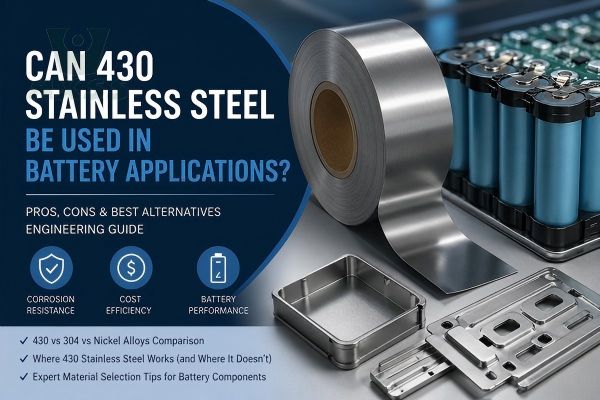
Can 430 Stainless Steel Be Used in Batteries?
Yes — but with limitations
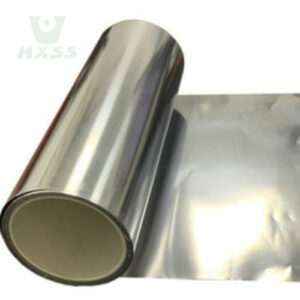
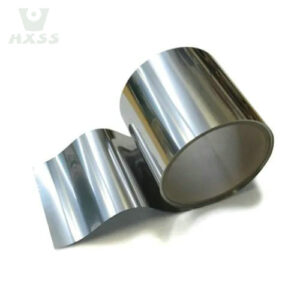
430 stainless steel foil can be used in battery-related components, but not in all parts of a battery system.
Suitable Battery Applications
430 stainless steel foil is suitable for:
- Battery outer casing
- Structural support components
- Non-reactive mechanical parts
- Shielding layers
These applications do not involve direct chemical exposure
Where 430 Stainless Steel Fails
430 is NOT recommended for:
- Electrolyte contact areas
- Electrochemical reaction zones
- High-corrosion battery environments (e.g., lithium-ion internal structures)
Why?
Because 430 has:
- Lower corrosion resistance
- No nickel content
- Reduced chemical stability
This can lead to material degradation and reduced battery life
Stainless Steel vs Nickel vs 430 in Battery Applications
| Material | Corrosion Resistance | Cost | Battery Suitability |
|---|---|---|---|
| 430 Stainless Steel | Medium | Low | Limited use |
| 304 Stainless Steel | High | Medium | Widely used |
| Nickel Alloys | Very High | High | Best performance |
Key Engineering Insight
- 430 → cost-driven structural use
- 304 → balanced general battery use
- Nickel alloys → high-performance / harsh environment
When 430 Stainless Steel Foil Becomes the Right Choice
In battery manufacturing, thin materials are often required for precision components.
In such cases, 430 stainless steel foil is commonly used due to:
- Ultra-thin thickness capability (0.01–0.3mm)
- Good stamping performance
- Cost efficiency
- Stable flatness
This is especially suitable for:
- Battery casings
- Support layers
- Non-corrosive structural parts
Related Product
If you are sourcing materials:
430 Stainless Steel Foil Supplier – Huaxiao Metal
- Precision foil
- Custom thickness
- Stable export quality
How to Choose the Right Material for Battery Applications?
Engineers should evaluate:
Corrosion exposure
Will the material contact electrolyte?
Mechanical function
Structural support or reactive component?
Cost constraints
Is cost optimization a priority?
Battery type
Lithium-ion, solid-state, or hybrid systems?
Material selection directly affects:
- Battery lifespan
- Safety
- Performance efficiency
Expert Recommendation from Huaxiao Metal
Based on industrial experience:
Use 430 stainless steel → for cost-sensitive structural parts
Use 304 stainless steel → for general battery applications
Use nickel alloys → for high-performance environments
Choosing the right material can significantly improve product reliability
FAQ – 430 Stainless Steel Be Used for Battery Applications
Is stainless steel used in batteries?
Yes, stainless steel is widely used in battery casings and structural components.
Why is 430 stainless steel used in batteries?
Because it offers a cost-effective solution for non-corrosive structural applications.
Can 430 stainless steel resist battery chemicals?
No, it has limited resistance to strong electrolytes.
What is the best stainless steel for batteries?
304 stainless steel is more widely used due to better corrosion resistance.