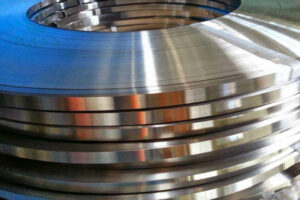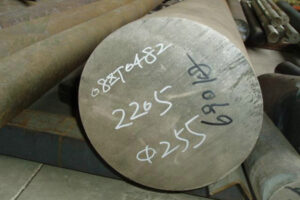
The hygiene requirements of the pharmaceutical and biotechnology industries are relatively high, and the materials used to manufacture processing containers and piping systems must have excellent corrosion resistance and cleanability to ensure the purity and quality of pharmaceuticals. Materials must be able to withstand the temperature, pressure, and aggressive media in production environments as well as in disinfection and cleaning procedures. In addition, the material must have good weldability and meet industry requirements for surface finish.
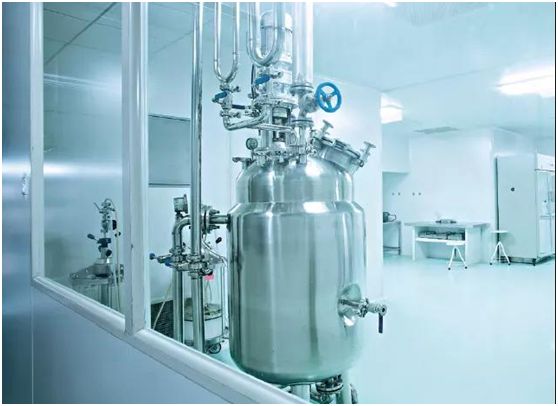
The main manufacturing material for process equipment in the pharmaceutical and biotechnology industries is 316L (UNS S31603, EN1.4404) austenitic stainless steel. The corrosion resistance, weldability, electropolishing properties, and ease of availability of 316L stainless steel make it an ideal material for most pharmaceutical applications.
Although 316L stainless steel performs well in many process environments, users are still improving the performance of 316L stainless steel by carefully selecting the specific chemical composition of 316L stainless steel and improving production processes such as electroslag remelting (ESR).
If the process conditions are too corrosive for 316L stainless steel, users can continue to use 316L stainless steel, but the maintenance cost will increase, or they can switch to 6% molybdenum super austenitic stainless steel with higher alloy composition, such as AL- 6XN® (UNS N08367) or 254SMO® (UNS S31254, EN1.4547). In recent years, the biotechnology industry has recognized the benefits of using 2205 (UNS S32205, EN1.4462) duplex stainless steel for manufacturing equipment.
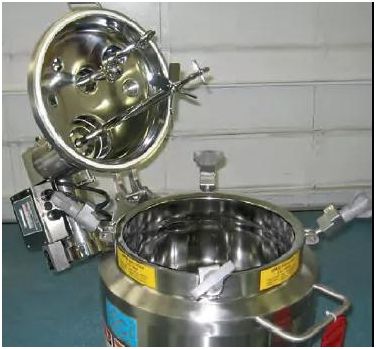
Figure 1 R&D containers for the pharmaceutical industry made of 2205 duplex stainless steel plate with a thickness of 10 and 2205 duplex stainless steel plate with a thickness of 4.8 mm. Surfaces in contact with the product are electropolished to an ASMEBPE – SF4 finish. @Genentech
The metallographic structure of 316L stainless steel includes an austenite phase and a very small amount of ferrite phase, and the austenite phase is stabilized by adding a sufficient amount of nickel to the alloy.
The nickel content of wrought 316L stainless steel is generally 10-11%. The chemical composition of duplex stainless steel has been adjusted so that the microstructure formed contains roughly the same amount of ferrite and austenite phases (Figure 2). microtissue. 2205 duplex stainless steel is formed by reducing the nickel content to about 5% and adjusting the addition of manganese and nitrogen to form about 40-50% ferrite.
The chemical composition of 2205 duplex stainless steel is balanced, and the austenite phase and the ferrite phase have large or equal corrosion resistance.
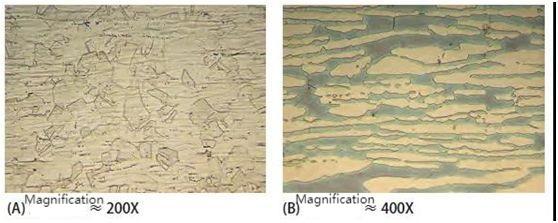
Figure 2 (A) Microstructure of wrought 316L stainless steel showing austenite grains and occasionally visible ferrite strips (B) Microstructure of wrought 2205 duplex stainless steel showing austenite (light phase) Roughly equal in amount to ferrite (dark hue).
The increased nitrogen content of 2205 duplex stainless steel and its fine-grained microstructure give it higher strength than common austenitic stainless steels such as 304L and 316L. Under solution annealing conditions, the yield strength of 2205 duplex stainless steel is about twice that of 316L stainless steel.
Due to its high strength, the allowable stress of 2205 duplex stainless steel can be much higher, depending on the design code used for the manufacture of process equipment. In many applications, the wall thickness can be reduced, resulting in weight savings and cost savings.
Table 1 Comparison of the chemical composition of 316L and 2205 stainless steel based on ASTM A 240 requirements
| Grade | UNS No. | C | Mn | P | S | Si | Cr | Ni | Mo | N |
|---|---|---|---|---|---|---|---|---|---|---|
| 316L | S31603 | 0.03 | 2.00 | 0.045 | 0.030 | 0.75 | 16.0-18.0 | 10.0-14.0 | 2.0-3.0 | 0.10 |
| 2205 | S32205 | 0.03 | 2.00 | 0.030 | 0.020 | 1.00 | 22.0-23.0 | 4.5-6.5 | 3.0-3.5 | 0.14-0.20 |
- Max unless otherwise stated
Table 2 Comparison of mechanical properties of solution annealed dual-grade 316/316L and 2205 duplex stainless steel (according to ASTM A240*)
| Grade | UNS No. | Tensile Strength | Yield Strength | Elongation | Hardness, Max | |||
|---|---|---|---|---|---|---|---|---|
| Ksi | MPa | Ksi | MPa | Brinell | Rockwell | |||
| 316L | S31603 | 75 | 515 | 30 | 205 | 40% | 217 | 95 HRg |
| 2205 | S32205 | 95 | 655 | 65 | 450 | 25% | 293 | 31 HRc |
- Unless otherwise noted, all are minimum 3
- The minimum value of the strong skin of the double-grade 316/316L stainless steel; the minimum steal requirement of the single-grade 316L stainless steel is lower
Corrosive Properties
Pitting Resistance
The most common form of corrosion on stainless steel in pharmaceutical and biotech applications is pitting corrosion in chloride-containing environments. The higher chromium, molybdenum and nitrogen content of 2205 duplex stainless steel achieves pitting and crevice corrosion resistance significantly better than 316L stainless steel. The relative pitting resistance of stainless steel can be determined by measuring the temperature required for pitting to occur (critical pitting temperature) in a 6% ferric chloride standard test solution.
As shown in Figure 3, the critical pitting temperature (CPT) of 2205 duplex stainless steel is between 316L stainless steel and 6% molybdenum super austenitic stainless steel. It should be noted that the CPT data measured in ferric chloride solution can be used to compare the resistance to chloride ion pitting corrosion of materials, but it should not be used to predict the critical pitting temperature of materials in other chloride environments.
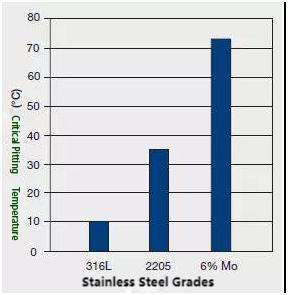
Fig.3 Comparison of critical pitting temperature measured in 6% FeCl3 test solution
Stress Corrosion Cracking
When the temperature is higher than 60°C, under the joint action of tensile stress and chloride ions, 316L stainless steel is prone to cracks. This catastrophic form of corrosion is called chloride stress corrosion cracking (SCC). This corrosion must be considered when selecting materials for hot process fluid conditions. The use of 316 stainless steel in the presence of chloride ions and temperatures of 60°C or above should be avoided. As shown in Figure 4, 2205 duplex stainless steel is resistant to SCC in simple salt solutions up to a temperature of at least 120°C.
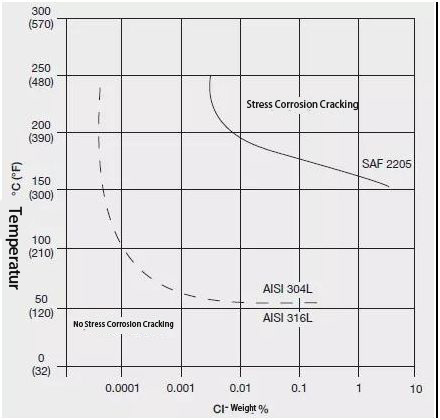
Fig.4 Comparison of the critical value of chloride ion stress corrosion cracking between 316L stainless steel and 2205 duplex stainless steel
Red Rust
Stainless steel exposed to high-purity water may develop thin stains or deposits of rust on the surface, known as red rust (Figure 5). This rust is mainly composed of iron oxide or hydroxide particles and can come in a variety of colors including shades of red, golden yellow, blue, gray and dark brown. The cause of red rust formation is not known, but specific stainless steel grades and surface treatments may affect the formation of red rust.
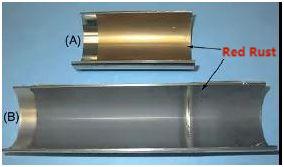
Figure 5. Golden yellow (A) and gray black (B) red rust on the inner wall of the cut stainless steel pipe
In the pharmaceutical and biotech industries, water for injection (WFI) systems are exposed to clean steam and high-purity water environments where red rust is a common occurrence. Components such as distillation units, storage tanks, process vessels, pumps, valves, and piping may be affected.
Because of the potential for product contamination, highly red-rusted material surfaces require costly and time-consuming cleaning operations. Therefore, it is necessary to require candidate materials used in pharmaceuticals and biotechnology to have at least the same red rust resistance as 316L stainless steel.
A systematic investigation of the red rust phenomenon has been carried out on materials including 316L stainless steel and 2205 duplex stainless steel. According to this study, 2205 stainless steel is at least as resistant to red rust as 316L stainless steel.