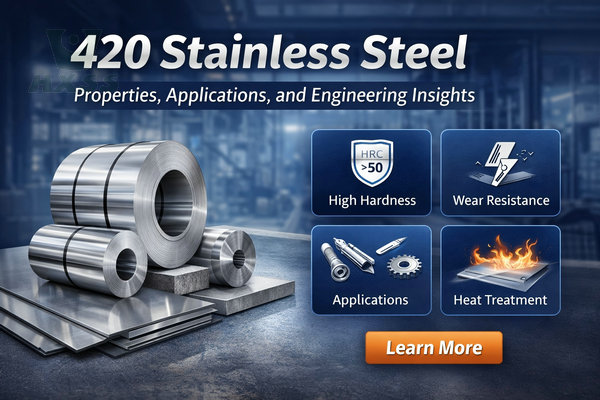
420 stainless steel is a high-carbon martensitic stainless steel widely recognized for its superior hardness, wear resistance, and corrosion performance in industrial applications. It is a preferred material for cutting tools, industrial knives, medical instruments, and precision mechanical parts.
This guide provides a detailed look into 420 stainless steel’s chemical composition, heat treatment, mechanical properties, surface finishes, and real-world applications, including comparisons with 410, 430, and 440C stainless steels. Engineers, designers, and procurement professionals can use this article to make informed material decisions, improve product longevity, and optimize manufacturing processes.
Note: This article focuses on technical insights and practical applications. For supplier and pricing information, visit our dedicated page: 420 Stainless Steel Products – Huaxiao Metal
Chemical Composition and Microstructure
420 stainless steel’s properties stem from its high carbon content and martensitic microstructure.
| Element | Typical Composition (%) | Function |
|---|---|---|
| Carbon (C) | 0.15 – 0.40 | Determines hardness and wear resistance |
| Chromium (Cr) | 12 – 14 | Provides moderate corrosion resistance |
| Manganese (Mn) | ≤1.0 | Improves hardness and strength |
| Silicon (Si) | ≤1.0 | Enhances strength |
| Phosphorus (P) | ≤0.04 | Impurity; minimize for toughness |
| Sulfur (S) | ≤0.03 | Improves machinability |
Microstructure:
Martensitic structure achieved by quenching
Hardenable via heat treatment
Magnetic properties due to martensitic phase
Good dimensional stability after machining and heat treatment
Insight: Higher carbon content enables edge retention and hardness, making 420 ideal for cutting tools and wear parts.
Mechanical Properties
| Property | Value | Notes |
|---|---|---|
| Hardness (HRC) | 50-55 | After quenching and tempering |
| Yield Strength | 450-550 MPa | Depends on heat treatment |
| Tensile Strength | 700-900 MPa | Varies by tempering |
| Elongation | 10-15% | Post-tempering |
| Corrosion Resistance | Moderate | Not as resistant as 304/316 |
| Magnetic | Yes | Due to the martensitic phase |
Key Insight: 420 stainless steel balances high hardness with moderate toughness, making it ideal for industrial and precision tools.
Heat Treatment and Performance
Heat treatment determines the final hardness, toughness, and wear resistance.
| Step | Purpose | Effect |
|---|---|---|
| Annealing | Soften for machining | Lower hardness, easier shaping |
| Quenching (oil/water) | Hardening | Achieves HRC 50-55 |
| Tempering | Reduce brittleness | Balances hardness and toughness |
| Polishing/Finishing | Surface quality | Reduces corrosion risk, improves aesthetics |
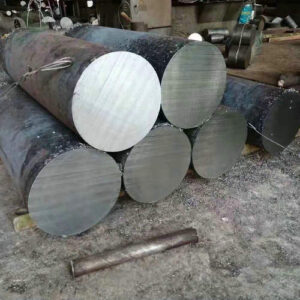
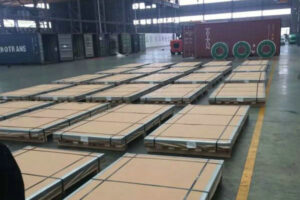
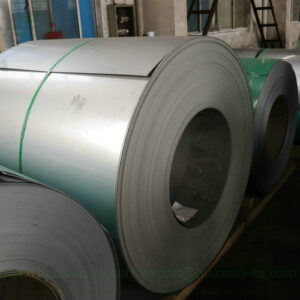
Tip: Industrial clients often order annealed 420 coils or sheets to machine into blades or precision parts before final hardening.
Surface Finishes and Manufacturing Practices
| Finish | Description | Typical Application |
|---|---|---|
| 2B | Cold-rolled, smooth | Industrial sheets, general tooling |
| BA | Bright annealed | Decorative components, medical instruments |
| No.4 | Brushed finish | Knives, visible parts, kitchen equipment |
| Polished | Mirror finish | Surgical tools, high-end blades |
Best Practices:
- Use proper grinding and polishing for cutting tools
- Avoid deep scratches to maintain corrosion resistance
- Ensure dimensional accuracy for precision components
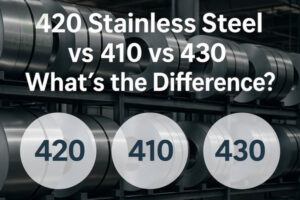
Comparison with 410, 430, and 440C Stainless Steels
| Feature | 410 | 420 | 430 | 440C |
|---|---|---|---|---|
| Carbon Content | Medium | High | Low | Very High |
| Max Hardness (HRC) | 40 | 55 | 30 | 60-65 |
| Wear Resistance | Medium | Excellent | Low | Excellent |
| Corrosion Resistance | Moderate | Moderate | High | Moderate |
| Applications | Fasteners, valve parts | Industrial knives, cutting tools | Decorative panels | High-end cutting tools, surgical blades |
Analysis:
- 420 vs 410: 420 has higher hardness; 410 is easier to weld and slightly cheaper
- 420 vs 430: 420 harder but 430 more corrosion-resistant
- 420 vs 440C: 440C harder and more wear-resistant, but more expensive and harder to machine
Tip: Choose 420 when high hardness + moderate corrosion resistance + cost-efficiency are required.
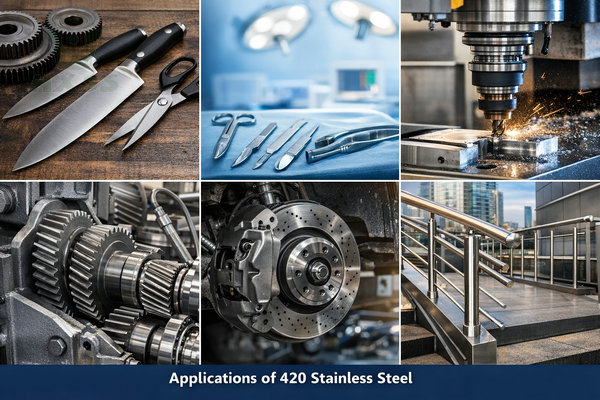
420 Stainless Steel Applications
Industrial Blades & Cutting Tools
Long-lasting sharp edges due to high hardness
Minimal wear in repetitive cutting cycles
Food Processing & Kitchen Equipment
Brushed (No.4) or polished surfaces
Satisfies hygiene and corrosion resistance requirements
Medical Instruments
Polished surfaces for sterilization compliance
Maintains precision and edge retention
Automotive Components
Wear-resistant gears and shafts
Heat-treated 420 ensures dimensional stability and durability
Precision Bearings & Mechanical Parts
Industrial machinery components
Maintains accuracy under high load conditions
Considerations: Choosing 420 Stainless Steel
When choosing 420 stainless steel for engineering applications:
Determine the required hardness → Select the appropriate tempering process
Assess corrosion risk → Use coatings or choose steel with higher chromium content if necessary
Consider machinability → For complex parts, order annealed steel
Plan surface finish → Polishing for medical applications, brushing for industrial applications
Check dimensional tolerances → Pre-machining ensures accuracy
Expert Tip: For cutting tools, heat treatment and surface finish determine their service life and performance more than the raw material itself.
FAQ - 420 Stainless Steel
Why does carbon content affect 420 SS hardness?
Higher carbon forms martensite during quenching, increasing hardness and wear resistance.
How does tempering temperature affect strength and toughness?
Lower tempering maintains hardness but reduces toughness; higher tempering improves toughness but slightly lowers hardness.
Is 420 SS suitable for cryogenic applications?
It can be used at low temperatures, but toughness decreases; for extremely low temps, consider 300 series austenitic stainless steels.
What are the limitations of 420 SS?
Moderate corrosion resistance; not ideal for highly corrosive environments unless coated or surface-treated.
How does 420 SS compare to 440C for high-end tools?
440C achieves higher hardness and wear resistance but is more expensive and difficult to machine; 420 offers better cost-performance for many industrial applications.
For engineers and industrial buyers looking for high-quality 420 stainless steel:
Inquire about custom heat treatment
Request samples for testing
Explore ready stock in coils, sheets, and strips
Explore 420 Stainless Steel Products – Huaxiao Metal