NO.4 vs 2B Stainless Steel is one of the most common comparison topics for buyers sourcing 304 stainless steel sheets for industrial, architectural, and commercial projects. While both finishes are produced from the same base material, their surface characteristics, visual appearance, maintenance requirements, and application scenarios are significantly different.
For many overseas buyers, choosing the wrong surface finish can lead to unnecessary cost increases, aesthetic mismatches, or even project rework. In this guide, we provide a detailed, buyer-focused comparison of NO.4 vs 2B stainless steel sheets, helping you make an informed decision based on real-world applications, export experience, and industry standards.
Whether you are sourcing 18 gauge stainless steel sheets, specifying materials for architectural decoration, or purchasing for industrial fabrication, understanding the difference between NO.4 finish and 2B finish stainless steel is essential.
When selecting 304 stainless steel sheets, the surface finish is just as important as the thickness and material grade. Two of the most common finishes are NO.4 (brushed) and 2B (mill finish). Understanding the differences between these finishes can help you choose the right sheet for your application, whether it’s for architectural, industrial, or food processing projects.
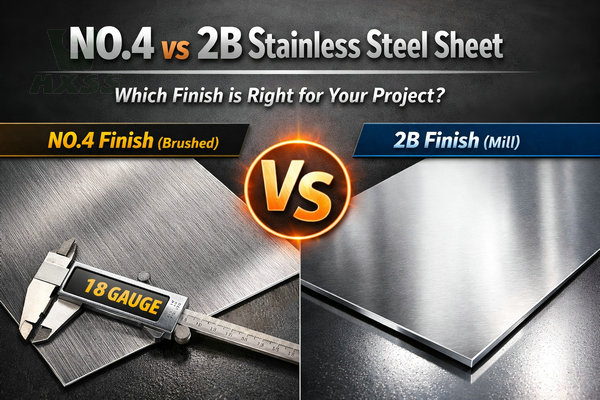
NO.4 vs 2B Stainless Steel Surface Appearance
Surface appearance is usually the first and most noticeable difference when comparing NO.4 vs 2B stainless steel sheets, especially for projects where the material remains visible after installation.
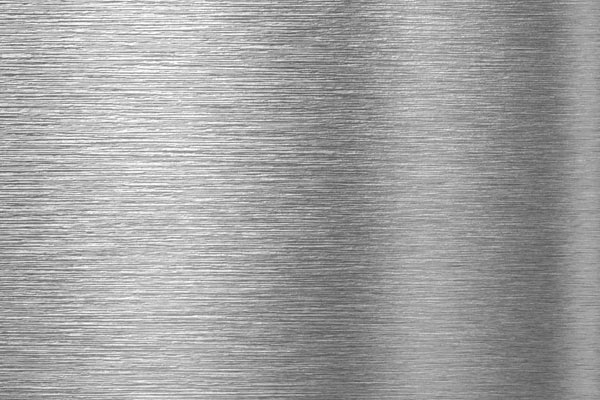
NO.4 Finish:
Also known as brushed finish.
Produces a uniform, satin-like appearance with fine lines.
Ideal for visible installations where aesthetics matter.
Hides scratches and fingerprints better than 2B.
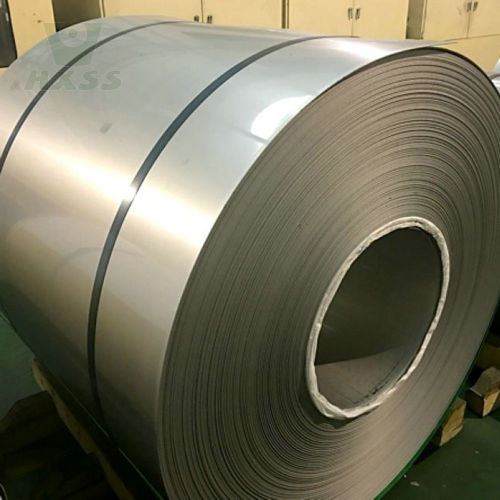
2B Finish:
Also known as mill finish or cold-rolled bright.
Smooth, slightly reflective surface.
Suitable for applications where appearance is less critical.
More prone to showing scratches compared to NO.4.
NO.4 vs 2B Stainless Steel Applications
The choice between NO.4 vs 2B stainless steel often depends on whether the material will be visible, decorative, or purely functional. Below are the most common application scenarios based on real project experience.
| Finish | Typical Applications |
|---|---|
| NO.4 | Elevator panels, kitchen equipment, architectural decoration, interior wall panels, furniture, and commercial fabrication |
| 2B | Tanks, ducts, piping, structural components, industrial fabrication, chemical processing equipment |
NO.4 vs 2B Stainless Steel Cleaning & Maintenance
NO.4 Finish:
Easier to clean and maintain for visible surfaces.
Hides fingerprints, water spots, and minor scratches.
2B Finish:
Smooth surface but shows marks more easily.
Suitable for applications requiring frequent cleaning with minimal aesthetic concern.
NO.4 vs 2B Stainless Steel Corrosion Resistance
When it comes to corrosion resistance, many buyers assume that surface finish plays a major role. In reality, the corrosion performance of NO.4 vs 2B stainless steel sheets is primarily determined by the steel grade rather than the finish.
Both finishes use the same 304 stainless steel grade, so corrosion resistance is equivalent. However, NO.4’s brushed texture may help mask minor surface oxidation or wear in visible areas.
NO.4 vs 2B Stainless Steel Cost & Availability
2B Finish is usually slightly cheaper as it requires less processing.
NO.4 Finish may cost more due to additional polishing but offers aesthetic advantages.
Both finishes are widely available in multiple thicknesses, including 18 gauge, and can be exported globally, including Canada, Mexico, etc.
NO.4 vs 2B Stainless Steel – Quick Buyer Decision Table
To help buyers make faster decisions, the table below summarizes the key differences between NO.4 vs 2B stainless steel sheets from a practical procurement perspective.
| Decision Factor | NO.4 Stainless Steel Sheet | 2B Stainless Steel Sheet |
| Surface appearance | Brushed, satin-like, decorative | Smooth, matte, industrial |
| Visibility after installation | Suitable for visible surfaces | Better for hidden or internal use |
| Scratch & fingerprint visibility | Less noticeable | More noticeable |
| Typical applications | Architecture, elevators, kitchens, decorative panels | Tanks, ducts, fabrication, industrial equipment |
| Maintenance requirements | Easier for visible areas | Simple, but marks show more easily |
| Cost level | Slightly higher due to polishing | More cost-effective |
| Buyer preference | Aesthetic-focused projects | Budget & function-focused projects |
This quick comparison clearly shows why NO.4 finish is preferred for projects where appearance matters, while 2B finish is widely used for functional and industrial applications.
Choosing the Right Stainless Steel Finish
The choice between No. 4 stainless steel and No. 2B stainless steel should be made by comprehensively considering appearance requirements, budget, application environment, and long-term maintenance expectations.
Ask yourself:
Is the sheet visible to users or customers? → NO.4 recommended
Is it purely structural or hidden? → 2B is sufficient
Do you require easier maintenance and scratch concealment? → NO.4 has the edge
Are cost and availability the primary concern? → 2B may be preferred
Huaxiao Metal’s Supply Capabilities
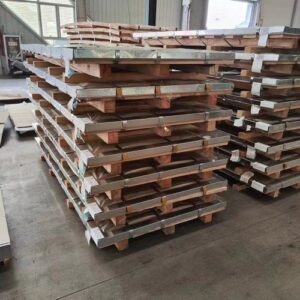
Huaxiao Metal offers 304 stainless steel sheets in various thicknesses, with surface treatments including NO.4 and 2B, and thickness specifications covering 18 gauge. We have successfully exported our products to Canada, Mexico, and Europe, ensuring consistent product quality, precise thickness, and reliable delivery.
Recent Project Case: We exported 18 gauge NO.4 surface-treated 304 stainless steel sheets to Canada, which fully met the customer’s requirements for surface treatment, thickness, and packaging.
FAQ: NO.4 vs 2B Stainless Steel Sheet
Is NO.4 stainless steel better than 2B?
NO.4 is not universally “better” than 2B—it is better for visible applications where appearance matters. If the stainless steel sheet will be exposed after installation, NO.4 finish is usually preferred. For hidden or purely functional parts, 2B is often sufficient and more cost-effective.
Which finish is better for architectural or decorative projects?
For architectural decoration, elevator panels, wall cladding, and interior design, NO.4 stainless steel sheets are strongly recommended due to their brushed, uniform appearance and reduced glare.
Is there a price difference between NO.4 and 2B stainless steel sheets?
Yes. NO.4 finish stainless steel sheets typically cost slightly more than 2B sheets because of the additional polishing process. However, for visible projects, the improved appearance often justifies the price difference.
Does NO.4 or 2B affect corrosion resistance?
No. The corrosion resistance mainly depends on the stainless steel grade (such as 304) rather than the surface finish. Both NO.4 and 2B finishes offer similar corrosion performance when produced from the same material standard.
Which finish is easier to maintain and clean?
NO.4 finish is generally easier to maintain for visible surfaces, as it hides fingerprints, water spots, and minor scratches better than 2B. This makes it popular in public and commercial environments.
Can both NO.4 and 2B finishes be supplied in 18 gauge thickness?
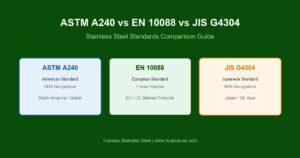
Yes. Both NO.4 and 2B stainless steel sheets are commonly available in 18 gauge, as well as other thicknesses, and can be supplied according to ASTM A240 or equivalent standards.
Conclusion & Inquiry
Choosing the right surface finish depends on your project requirements, balancing aesthetics, maintenance, and cost. For visible applications where a high-quality appearance is needed, NO.4 is ideal. For functional, hidden, or structural applications, 2B is sufficient and cost-effective.
Contact Huaxiao Metal today to request a quote for 304 stainless steel sheets in NO.4 or 2B finish, including 18 gauge or other thicknesses.