When choosing the right stainless steel for your project, it’s crucial to understand the differences between the different grades. The two most commonly compared grades are 304 vs 301 stainless steel. Both are austenitic stainless steels that are widely used in various industries and have excellent corrosion resistance, but they have different mechanical properties, compositions, and make them suitable for different applications.
In this article, we will take an in-depth look at the differences between 301 stainless steel and 304, exploring their composition, strength, durability, mechanical properties, applications, and more. By the end of this article, you will have a clear understanding of which grade is best for your needs.
This article will provide a detailed comparison of 301 and 304 stainless steel, hopefully helping you determine which 301 or 304 stainless steel is better for your needs when purchasing stainless steel.
-
If you need high strength & spring performance → choose 301 stainless steel
-
If you need corrosion resistance & easy processing → choose 304 stainless steel
👉 If you are unsure, Huaxiao Metal can recommend the most cost-effective solution based on your application.
What Is 304 Stainless Steel?
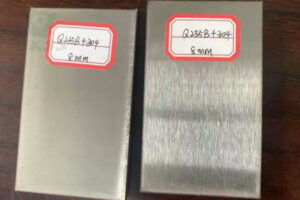
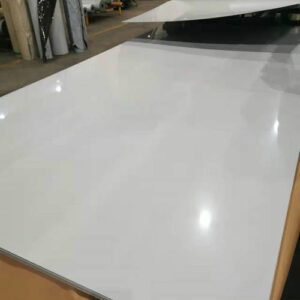
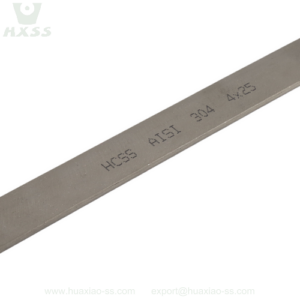
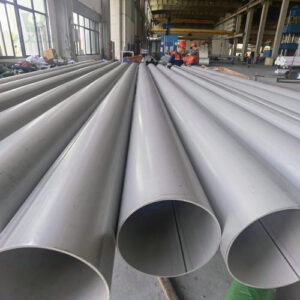
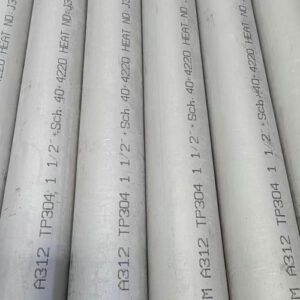
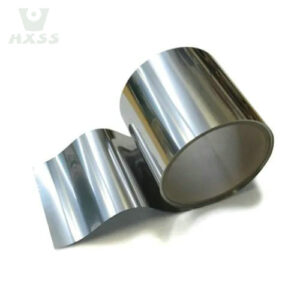
304 stainless steel is arguably the most widely used and versatile grade of stainless steel. Known as the “workhorse” of the industry, it is a non-magnetic, austenitic alloy with a high chromium and nickel content. The typical composition of 304 stainless steel is approximately 18% chromium and 8% nickel (hence its common name, 18/8 stainless steel). This composition provides excellent corrosion resistance, making it suitable for a vast range of applications.
Key Characteristics of 304 Stainless Steel:
-
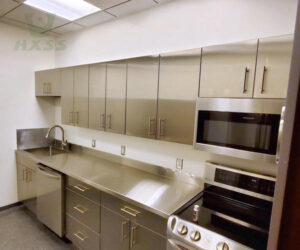
Corrosion Resistance: The high chromium content forms a passive layer on the surface, which protects the steel from rust and corrosion, even in many acidic environments. This makes it ideal for kitchen sinks, food processing equipment, and chemical containers.
-
Weldability: 304 stainless steel has excellent weldability and can be easily welded using most standard fusion methods without the need for post-weld heat treatment.
-
Formability: It exhibits good formability and can be deep drawn, bent, and stamped into complex shapes.
-
Heat Resistance: It maintains good strength and oxidation resistance in temperatures up to 870°C (1,598°F) in intermittent service and 925°C (1,697°F) in continuous service.
-
Applications: Kitchen and food processing equipment, architectural trim, tanks, springs, screws, and hardware.


What Is 301 Stainless Steel?
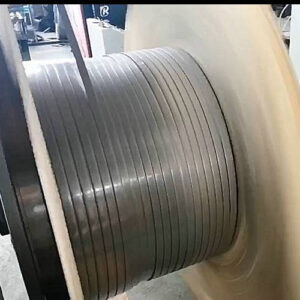
301 stainless steel is a metastable austenitic stainless steel that is also a part of the 300 series. Its typical chemical composition is slightly lower in chromium and nickel than 304 stainless steel, with a higher percentage of carbon. The standard composition for 301 stainless steel is around 17% chromium and 7% nickel.
The key differentiator for 301 stainless steel lies in its work-hardening properties. When it is cold-worked (e.g., rolled, drawn, or bent), its tensile strength and hardness increase dramatically. This unique characteristic makes it a go-to choice for applications requiring high strength and durability.
Key Characteristics of 301 Stainless Steel:
-
High Strength and Hardness: The most significant advantage of 301 stainless steel is its ability to be work-hardened. This process converts the austenitic structure into a martensitic structure, significantly increasing its tensile strength and yield strength.
-
Corrosion Resistance: While it offers good corrosion resistance, it is generally considered less resistant than 304 stainless steel, especially in environments with high chloride or acidic content, due to its lower chromium and nickel content.
-
Weldability: It has good weldability, but the high carbon content can increase the risk of sensitization (carbide precipitation) in the heat-affected zone, which can reduce its corrosion resistance.
-
Applications: Due to its high strength, 301 stainless steel is predominantly used in structural components, springs, clips, fasteners, railcar bodies, and aircraft parts.
304 vs 301 Stainless Steel: The Difference
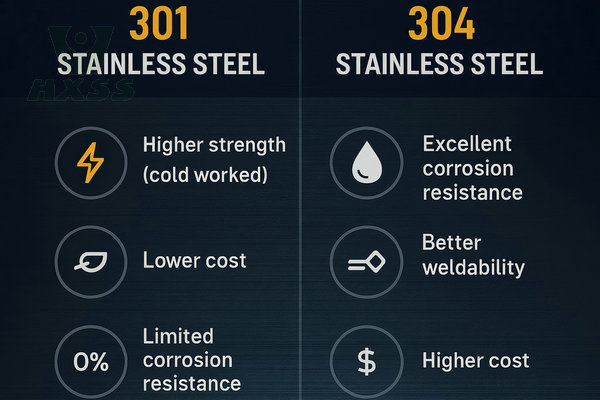
To provide a clear understanding of the difference between 301 and 304 stainless steel, let’s compare them across the most critical metrics.
| Feature | 301 Stainless Steel | 304 Stainless Steel |
| Chemical Composition | ≈ 17% Cr, 7% Ni, higher C | ≈ 18% Cr, 8% Ni, lower C |
| Mechanical Strength | High (especially after cold-working) | Moderate |
| Corrosion Resistance | Good (less than 304) | Excellent |
| Formability | Good (can be work-hardened) | Excellent (deep-drawable) |
| Cost | Generally slightly lower | Generally slightly higher |
| Typical Applications | Springs, clips, structural components, railcars | Kitchenware, tanks, architectural trim, food processing |
When comparing 304 vs 301 stainless steel, it’s essential to consider several factors, including composition, mechanical properties, physical properties, cost, and applications. Each of these aspects plays a crucial role in determining which grade is more suitable for a specific use case.
304 vs 301 Stainless Steel Composition:
The fundamental difference between 304 and 301 lies in nickel and carbon content, which directly impacts corrosion resistance and mechanical strength.
| Element | 304 Stainless Steel | 301 Stainless Steel |
|---|---|---|
| Cr | 18-20% | 16-18% |
| Ni | 8-10.5% | 6-8% |
| C | ≤ 0.08% | ≤ 0.15% |
| Mn | ≤ 2% | ≤ 2% |
| Si | ≤ 1% | ≤ 1% |
| P | ≤ 0.045% | ≤ 0.045% |
| S | ≤ 0.03% | ≤ 0.03% |
301 gains strength from higher carbon content, while 304 delivers better corrosion resistance and weldability due to higher nickel and lower carbon.
304 vs 301 Stainless Steel Equivalent Grades:
| Standard | 304 Stainless Steel | 301 Stainless Steel |
| UNS | S30400 | S30100 |
| EN | 1.4301 | 1.4310 |
| JIS | SUS 304 | SUS 301 |
| ASTM | 304 | 301 |
304 vs 301 Stainless Steel: Mechanical Properties
301 stainless steel is specifically designed for work hardening, meaning its strength increases significantly after cold deformation.
| Property | 304 Stainless Steel | 301 Stainless Steel |
| Tensile Strength (MPa) | 515-720 | 515-1380 |
| Yield Strength (MPa) | 205 | 275-960 |
| Hardness (Brinell) | ≤ 201 | ≤ 235 |
| Elongation (%) | 40 | 40-60 |
304 vs 301 Stainless Steel: Physical Properties
| Property | 304 Stainless Steel | 301 Stainless Steel |
| Density (g/cm³) | 7.93 | 7.86 |
| Melting Point (°C) | 1400-1450 | 1400-1450 |
| Thermal Conductivity (W/m·K) | 16.2 | 16.3 |
| Electrical Resistivity (Ω·m) | 7.2×10⁻⁷ | 7.1×10⁻⁷ |
304 vs 301 Stainless Steel Cost:
Ex-factory unit price: 304 is usually more expensive
Under the same specifications, the ex-factory price of raw materials of 304 stainless steel is usually higher than that of 301 stainless steel. The root cause lies in its higher Ni content. Nickel is an expensive alloying element that gives 304 excellent corrosion resistance and stability.
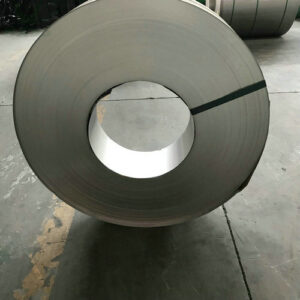
But why do customers feel that 301 is more expensive than 304 stainless steel when they purchase and inquire about the price? That’s because 301 steel is mostly delivered in cold-rolled hard form, and the processing cost is higher. The common form of 301 steel is cold-rolled hard strip or semi-hard, 1/2H, 3/4H, FH, and other states of coils. Compared with the general annealed soft material of 304, 301 has higher production difficulty and process control requirements, so the price of 301 is higher than 304.
If you need more detailed 304 SS or 301 SS pricing, please contact us directly.
304 vs 301 Stainless Steel Application:
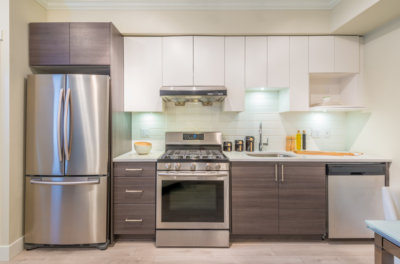
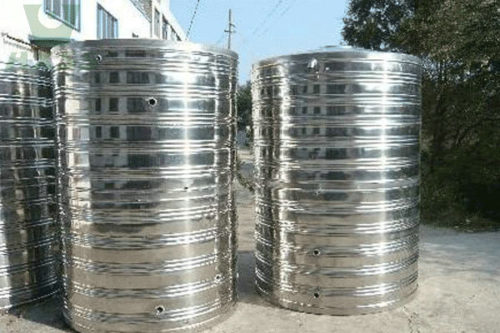
304 Stainless Steel Applications:
-
-
Food processing equipment
-
Medical and pharmaceutical devices
-
Structural and architectural components
-
Heat exchangers and pressure vessels
-
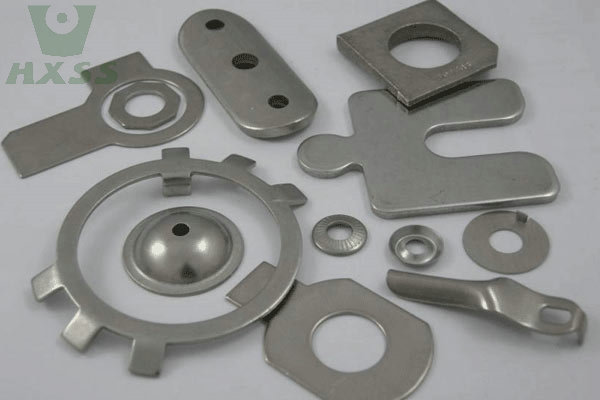
301 Stainless Steel Applications:
-
-
Automotive trim and springs
-
Aerospace components
-
Conveyor belts and industrial fasteners
-
High-strength structural parts
-
304 vs 301 Stainless Steel Other Difference:
Corrosion Resistance
- 304 performs better in humid, chemical, and outdoor environments
- 301 is more prone to corrosion (especially after welding)
👉 Because 304 has higher chromium & nickel content
✔ Conclusion:
- Outdoor / marine → 304
- Indoor / dry → 301
Strength & Hardness
-
- 301 can reach extremely high strength after cold working
- 304 remains more ductile and stable
👉 301 tensile strength can be significantly higher than 304 under deformation conditions
✔ Conclusion:
-
- Structural parts → 301
- General fabrication → 304
Weldability: 304 is easier to weld compared to 301.
Flexibility: 301 is more flexible and suitable for applications requiring high elasticity.
Work Hardening Ability
- 301 becomes harder when cold rolled
- Used in spring and elastic components
✔ Examples:
-
- Springs
- Clips
- Fasteners
Advantages & Disadvantages: 301 vs 304 Stainless Steel
Advantages of 301 Stainless Steel
-
Higher strength after cold working
-
Good wear resistance
-
Slightly lower cost
Disadvantages of 301 Stainless Steel
-
Lower corrosion resistance than 304
-
Less suitable for food-grade or medical applications
Advantages of 304 Stainless Steel
-
Excellent corrosion resistance
-
Easy to weld and fabricate
-
Hygienic and safe for food & medical use
Disadvantages of 304 Stainless Steel
-
Higher initial cost
-
Lower strength compared to work-hardened 301
304 vs 301 Stainless Steel: Which is Better?
Choosing 304 or 301 is never a simple question of “who is better”, but a strategic choice of “who is more suitable”. The right material selection can save you a lot of procurement and processing costs while ensuring product quality.
Ultimately, the choice between 301 and 304 stainless steel is not a simple material replacement, but a strategic decision based on application priorities. This decision can be simplified into the following two directions:
Invest in “reliability” and choose 304 stainless steel: If your product has strict requirements for corrosion resistance (such as outdoor, humid, food contact), or requires complex deep drawing and bending, then 304 stainless steel is a better choice. It sacrifices some strength in exchange for excellent long-term stability, processing, and safety. From a life cycle perspective, this is the most cost-effective solution, which can save you from huge losses caused by corrosion or processing failure.
Invest in “high performance” and choose 301 stainless steel: If your product pursues extreme strength, hardness, or elasticity (such as springs, high-strength structural parts), 301 stainless steel is an unparalleled choice. Its cost-effectiveness is not reflected in the unit price of raw materials, but in that after it is strengthened by cold working, it allows you to use thinner and lighter materials to achieve the design strength, thereby significantly reducing the total weight of materials and procurement costs overall.
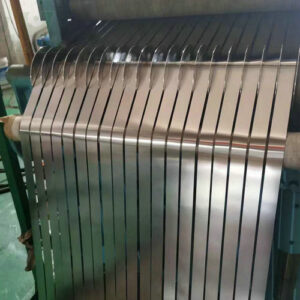
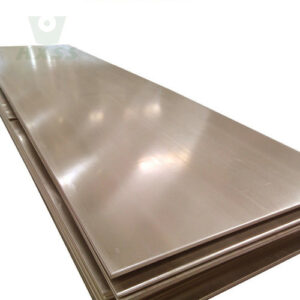
At Huaxiao Metal, we are not only a material supplier but also a partner for the success of your project. We can provide both grades in various forms, including 301 stainless steel strips and 304 stainless steel sheets, our team of experts has rich industry experience and can provide you with the most professional and cost-effective material solutions based on your specific working conditions, performance requirements, and cost budget.
Don’t hesitate! Contact us now for a free consultation and competitive quotation.
Why Source from Huaxiao Metal?
As a leading supplier of stainless steel in China, Huaxiao Metal provides:
-
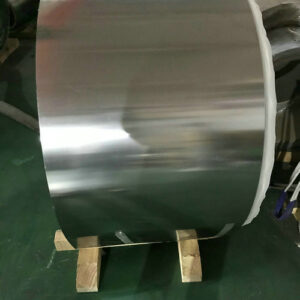
Large Stock: Immediate delivery for 304 and 301 cold-rolled coils/sheets.
-
Custom Processing: Precision slitting, polishing (No.4, HL, Mirror), and PVC coating.
-
Quality Assurance: Full MTC (Mill Test Certificate) according to ASTM, JIS, and EN standards.
Looking for the best price for your next project?
Don’t let material selection slow you down. Contact our engineering team for free technical advice and a highly competitive quote within 12 hours.
FAQ: 301 vs 304 Stainless Steel
Is 304 stainless steel better than 301 stainless steel?
Neither grade is inherently “better” than the other; they are simply designed for different purposes. 304 stainless steel is superior for corrosion resistance and formability, while 301 stainless steel is superior for strength and work-hardening properties. The “better” choice depends entirely on the specific requirements of your application.
Can I use 301 stainless steel for kitchen utensils?
While it is technically possible, 304 stainless steel is the industry standard for kitchen utensils and food processing equipment. Its superior corrosion resistance to food acids and ease of cleaning make it the preferred and safer option.
Which is better for outdoor use, 301 or 304 stainless steel?
304 stainless steel is better suited for outdoor use due to its superior corrosion resistance.
Is 301 stainless steel stronger than 304?
Yes. 301 offers higher tensile strength, especially after cold working.
Does 301 stainless steel rust faster than 304?
Yes. 304 is more resistant to rust and chemical corrosion, especially in high-moisture or chloride environments.
My parts need to be very strong, should I choose 301?
In most cases, yes. 301 can achieve extremely high hardness and strength through cold working, making it an excellent choice for making high-strength parts. But please note that this also means that it is more difficult to machine and shape.
What is the difference between 304 and 301 when welding?
The welding performance of 304 is very excellent, and the weld area can still maintain good corrosion resistance. After welding, the corrosion resistance of the weld area of 301 will decrease. For high-demand occasions, post-weld heat treatment may be required, which increases the process and cost.
Can I use 301 instead of 304 to make tableware to reduce costs?
Strongly not recommended. Although it may seem fine in the short term, the corrosion resistance of 301 is not enough to resist the acid, alkali, and salt in food, and long-term use may cause health risks and rust problems.
Which stainless steel is more cost-effective?
301 is cheaper upfront, but 304 may be more cost-effective long-term in corrosive environments.
Which is more magnetic?
Both are non-magnetic in the annealed state. However, 301 becomes significantly more magnetic after cold working compared to 304.
Conclusion: 301 vs 304 Stainless Steel
In conclusion, both 304 vs 301 stainless steel are excellent materials with unique properties that make them suitable for different applications. Understanding the differences between 304 vs 301 stainless steel, including their composition, mechanical properties, and applications, is crucial for making an informed decision. Whether you choose 304 or 301 stainless steel will depend on your specific project requirements and the conditions in which the material will be used.
By carefully considering the factors discussed in this article, you can select the right stainless steel grade for your needs, ensuring optimal performance and longevity for your project.
Understanding the differences between SS 304 vs 301 Stainless Steel is essential to making an informed decision. While 304 offers better corrosion resistance and weldability, 301 offers superior strength and cost advantages. Both materials offer unique advantages, so the choice depends on the specific requirements of your application.
Huaxiao Metal offers both 301 stainless steel and 304 stainless steel products, with global shipping and competitive pricing. Contact us today for a free quote and expert guidance on selecting the right grade for your application.