
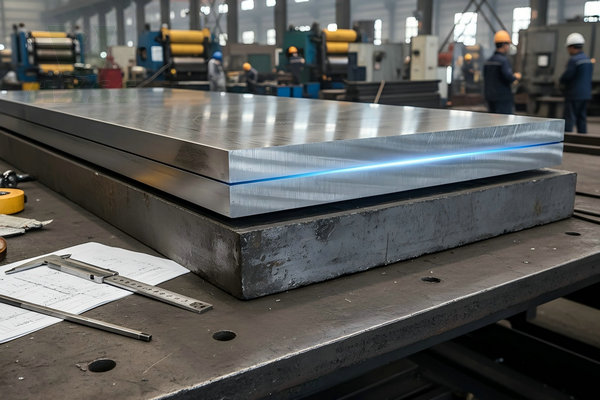
The ss clad plate is a composite plate steel plate formed by combining a carbon steel base layer and a stainless steel cladding layer. Its main feature is that carbon steel and stainless steel form a strong metallurgical combination, which can be processed by hot pressing, cold bending, cutting, welding, etc., and has good process performance. The base material of the stainless steel clad plate can use various ordinary carbon steels and special steels such as Q235B, Q245R, Q345B, Q345R, and so on.
Various grades of stainless steel, such as 304, 316L, 321, and duplex stainless steel, can be used as the coating material. The material and thickness can be freely combined to meet the needs of different users. Stainless steel composite plates have been widely used in the petroleum, chemical, salt, water conservancy, and electric power industries. As a resource-saving product, stainless steel clad plate reduces the consumption of precious metals and greatly reduces the project cost. To achieve the perfect combination of low cost and high performance, there are good social benefits.

How is the Ss Clad Plate Produced?
How is a stainless steel clad plate produced? There are two main methods for the industrial production of stainless steel clad plates, explosive clad and hot rolled clad. The production process of the explosive clad plate is to overlap the stainless steel plate on the carbon steel substrate, and the stainless steel plate and the carbon steel substrate are separated by a certain distance with a cushion.
Explosives are spread flat on the stainless steel plate, and the energy of the explosion makes the stainless steel plate hit the carbon steel substrate at high speed, generating high temperature and high pressure so that the interface of the two materials can be solid-phase welded. Ideally, the shear strength per square millimeter of the interface can reach 400 MPa. The hot-rolled composite plate process is made by rolling the carbon steel base plate and the stainless steel plate in a physically pure state under high vacuum conditions. In the rolling process, the two metals diffuse to achieve complete metallurgical bonding.
Of course, to improve the wetting effect of the composite interface and increase the bonding strength, a series of technical measures must be taken in the physical and chemical treatment of the interface. The above two composite board manufacturing methods are according to the GB/T-8165-1977 national standard. This standard is not equivalent to the Japanese JISG3601-1990 standard, and the main technical indicators are the same or higher than the Japanese standard.
What are the Technical Characteristics of the Explosive Clad Plate and Hot-Rolled Clad Plate?
So what are the technical characteristics of explosive clad and hot-rolled clad plates? Let me talk about the characteristics of explosive compounding:
1. Because explosive compounding is cold processed, it can produce many kinds of metal compound plates in addition to stainless steel clad plates, such as titanium, copper, aluminum, and so on.
2. Explosive compounding can produce stainless steel compound plates with a total thickness of several hundred millimeters, such as large bases and tube plates. However, it is unsuitable for producing thinner-clad steel plates with a total thickness of less than 10mm. The three-explosion compound uses the energy production of explosives, which will cause vibration, noise, and smoke pollution to the environment.
However, the equipment investment is small, and there are hundreds of domestic explosive production plants. Due to the limitations of weather and other process conditions, the production efficiency of the explosive compounds is low.
Comparison Table:
| Feature | Explosion Bonding | Hot Rolling |
|---|---|---|
| Bond Strength | Very High | High |
| Plate Thickness | Up to 200mm | Typically <100mm |
| Surface Uniformity | Excellent | Good |
| Cost | Higher | Lower |
Let’s talk about the Characteristics of the Hot-Rolling Composite Process:
1. It uses a large-scale medium plate rolling mill and a hot tandem mill for production, so the production efficiency is high and the supply speed is fast. The product format is large and the thickness can be freely combined. Stainless steel cladding thickness over 0.5mm can be produced. But the investment is large, so there are fewer manufacturers.
2. Due to the limitation of the rolling steel compression ratio, hot rolling production cannot produce composite steel plates with a thickness of more than 50mm, and it is not convenient to produce various small batches, circular composite plates, and other special-shaped composite plates. Advantages of hot-rolled composite panels 6, 8, and 10mm thin-gauge composite panels. Under hot continuous rolling conditions, it can produce composite coils, reduce production costs, and meet more user needs.
3. Under current technical conditions, the hot rolling process cannot directly produce titanium, copper, aluminum, and other non-ferrous metal composite plates.
Stainless Steel Composite Panels Applications in Engineering Design
Stainless steel composite plates, with their excellent cost-effectiveness, have become the preferred material in heavy industries such as petroleum, chemical, power, and environmental protection.
Application Scenario 1: Petroleum Refining and Chemical Containers
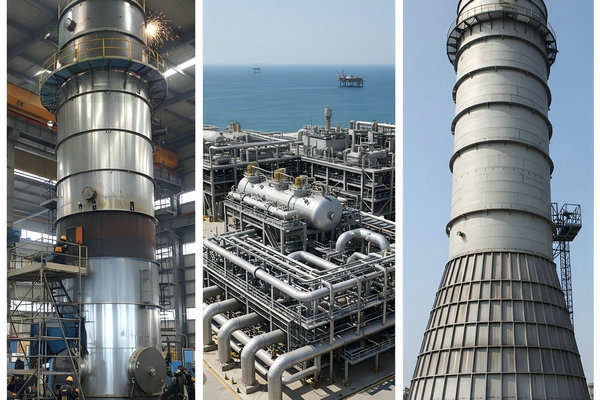
In the petrochemical industry, reactors, towers, heat exchangers, storage tanks, and other equipment often need to withstand high temperatures, high pressures, and highly corrosive media (such as sulfides and chloride ions).
Material Selection Points: The interior is typically clad with 316L or 304 stainless steel composite plates to resist acid and alkali corrosion; the base material is pressure vessel steel such as Q245R/Q345R to meet high pressure and safety regulations.
Value Proposition: Using composite plates instead of pure stainless steel can save up to 30% in material costs for large-scale chemical projects.
Application Scenario 2: Seawater Desalination and Marine Engineering (Utilizing 316L/Duplex Stainless Steel)
Seawater desalination equipment, offshore platforms, and coastal power plants face the threat of high-concentration chloride ion corrosion.
Material Selection Considerations: Chloride ion environments require higher corrosion resistance; therefore, 316L or duplex stainless steel is often chosen as the cladding material. Duplex stainless steel composite plates are particularly suitable for applications requiring both high strength and high corrosion resistance.
Value Proposition: Duplex stainless steel composite plates offer high strength and light weight, helping to reduce the structural weight of marine equipment while providing a longer service life.
Application Scenario 3: Power Plant Desulfurization and Nuclear Energy (Utilizing High-Thickness Composite Plates)
In wet desulfurization (FGD) units and nuclear power plant equipment, ultra-large dimensions and ultra-high thickness corrosion-resistant materials are often required.
Material Selection Considerations: Desulfurization towers need to resist acid corrosion, and nuclear power pressure vessels need to resist complex media and meet high safety standards. Explosive composite plates, due to their ability to be produced in thicknesses of hundreds of millimeters, are ideal for manufacturing these large, critical structural components.
Value Proposition: Ensures that the material properties of critical components meet the stringent requirements of nuclear-grade or ultra-large equipment, while avoiding the enormous costs of pure stainless steel.
Quick Inquiry: Are you looking for a high-performance stainless steel composite plate supplier for your project? Contact Huaxiao Metal now, and we will provide you with a cost comparison of exploded composite and hot-rolled composite plates, as well as professional material selection advice to help you optimize your project budget.
Why Choose Huaxiao Metal for Stainless Steel Clad Plates?
Huaxiao Metal has been a trusted supplier and manufacturer of stainless steel and composite plates for over a decade.
Our Advantages:
Extensive Stock & Fast Delivery: Large inventory ensures rapid response to inquiries.
High-Quality Assurance: All plates come with MTC/MTR certificates; third-party inspection available.
Expert Technical Support: Guidance on material selection, thickness, and design for specific engineering requirements.
Global Export Experience: Serving clients in petrochemical, power, water treatment, and offshore industries worldwide.
How to Select the Right Clad Plate for Your Project
Determine Cladding Material: Select stainless steel grade based on corrosion environment (e.g., 304, 316, Duplex).
Select Base Material: Choose a carbon steel grade for the required strength and load-bearing.
Decide Plate Thickness: Consider engineering load, corrosion allowance, and bonding method.
Review Manufacturing Method: Explosion bonding for thick/high-strength plates; hot rolling for standard plates.
Verify Certifications: Ensure all plates comply with ASTM, JIS, or GB/T standards.
In Conclusion
In summary, the two very different production processes have their characteristics and exist and develop at the same time to meet the diverse needs of different users. The explosive rolling method is a combination of the foregoing two processes, and will not be repeated.
Stainless steel clad plates have the characteristics of various carbon steels and stainless steel and are welcomed by users with their excellent performance-to-price ratio and have broad market prospects. But what’s interesting is that since the 1950s, after more than half a century of ups and downs in the development process, many people still don’t know it. More people have not used it. It should be said that the market for stainless steel composite panels is far from entering a mature period and is still in the development process. The exploration and efforts of scientific and technological workers to build a resource-saving society will never stop.
Contact Huaxiao Metal for Pricing & Stock
Maximize your project’s efficiency with our high-performance, cost-effective stainless steel clad plates. Contact Huaxiao Metal today to:
Get detailed technical specifications
Confirm available stock and thickness
Receive a fast, competitive quotation