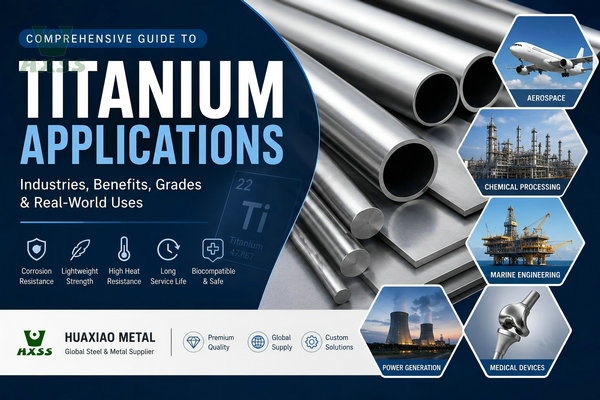
Titanium is one of the most valuable engineering metals used in modern industry. Known for its excellent corrosion resistance, high strength-to-weight ratio, and long service life, titanium alloys has become the preferred material for demanding applications where conventional metals may fail.
From chemical processing plants and seawater desalination systems to aerospace components and medical devices, titanium helps manufacturers improve equipment reliability, reduce maintenance costs, and extend operating life in harsh environments.
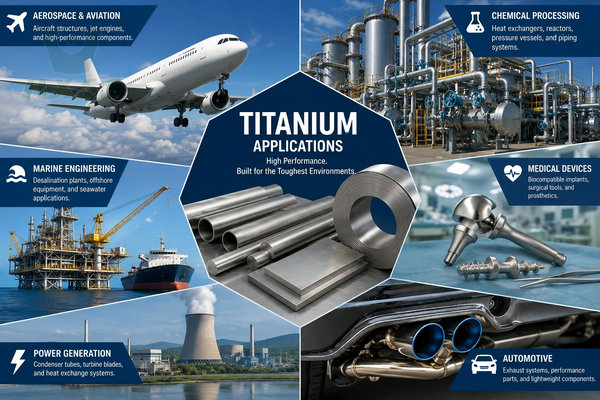
As industries continue to pursue lightweight, durable, and corrosion-resistant materials, the demand for titanium products continues to grow worldwide. Today, titanium sheets, plates, tubes, bars, and coils are widely used across sectors such as aerospace, marine engineering, power generation, chemical processing, automotive manufacturing, and healthcare.
In this guide, we explore the most common applications of titanium, compare its advantages with other engineering materials, explain popular titanium grades, and help buyers choose the right titanium products for specific industrial requirements.
Why Is Titanium Widely Used in Industry?
Titanium has become an essential material because it combines several advantages that are difficult to achieve with conventional metals.
Excellent Corrosion Resistance
Titanium naturally forms a stable oxide film on its surface, protecting it from corrosion in aggressive environments such as:
- Seawater
- Chloride solutions
- Acidic media
- Industrial chemicals
- Desalination systems
High Strength-to-Weight Ratio
Titanium is approximately 40% lighter than steel while maintaining excellent mechanical strength. This makes it ideal for applications where reducing weight is critical.
Outstanding Heat Resistance
Titanium maintains its structural integrity at elevated temperatures and performs reliably in demanding thermal environments.
Long Service Life
Titanium components often last significantly longer than conventional metal alternatives, reducing maintenance costs and replacement frequency.
Biocompatibility
Titanium is highly compatible with the human body, making it the preferred material for medical implants and surgical devices.
Top Applications of Titanium Across Industries
1. Aerospace Industry
The aerospace sector is one of the largest consumers of titanium materials.
Titanium is used extensively in:
- Aircraft structures
- Jet engine components
- Landing gear systems
- Fasteners
- Airframe assemblies
- Spacecraft structures
The combination of lightweight performance and high strength allows aircraft manufacturers to improve fuel efficiency while maintaining structural reliability.
Benefits include:
- Weight reduction
- Improved fuel economy
- Excellent fatigue resistance
- Superior corrosion resistance
2. Chemical Processing Industry
Titanium has become a preferred material in chemical plants because of its ability to resist corrosion from aggressive chemicals.
Typical applications include:
- Heat exchangers
- Pressure vessels
- Storage tanks
- Reactors
- Pipelines
- Condensers
Chemical manufacturers often choose titanium to reduce downtime and increase equipment lifespan.
Common industries include:
- Petrochemicals
- Fertilizer production
- Chlor-alkali plants
- Acid processing facilities
3. Marine and Offshore Industry
Titanium performs exceptionally well in seawater environments.
Unlike many metals that experience rapid corrosion, titanium can withstand long-term exposure to saltwater with minimal degradation.
Marine applications include:
- Shipbuilding components
- Offshore platforms
- Desalination plants
- Seawater cooling systems
- Subsea equipment
- Marine heat exchangers
Its superior resistance to seawater corrosion significantly reduces maintenance requirements.
4. Power Generation Industry
Power plants require materials capable of operating in high-temperature and corrosive environments.
Titanium is commonly used in:
- Steam condensers
- Cooling systems
- Heat exchangers
- Turbine auxiliary equipment
- Nuclear power facilities
Titanium equipment helps improve operational efficiency and extends service life in power generation facilities.
5. Medical Industry
Titanium is widely recognized as one of the safest metals for medical applications.
Its biocompatibility allows it to integrate well with human tissue without causing harmful reactions.
Medical applications include:
- Orthopedic implants
- Dental implants
- Bone fixation devices
- Joint replacement systems
- Surgical instruments
Titanium’s lightweight nature and excellent strength make it ideal for long-term implantation.
6. Automotive Industry
Automotive manufacturers use titanium to reduce vehicle weight while improving performance.
Common applications include:
- Exhaust systems
- Racing components
- Suspension springs
- Engine valves
- Performance vehicle parts
Titanium helps improve acceleration, fuel efficiency, and overall vehicle performance.
7. Energy and Renewable Energy Industry
Titanium is increasingly used in renewable energy systems due to its durability and corrosion resistance.
Applications include:
- Solar energy equipment
- Geothermal systems
- Hydrogen production facilities
- Offshore wind energy infrastructure
As the global energy transition accelerates, demand for titanium materials continues to grow.
Titanium Grades and Their Applications
Different titanium grades are designed for specific industrial requirements.
Grade 1 Titanium
Characteristics:
- Excellent corrosion resistance
- High ductility
- Good formability
Applications:
- Chemical processing equipment
- Heat exchangers
- Marine environments
Grade 2 Titanium
Characteristics:
- Most widely used commercial pure titanium grade
- Excellent balance of strength and corrosion resistance
Applications:
- Industrial equipment
- Desalination plants
- Pressure vessels
- Piping systems
Grade 5 Titanium (Ti-6Al-4V)
Characteristics:
- High strength
- Excellent fatigue resistance
- Superior mechanical performance
Applications:
- Aerospace components
- Medical implants
- High-performance engineering parts
Titanium vs Stainless Steel
Many buyers compare titanium and stainless steel when selecting materials for industrial projects.
| Property | Titanium | Stainless Steel |
|---|---|---|
| Weight | Much Lighter | Heavier |
| Corrosion Resistance | Excellent | Very Good |
| Strength-to-Weight Ratio | Excellent | Moderate |
| Service Life | Longer in Harsh Environments | Good |
| Cost | Higher | Lower |
| Marine Applications | Excellent | Good |
| Chemical Processing | Excellent | Good |
When to Choose Titanium
Titanium is often the better choice when:
- Corrosion resistance is critical
- Weight reduction is important
- Long-term operating costs matter
- Equipment operates in seawater environments
- High-performance applications are required
When to Choose Stainless Steel
Stainless steel may be more suitable when:
- Budget is the primary concern
- Corrosion conditions are moderate
- High-volume production is required
Common Titanium Products Available for Industrial Projects
Titanium is supplied in various product forms to meet different engineering requirements.
Common titanium products include:
Titanium Sheet
Used for:
- Chemical equipment
- Fabrication projects
- Aerospace components
Titanium Plate
Used for:
- Pressure vessels
- Industrial machinery
- Structural applications
Titanium Coil
Used for:
- Continuous processing operations
- Manufacturing applications
Titanium Tube and Pipe
Used for:
- Heat exchangers
- Condensers
- Fluid transportation systems
Titanium Bar and Rod
Used for:
- Machined components
- Fasteners
- Structural parts
Titanium Wire
Used for:
- Welding applications
- Medical devices
- Precision manufacturing
Why Global Buyers Choose Huaxiao Metal
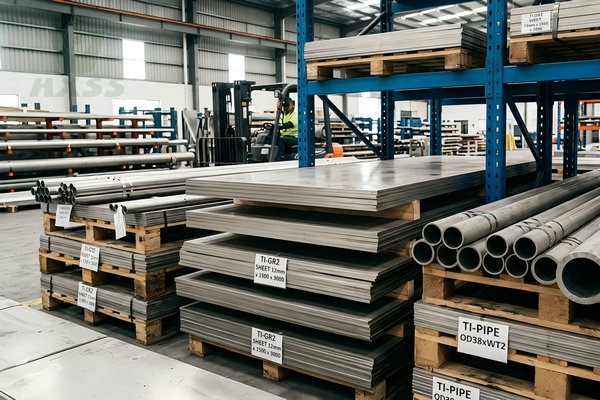
Huaxiao Metal supplies high-quality titanium products for customers worldwide.
Our advantages include:
- Comprehensive titanium product range
- International quality standards
- Custom sizes and specifications
- Competitive factory-direct pricing
- Global export experience
- Fast response and technical support
Whether you require titanium sheets, plates, tubes, bars, or customized titanium products, our team can provide reliable solutions for your project.
Request a Titanium Material Solution
Selecting the correct titanium grade and product form is critical to project performance and cost control.
If you are looking for titanium materials for chemical processing, marine engineering, aerospace, medical, or industrial applications, contact Huaxiao Metal for professional support and customized quotations.
Our technical team can help you choose the most suitable titanium products based on your operating environment, mechanical requirements, and budget.
FAQ About Titanium Applications
What is titanium mainly used for?
Titanium is primarily used in aerospace, chemical processing, marine engineering, medical devices, power generation, and automotive industries.
Why is titanium used in chemical plants?
Titanium offers outstanding corrosion resistance against many aggressive chemicals, making it ideal for heat exchangers, reactors, and storage tanks.
Is titanium stronger than stainless steel?
Titanium generally provides a better strength-to-weight ratio than stainless steel, making it stronger relative to its weight.
Is titanium resistant to seawater?
Yes. Titanium has exceptional resistance to seawater corrosion and is widely used in marine environments.
What is the most commonly used titanium grade?
Grade 2 titanium is the most widely used commercial pure titanium grade for industrial applications.
Is titanium expensive?
Titanium is generally more expensive than stainless steel, but its longer service life and lower maintenance costs can reduce total ownership costs.
Can titanium replace stainless steel?
In many highly corrosive or weight-sensitive applications, titanium can be an excellent alternative to stainless steel.
What industries use the most titanium?
The largest consumers of titanium include aerospace, chemical processing, marine engineering, power generation, medical, and automotive industries.