When choosing corrosion-resistant stainless steel, 316L is usually the first choice for engineers. However, when facing more severe chemical environments, especially those containing chlorides or strong acidic media, you need a stronger material – SUS 317L stainless steel (UNS S31703).
As an “enhanced version” of 316L, 317L provides better resistance to pitting and stress corrosion cracking. This article will give you a comprehensive analysis of the characteristics, advantages, and application scenarios of SUS 317L, and answer common questions you may encounter.

What is SUS 317L stainless steel?
317L stainless steel is a low-carbon, molybdenum-bearing austenitic stainless steel. As a high-alloy variant of 316L, it is designed to offer enhanced resistance to a wider range of corrosive media, particularly sulfuric acid, acetic acid, and other chlorides.
The “L” in its designation stands for “low carbon,” which makes it highly resistant to sensitization (carbide precipitation) during welding. This characteristic is crucial for maintaining its corrosion resistance in welded joints.
SUS 317L stainless steel Data Sheet
1. Summary
304L steel is added with Mo (3~4%), which has better resistance to pitting corrosion and stress corrosion cracking.
2. Features
1) The cold-rolled product has good gloss and a beautiful appearance;
2) Mo content is higher than 316L, so its resistance to pitting corrosion and stress corrosion cracking is better than 316L;
3) Compared with 316L, it has higher ductility, compressive strength, and high-temperature resistance.
4) It has good welding performance, usually, no annealing treatment is required after welding;
5) Non-magnetic in solid solution;
6) Because the content of Ni and Mo is higher, the price is higher than that of 316L stainless steel.
3. Scope of Application
Due to its robust performance, 317L stainless steel is the material of choice for demanding industrial applications, including:
Chemical and petrochemical equipment
Pulp and paper processing
Textile and food processing equipment
Power generation plants (flue gas desulfurization systems)
Marine and offshore environments
4. UNS S31703 Chemical composition (JIS G 4305-2005) (wt%)
The key difference between 317L and other common stainless steels lies in its higher molybdenum and chromium content, which significantly improves resistance to pitting and crevice corrosion.
Chemical composition | C | Si | Mn | P | S | Cr | Ni | Mo |
Standard | £0.03 | £1.00 | £2.00 | £0.045 | £0.030 | 18.0~20.0 | 11.0~15.0 | 3.0~4.0 |
General | 0.020 | 0.6 | 1.0 | 0.025 | 0.003 | 18.40 | 11.2 | 3.2 |
5. Performance (JIS G 4305-2005)
Distinguish | Mechanical properties | |||
Ys (Mpa) | Ts (Mpa) | El (%) | Hv | |
| Standard | ≥ 175 | ≥ 480 | ≥ 40 | ≤ 200 |
General | 320 | 620 | 48 | 165 |
6. Physical properties
Density (g/cm3) | Magnetic | Specific heat 250C (J/kg.0C) | Thermal conductivity 1000C(W/m. 0C) | Thermal expansion rate 20~1000C (10-6/0C) |
7.98 | None | 486 | 14.4 | 16.5 |
7. Heat treatment
Melting point: 1375~14000°C;
Solution treatment: 1010~11500 °C Rapid cooling.
8. Use status
Annealing and solid solution state
No. 1, 2B, No. 0.4, HL and other surface conditions.
9. Matters needing attention
Pay attention to avoiding copper or zinc pollution during welding, which may cause brittle fracture in the weld and its vicinity.
Core Comparison: SUS 317L vs. 316L vs. 304
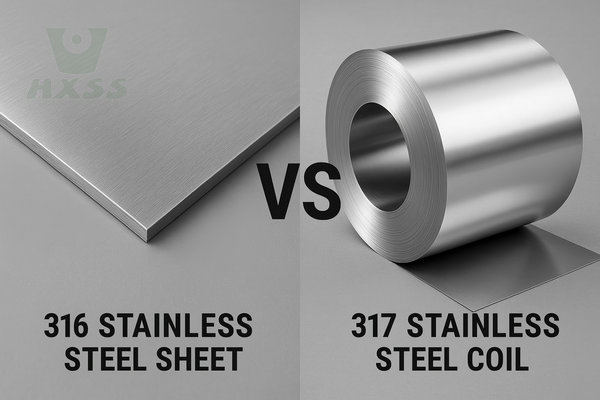
Choosing between these three grades can be complex, but it boils down to balancing cost with performance requirements. This table provides a quick overview.
| Grade | 304 Stainless Steel | 316L Stainless Steel | 317L Stainless Steel |
| Corrosion Resistance | Good | Better | Best |
| Molybdenum Content | 0% | 2.0-3.0% | 3.0-4.0% |
| Relative Cost | Low | Medium | High |
| Typical Use | Everyday kitchenware, food equipment | Food processing, mild marine environments | Chemical plants, paper mills, offshore equipment |
FAQ
Is SUS 317L magnetic?
SUS 317L is an austenitic stainless steel and is generally non-magnetic in the annealed state. However, after severe cold working (such as drawing, stamping), it may produce slight magnetism.
How is the weldability of SUS 317L?
The weldability of 317L is very good. Due to its low carbon characteristics (“L” grade), it is not prone to intergranular corrosion (sensitization) when welding, and post-weld annealing is usually not required. It is recommended to use matching 317L welding consumables (such as ER317L) for welding.
What is the difference between 317 and 317L?
The standard carbon content of 317 (UNS S31700) can be up to 0.08%, while the carbon content of 317L (UNS S31703) is limited to less than 0.03%. For thick-section parts that need to be welded, 317L is strongly recommended to avoid corrosion problems in the heat-affected zone of the weld.
How much more expensive is SUS 317L than 316L?
Since 317L contains more precious alloying elements such as nickel and molybdenum, its raw material cost is usually higher than 316L. The specific price difference varies with market fluctuations and procurement specifications. Although the initial investment is higher, the longer service life and lower maintenance cost of 317L in highly corrosive environments often bring better long-term economic benefits.
What is the main difference between SUS 317L and 316L?
The main difference is the molybdenum (Mo) content. The Mo content of 316L is usually 2-3%, while the Mo content of 317L is 3-4%. This difference makes 317L significantly better than 316L in resisting chloride pitting and crevice corrosion. If you expect your working environment to be very corrosive, 317L is a safer choice.
Can 317L be used in fresh water applications?
While 317L provides excellent resistance, it is generally over-engineered and more costly than necessary for fresh water or less corrosive applications. 304 or 316L would be a more cost-effective choice in these scenarios.
Exclusive Case Study: Solving a Corrosion Challenge
A major chemical plant approached us with a recurring problem: their standard 316L stainless steel heat exchangers were failing prematurely due to corrosion from a sulfuric acid solution. The constant maintenance and downtime were causing significant financial losses.
After a thorough material analysis, our engineers recommended replacing the heat exchanger components with SUS 317L stainless steel. Its superior resistance to sulfuric acid ensured the new parts would withstand the aggressive environment for decades, not just years. The initial investment in a higher-grade material was quickly recouped through reduced maintenance costs and zero production downtime.
Sourcing High-Quality SUS 317L Stainless Steel
At Huaxiao Metal, we specialize in providing specialty stainless steel materials that meet your most demanding requirements. We stock 317L stainless steel in a variety of forms, including plates, coils, tubes, bars, and profiles, and offer custom processing services.
Ready to upgrade the material for your project?