Stainless steel is a widely used metallic material when we talk about materials used in fabrication and construction. The unique properties of stainless steel make it commonly used in industries such as construction, automotive, chemical, manufacturing, and medical equipment. There are many types and grades of stainless steel, two of the common types are 304 vs 409 stainless steel.
While both types of stainless steel are highly corrosion-resistant and robust, they differ in their chemical composition, physical properties, and application areas. This article will discuss the differences, advantages and disadvantages, and application scenarios of 304 vs 409 stainless steel to help readers better understand these two stainless steel materials so that they can choose the appropriate material according to specific needs.
👉 Choose 304 for corrosion resistance and longevity
👉 Choose 409 for automotive or industrial exhaust systems where cost is critical
Huaxiao Metal supplies both 304 and 409 stainless steel with factory-direct pricing and fast global delivery.
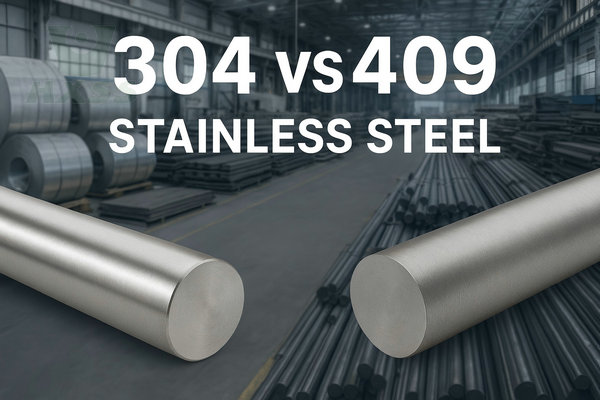
Overview of 304 and 409 Stainless Steel
What is 304 Stainless Steel?
304 stainless steel, also known as AISI 304, is an austenitic chromium-nickel stainless steel containing 18% chromium and 8% nickel. It offers excellent corrosion resistance, outstanding formability, and great welding properties.
It is one of the most commonly used stainless steels for kitchen equipment, food processing, architecture, and chemical containers.
Learn more about our China 304L/304 Stainless Steel supply, specifications, and prices.
What is 409 Stainless Steel?
409 stainless steel is a ferritic stainless steel containing 11% chromium with the addition of titanium for stabilization. It provides moderate corrosion resistance and good high-temperature strength, making it ideal for automotive exhaust systems and industrial applications where heat and oxidation resistance are key.
Explore our China 409L/409 Stainless Steel products and get the latest factory pricing.
Equivalent Grade Comparison Table of 304 vs 409 Stainless Steel
| Standard | 304 Stainless Steel Equivalent | 409 Stainless Steel Equivalent |
|---|---|---|
| China (GB) | 06Cr19Ni10 / 0Cr18Ni9 | 06Cr11Ti / 0Cr11Ti |
| USA (ASTM / AISI) | 304 | 409 |
| EU (EN / DIN) | X5CrNi18-10 (EN 1.4301) | X6CrTi12 (EN 1.4512) |
| Japan (JIS) | SUS304 | SUS409 |
| UK (BS) | 304S15 / 304S31 | 409S19 |
| France (AFNOR) | Z7CN18-09 | Z6CT12 |
| Russia (GOST) | 08Х18Н10 / 12Х18Н10Т | 08Х13 / 12Х11Т |
| ISO | X5CrNi18-10 | X6CrTi12 |
Huaxiao Metal supplies both 304L/304 Stainless Steel and 409L/409 Stainless Steel in coils, sheets, and strips according to ASTM, EN, JIS, and GB standards.
We provide material certificates, cutting service, and export packaging, ensuring your purchase fully meets international specifications.
Price Comparison (2026)
| Grade | Price/ton (USD) | Notes |
|---|---|---|
| 304 | $2,000 – $2,800 | General corrosion resistance |
| 409 | $1,200 – $2,000 | Automotive exhaust, low nickel |
Why is 409 cheaper than 304?
A: 409 contains little or no nickel, reducing cost.
Looking for the latest 304 or 409 stainless steel prices? Contact Huaxiao Metal for factory-direct quotes and bulk discounts.
304 VS 409 Stainless Steel: Chemical Composition and Physical Properties
304 stainless steel is one of the most common types of stainless steel and is widely used in the manufacturing and construction industries due to its excellent corrosion resistance, heat resistance, and ease of processing.
Chemical Composition
| Grades | C | Si | Mn | Cr | Ni | S | P | N |
|---|---|---|---|---|---|---|---|---|
| 304 | ≤0.08 | ≤0.75 | ≤2.0 | 18.0~20.0 | 8.0~10.5 | ≤0.03 | ≤0.045 | ≤0.1 |
| 409 | ≤0.08 | ≤1.0 | ≤1.0 | 10.5~11.7 | 0.5 Max | ≤0.03 | ≤0.045 | – |
409 stainless steel is a low-alloy steel that contains less chromium than 304 stainless steel.
Physical Properties
The physical properties of 304 stainless steel include a density of 7.93g/cm³, a melting point of 1400-1450°C, a thermal expansion coefficient of 17.2μm/m·°C, a thermal conductivity of 16.2 W/m·K, and a resistivity of 72 μΩ·cm.
The physical properties of 409 stainless steel include a density of 7.73g/cm³, a melting point of 1405°C, a thermal expansion coefficient of 11.2μm/m·°C, a thermal conductivity of 26 W/m·K, and a resistivity of 63 μΩ·cm.
Mechanical Properties
Property | 304 Stainless Steel | 409 Stainless Steel |
|---|---|---|
Tensile Strength | ≥520 MPa | ≥380 MPa |
Yield Strength | ≥205 MPa | ≥170 MPa |
Elongation | ≥40% | ≥20% |
Hardness (HB) | ≤201 | ≤170 |
304 stainless steel provides higher strength and ductility, making it more suitable for forming, bending, and structural applications.
304 and 409 Stainless Steel: Advantages and Disadvantages
Advantages and disadvantages: 304 stainless steel has good corrosion resistance and heat resistance, and is easy to process and form. Due to its high nickel content, it has high strength and durability. In addition, 304 stainless steel has good oxidation resistance and corrosion resistance and performs well for general corrosive media, such as atmosphere, freshwater, seawater, alkali, etc. The disadvantage is that in the strong oxidizing acid medium containing chloride ions, 304 stainless steel is prone to pitting corrosion and intergranular corrosion. At this time, it is recommended to choose materials with better corrosion resistance.
Advantages and disadvantages: The main advantage of 409 stainless steel is that it has good heat resistance and corrosion resistance, and it has good corrosion resistance to heat and chemical reaction media. In addition, 409 stainless steel has higher strength and ductility, so it is more durable in application. The disadvantage is that its corrosion resistance is slightly inferior to that of 304 stainless steel, so its application in strongly corrosive media such as strong acid, strong alkali, and chloride will be limited.
304 VS 409 Stainless Steel: Main Application Fields
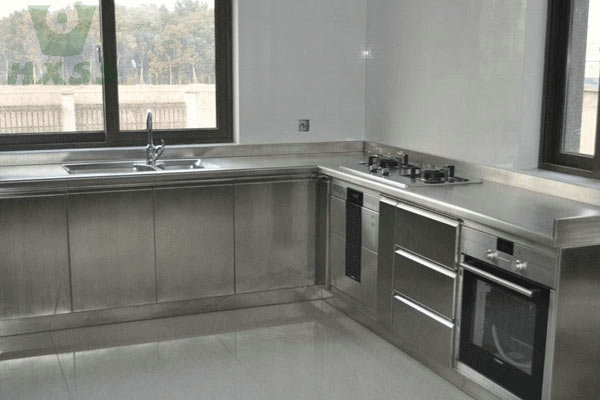
Main application fields: 304 stainless steel is suitable for a wide range of application fields, including food processing, chemical equipment, pharmaceutical equipment, medical equipment, automobiles, architectural decoration, and other fields. It is widely used in the food industry and medical equipment due to its ease of cleaning and maintenance. In the field of construction and decoration, 304 stainless steel is widely used in interior decoration, railings, door handles, kitchen utensils, sinks, etc.
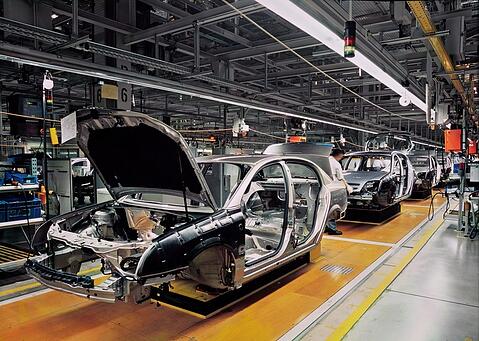
Main application fields: 409 stainless steel is widely used in automobile, manufacturing, and construction fields. Due to its good high-temperature resistance, 409 stainless steel is widely used in automobile exhaust systems. In addition, due to its high strength and good processing performance, 409 stainless steel is also used in various parts and structures in manufacturing and construction, such as chimneys, radiators, stoves, ovens, etc.
Application fields 304 stainless steel is widely used in food, pharmaceutical, chemical, and construction fields. 409 stainless steel is mainly used in automotive, manufacturing, and construction fields, especially in automotive exhaust systems.
In short, 304 stainless steel and 409 stainless steel have their own advantages and disadvantages, and the appropriate material should be selected according to specific application requirements. If you need stainless steel with stronger corrosion resistance, it is recommended to choose 304 stainless steel; if you need stainless steel with higher temperature resistance and strength, 409 stainless steel may be more suitable
304 VS 409 Stainless Steel: Comparative Analysis
304 stainless steel and 409 stainless steel are two common stainless steel materials. They are different in chemical composition, physical properties, advantages and disadvantages, and application fields. The following will compare and analyze them:
Chemical composition The main composition of 304 stainless steel is 18% to 20% chromium, 8% to 10.5% nickel, a small amount of carbon, manganese, and silicon, and other elements. The main components of 409 stainless steel are 10.5% to 11.75% chromium, a small amount of titanium, copper and aluminum, and other elements. Compared with 304 stainless steel, 409 stainless steel has a lower nickel content.
Physical properties 304 stainless steel has a density of 7.93g/cm³, a melting point of 1400°C, a linear expansion coefficient of 17.2μm/m·°C, a thermal conductivity of 16.2 W/m·K, and a resistivity of 72 μΩ·cm. The density of 409 stainless steel is 7.73g/cm³, the melting point is 1405℃, the linear expansion coefficient is 11.2μm/m·℃, the thermal conductivity is 26 W/m·K, and the resistivity is 63 μΩ·cm. It can be seen that the density and thermal conductivity of the two stainless sheets of steel are different.
Advantages and disadvantages The advantages of 304 stainless steel are good corrosion resistance, toughness, and high-temperature resistance, and easy processing and cleaning. However, its cost is high, its strength is relatively low, and problems such as oxidation and embrittlement may occur at high temperatures. The advantage of 409 stainless steel is that it has good high-temperature resistance and strength, and is suitable for the medium of heat and chemical reactions. The disadvantage is that the corrosion resistance is relatively low, and corrosion may occur in media such as strong acids, strong alkalis, and chloride.
Corrosion and Oxidation Resistance
304 stainless steel offers excellent resistance to corrosion in a wide range of environments, including acids and chlorides. It performs well in outdoor and marine atmospheres.
409 stainless steel, though resistant to oxidation and exhaust gases, can corrode more quickly in humid or saltwater environments.
If your application is exposed to moisture, chemicals, or salty air, 304 stainless steel is the better choice. For cost-sensitive or high-temperature applications such as automotive exhausts, 409 stainless steel is sufficient.
Heat Resistance and Temperature Performance
409 stainless steel can withstand continuous exposure to temperatures up to 675°C, making it ideal for exhaust systems.
304 stainless steel performs well up to 870°C, suitable for boilers, heat exchangers, and furnace components.
Weldability and Fabrication
Both grades are weldable using standard techniques. However, 304 stainless steel offers superior weldability and post-weld corrosion resistance.
409 stainless steel may require post-weld annealing to prevent brittleness and improve corrosion resistance.
Huaxiao Metal provides professional cutting, forming, polishing, and welding services for both grades to match your industrial requirements.
Not sure which material fits your project? Huaxiao Metal engineers will recommend the best grade based on your application.
304 and 409 Stainless Steel: Application Advice
Based on the above comparative analysis, we can draw the following application suggestions:
1. For occasions that require good corrosion resistance, such as food, pharmaceutical, and chemical fields, it is recommended to choose 304 stainless steel.
2. For occasions that require good high-temperature resistance and strength, such as automotive, manufacturing, and construction fields, it is recommended to choose 409 stainless steel.
3. If you need a material with good corrosion resistance and good high-temperature resistance at the same time, you can consider choosing 316 stainless steel. 316 stainless steel contains 2% to 3% molybdenum. Compared with 304 and 409 stainless steel, its performance in corrosion, wear resistance, and high temperature is better.
4. For occasions that require higher strength, it is recommended to choose other high-strength stainless steel, such as –174PH stainless steel, 15-5PH stainless steel, etc.
5. When choosing stainless steel materials, factors such as economy, processability, environmental impact, and reliability should also be considered.
In short, in practical applications, we need to choose appropriate stainless steel materials according to different needs and situations, so as to ensure that the performance and cost of the selected materials meet our needs to the greatest extent.
Chemical composition The main composition of 304 stainless steel is 18% to 20% chromium, 8% to 10.5% nickel, a small amount of carbon, manganese, and silicon, and other elements. The main components of 409 stainless steel are 10.5% to 11.75% chromium, a small amount of titanium, copper and aluminum, and other elements. Compared with 304 stainless steel, 409 stainless steel has a lower nickel content.
Physical properties 304 stainless steel has a density of 7.93g/cm³, a melting point of 1400°C, a linear expansion coefficient of 17.2μm/m·°C, a thermal conductivity of 16.2 W/m·K, and a resistivity of 72 μΩ·cm. The density of 409 stainless steel is 7.73g/cm³, the melting point is 1405℃, the linear expansion coefficient is 11.2μm/m·℃, the thermal conductivity is 26 W/m·K, and the resistivity is 63 μΩ·cm. It can be seen that the density and thermal conductivity of the two stainless sheets of steel are different.
Advantages and disadvantages The advantages of 304 stainless steel are good corrosion resistance, toughness, and high-temperature resistance, and easy processing and cleaning. However, its cost is high, its strength is relatively low, and problems such as oxidation and embrittlement may occur at high temperatures. The advantage of 409 stainless steel is that it has good high-temperature resistance and strength, and is suitable for the medium of heat and chemical reactions. The disadvantage is that the corrosion resistance is relatively low, and corrosion may occur in media such as strong acids, strong alkalis, and chloride.
304 vs 409 Stainless Steel: Quick Summary Table
| Feature | 304 Stainless Steel | 409 Stainless Steel |
|---|---|---|
| Type | Austenitic | Ferritic |
| Corrosion Resistance | Excellent | Moderate |
| Strength | High | Medium |
| Heat Resistance | Very Good | Good |
| Weldability | Excellent | Moderate |
| Magnetic | Non-magnetic | Slightly Magnetic |
| Cost | Higher | Lower |
| Ideal Use | Food, Chemical, Construction | Automotive, Industrial |
Which Should You Choose?
Choose 304 stainless steel if:
You need high corrosion resistance.
Your product is for kitchen, medical, or marine applications.
Long lifespan and aesthetics matter more than cost.
Choose 409 stainless steel if:
You are manufacturing exhaust systems, mufflers, or heat shields.
Cost efficiency is a priority.
Your application involves high temperatures but low humidity.
Huaxiao Metal’s engineering team can help you choose the right grade based on your design, environment, and budget.
FAQ — 304 vs 409 Stainless Steel
What is the biggest difference between 304 and 409 stainless steel?
The biggest difference lies in their chemical composition and the resulting corrosion resistance. 304 is an austenitic steel containing high nickel (at least 8%), offering excellent corrosion resistance and suitable for most environments. 409 is a ferritic steel with very low nickel content, making it an economical choice. It relies primarily on chromium (approximately 10.5%-11.7%) for basic corrosion resistance and is suitable for heat-resistant, mildly corrosive environments.
Is 409 stainless steel magnetic? Is 304 stainless steel magnetic?
409 stainless steel is magnetic. It has a ferritic structure and is a ferromagnetic material. 304 stainless steel in the annealed state has an austenitic structure and is generally non-magnetic. It should be noted that after cold working, bending, or stretching, the austenite in 304 stainless steel may partially transform into martensite, resulting in slight weak magnetism, but this does not affect its basic properties.
Can 409 stainless steel replace 304 stainless steel?
It is not recommended for use in corrosive environments or where appearance is critical. 409 can be considered for cost savings in some applications with less stringent corrosion resistance requirements (such as dry interior finishing or lightly heated applications). However, if the project involves moisture, acids, alkalis, chlorides, or requires a long service life, Huaxiao Metal strongly recommends using 304 stainless steel to ensure structural safety and durability.
Is there a significant cost/price difference between 304 and 409 stainless steel?
The difference is significant and fluctuates considerably. Due to the presence of expensive nickel in 304 stainless steel, its price is typically 30% to 100% higher than 409 stainless steel, depending on real-time fluctuations in international nickel prices. Therefore, 409 is an excellent alternative for projects with tight budgets.
Is 304 stainless steel better than 409?
Yes, 304 has higher corrosion resistance and durability, but 409 is cheaper and sufficient for exhaust or heat applications.
What forms of 304 and 409 stainless steel products does Huaxiao Metal offer?
As a professional stainless steel supplier, Huaxiao Metal offers a full range of 304 and 409 stainless steel products, including but not limited to: plates, coils, strips, tubes, and bars. We provide standard specifications and customized processing services to meet your specific project needs.
In Conclusion
Based on the above analysis, we can draw the following conclusions:
- 304 vs 409 stainless steel are commonly used stainless steel materials, they have different advantages and applications in different fields.
- 304 stainless steel has good corrosion resistance and machinability and is suitable for food, pharmaceutical, and chemical fields.
- 409 stainless steel has good high-temperature resistance and strength, suitable for automotive, manufacturing, and construction fields.
- Different types of stainless steel materials have differences in performance. To choose a suitable stainless steel material, you need to consider many factors, such as economy, processability, environmental impact, and reliability.
- In practical applications, appropriate stainless steel materials should be selected according to different needs and situations, so as to ensure that the performance and cost of the selected materials meet our needs to the greatest extent.
Therefore, when choosing stainless steel materials, it is necessary to choose according to the specific application scenarios and needs in order to achieve the optimal effect.