When seeking engineering materials with exceptional corrosion resistance and superior mechanical strength, duplex and super duplex stainless steels are the undisputed top choices across numerous industries. These two stainless steels are renowned for their unique ferrite-austenite dual-phase microstructure, offering a combination of properties unmatched by conventional austenitic or ferritic stainless steels.
As a leading supplier and manufacturer of duplex and super duplex stainless steels, Huaxiao Metal is committed to providing high-quality products and services to customers worldwide. This comprehensive guide to duplex and super duplex stainless steels provides an in-depth look at the grades, chemical composition, outstanding properties, key applications, and key differences between these two key materials. Whether you’re an engineer, procurement manager, or technical expert, this guide will provide you with all the knowledge you need.
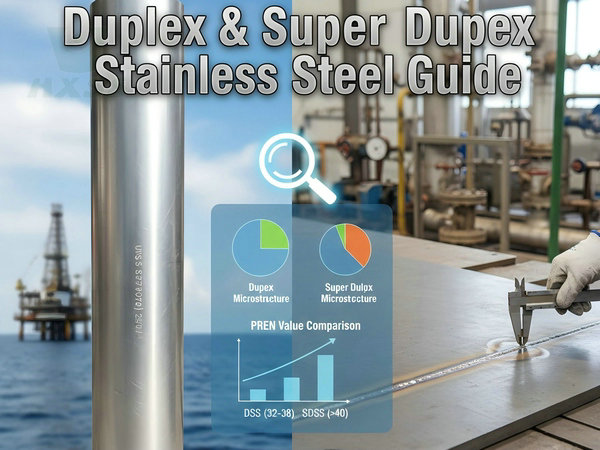
What is Duplex and Super Duplex Stainless Steel?
1. Duplex Stainless Steel Definition
Duplex stainless steel is a family of stainless steels that contain approximately equal proportions of austenite and ferrite in their microstructure. This dual-phase composition gives duplex steels higher strength than conventional austenitic stainless steels (such as 304 or 316) while maintaining good corrosion resistance.
Typical duplex grades include:
UNS S32205 / S31803 (2205 Duplex)
UNS S32304 (2304 Duplex)
UNS S32101 (Lean Duplex)
These steels are widely used in pipelines, pressure vessels, and marine environments due to their high yield strength and stress corrosion cracking resistance.
2. Super Duplex Stainless Steel Definition
Super duplex stainless steel is an advanced version of duplex steel with higher alloying elements — particularly chromium (24–26%), molybdenum (3–5%), and nitrogen.
The result is even greater resistance to pitting, crevice, and chloride-induced corrosion.
Common super duplex grades include:
UNS S32750 (2507 Super Duplex)
UNS S32760
UNS S32550
They are ideal for offshore platforms, subsea pipelines, chemical processing plants, and desalination units where extreme corrosion resistance is required.
Duplex and Super Duplex Stainless Steel Grades and Chemical Composition
Understanding the specific Duplex and Super Duplex Stainless Steel Grades is fundamental for both design and procurement. Each grade is optimized for particular application demands.
Common Duplex Stainless Steel Grades (Standard Duplex Grades)
UNS S32205 / S31803 (Duplex 2205) – The Industry Workhorse
2205 is the most widely used duplex stainless steel globally, often referred to as the “standard duplex.” Its success is based on an exceptional balance of performance and cost-effectiveness.
S31803 is the original grade, while S32205 is the nitrogen-enhanced version, offering tighter control on nitrogen content for more stable properties. S32205 has become the current industry standard.
Characteristics: High strength, good weldability, excellent SCC resistance, and moderate pitting resistance (PREN 32–34).
Applications: Pressure vessels, storage tanks, piping, heat exchangers, and equipment in the pulp and paper industry.
Lean Duplex Grades (e.g., 2304 / S32304 and 2101 / S32101)
“Lean Duplex” grades are designed to provide the strength benefits of the duplex structure while offering a lower cost solution by reducing the nickel and molybdenum content.
S32304 (Duplex 2304): Contains little to no molybdenum. Its PREN value is slightly lower than 2205, making it suitable for mildly corrosive environments.
S32101 (Duplex 2101): An economic duplex, with very low nickel and molybdenum, but high nitrogen content to maintain strength and a level of corrosion resistance.
Common Super Duplex Stainless Steel Grades (Standard Super Duplex Grades)
UNS S32750 (Super Duplex 2507) – The Performance Benchmark
2507 is the most prominent and widely recognized Super Duplex grade, commonly specified for the most demanding service conditions.
Characteristics: Extremely high strength and toughness, with a PREN value typically greater than 40. Exhibits outstanding resistance to pitting, crevice corrosion, and stress corrosion cracking.
Applications: Marine and offshore oil and gas industry (especially subsea pipelines and risers), desalination plants, and high-pressure chemical reactors.
UNS S32760 (Zeron 100) – Special Application Alloy
S32760 is a highly alloyed super duplex grade that often contains tungsten (W) and copper (Cu) to further enhance its resistance to specific acids and abrasive wear.
Characteristics: PREN value comparable to or higher than 2507, excelling particularly in acidic (e.g., sulfuric acid) and abrasive-particle-containing environments.
Applications: Pump and valve components, and corrosive downhole equipment.
Chemical Composition Comparison
The table below clearly illustrates the difference in key alloying elements among 316L, 2205 Duplex, and 2507 Super Duplex, which directly dictates their properties and Duplex Stainless Steel Prices.
| Grade (UNS) | Type | Cr (%) | Ni (%) | Mo (%) | N (%) | Typical PREN |
| S31603 (316L) | Austenitic | 16.0–18.0 | 10.0–14.0 | 2.0–3.0 | < 0.1 | ~25 |
| S32205 (2205) | Duplex (DSS) | 22.0–23.0 | 4.5–6.5 | 3.0–3.5 | 0.14–0.20 | 32–38 |
| S32750 (2507) | Super Duplex (SDSS) | 24.0–26.0 | 6.0–8.0 | 3.0–4.0 | 0.24–0.32 | > 40 |
| S32760 (Zeron 100) | Super Duplex (SDSS) | 24.0–26.0 | 6.0–8.0 | 3.0–4.0 | 0.20–0.30 | > 40 |
Huaxiao Metal, as a professional Super Duplex Stainless Steel Manufacturer, strictly controls the ratio of these critical alloying elements, ensuring that every batch of material we supply meets or exceeds international standards, particularly the precise nitrogen control, which is vital for maintaining optimal phase balance.
In-Depth Performance Analysis: Why Choose Duplex/Super Duplex?
The decision to choose Duplex or Super Duplex steel is based not just on corrosion resistance, but on their overall superior mechanical and physical properties, which allow designers to optimize structures, reduce weight, and extend equipment lifespan.
Mechanical Properties
The core mechanical advantage of Duplex Steels is their exceptionally high strength, a direct result of the ferritic phase.
High Yield Strength: Duplex steels typically exhibit a yield strength that is double that of standard austenitic stainless steels (like 304L or 316L). For instance, the 2205 grade often has a minimum yield strength of 450 MPa, compared to only 205 MPa for 316L.
Design Optimization and Cost-Effectiveness: High strength allows engineers to design with thinner material sections, leading to significant weight savings, reduced material consumption, and lower overall Duplex Stainless Steel Prices, while maintaining or improving structural integrity. This is particularly crucial in bridges, large storage tanks, and offshore structures.
Toughness: Despite their high strength, the presence of the austenitic phase allows Duplex and Super Duplex steels to retain good toughness and ductility, enabling reliable performance even at lower temperatures (though careful consideration is required for very low-temperature applications, generally performing better than ferritic grades).
Corrosion Resistance
Corrosion resistance is the primary selling point for DSS and SDSS, especially in chloride environments.
Superior Pitting and Crevice Corrosion Resistance: The higher the PREN value, the stronger the localized corrosion resistance. Super Duplex Steels (PREN > 40) offer outstanding protection in high-chloride environments (like seawater), far surpassing 316L.
Excellent Stress Corrosion Cracking (SCC) Resistance: Austenitic stainless steels are highly susceptible to SCC in hot, stressed, and high-chloride environments. The ferritic phase in the duplex microstructure provides high resistance to SCC, making duplex steels the ideal choice for heat exchangers, pressurized vessels, and desalination plants.
Acid Resistance: The high chromium and molybdenum content provides good resistance to a wide range of organic and inorganic acids (e.g., sulfuric, phosphoric, and acetic acids). Super Duplex grades, like S32760, perform even better in acidic media due to their higher alloy content.
Physical Properties and Heat Treatment
Understanding the physical characteristics and processing requirements is essential when utilizing these high-performance materials.
Weldability: Duplex and Super Duplex steels exhibit good weldability, but the process must be carefully controlled to maintain the ideal 50/50 phase balance in the Heat Affected Zone (HAZ). Nitrogen shielding gas is key, as it helps regenerate austenite and prevents excessive ferrite content, which can cause embrittlement.
Formability: Due to their high yield strength, Duplex steels require higher forces and greater compensation for springback during cold forming compared to austenitic grades.
Thermal Expansion: Duplex steels have a lower coefficient of thermal expansion than austenitic stainless steels. This can reduce thermal stress when joining dissimilar metals (like connecting to carbon steel) or in applications with significant temperature fluctuations.
Heat Treatment: The only recommended heat treatment is solution annealing followed by water quenching. This is done to relieve cold work stresses and ensure optimal phase balance. Long-term exposure in the temperature range of 300°C to 950°C must be strictly avoided, as it can lead to the precipitation of brittle intermetallic phases (such as the σ phase), causing sudden embrittlement and catastrophic loss of corrosion resistance.
Key Differences Between Duplex and Super Duplex Stainless Steel
Understanding the Difference Between Duplex and Super Duplex Stainless Steel is the most critical decision point in material selection, directly impacting performance, lifespan, and Super Duplex Stainless Steel Prices.
Fundamental Differences in Alloy Content and PREN Value
| Characteristic | Standard Duplex (DSS) – 2205 | Super Duplex (SDSS) – 2507 |
| Mo (Molybdenum) Content | 3.0% – 3.5% | 3.0% – 4.0% (Higher maximum) |
| N (Nitrogen) Content | 0.14% – 0.20% | 0.24% – 0.32% (Significantly higher) |
| Cr (Chromium) Content | Approx. 22% | Approx. 25% (Higher) |
| Typical PREN Value | 32 – 38 | > 40 |
| Environmental Tolerance | Moderate to high chloride environments (e.g., brackish water) | High chloride, high temperature, highly acidic environments (e.g., seawater) |
Fundamental Distinction: SDSS elevates its PREN value above the critical 40 mark through higher Mo and N content, reaching a “super” level. This allows it to withstand higher chloride concentrations and temperatures than DSS, a threshold where DSS would likely fail prematurely.
Comparison of Strength and Corrosion Resistance
| Performance Metric | Standard Duplex (DSS) | Super Duplex (SDSS) |
| Mechanical Strength | Very High (Yield Strength ≈ 450 MPa) | Even Higher (Yield Strength ≈ 550 MPa) |
| Pitting/Crevice Resistance | Good | Excellent/Extreme |
| Maximum Service Temp. | Around 300°C (Limited by embrittlement) | Around 300°C (Limited by embrittlement) |
| Cost-Effectiveness | Excellent (Suitable for most demanding applications) | Reserved for critical, high-risk, extreme applications |
Selection Criteria Based on Application Environment
The choice between Duplex and Super Duplex must be based on the aggressiveness of the service environment:
Chloride Concentration: If chloride levels are below 1000 ppm, standard Duplex (2205) is usually sufficient. If concentrations exceed 5000 ppm or are higher (e.g., direct seawater), Super Duplex (2507) is mandatory.
Temperature: Increased temperature accelerates corrosion. At temperatures above 50°C in high-chloride environments, SDSS provides a safer margin.
Pressure/Mechanical Load: If the design requires higher yield strength to manage extreme pressure or load, the superior strength of SDSS offers a definite advantage.
Impact of Prices, Stock, and Supply
In procurement decisions, Super Duplex Stainless Steel Prices are a significant consideration.
Price Factors: Due to the higher content of expensive alloying elements (Chromium, Nickel, Molybdenum), the raw material cost of Super Duplex is substantially higher than standard Duplex. Typically, Super Duplex Stainless Steel Prices can be 20% to 50% higher than standard Duplex, depending on market fluctuations.
Stock and Supply: Standard Duplex 2205 is the most common grade, with the largest volume of Duplex Stainless Steel Stock available in the market, often resulting in shorter lead times. Conversely, Super Duplex, particularly specialized grades like S32760, may have lower Super Duplex Stainless Steel Stock levels, potentially requiring longer ordering cycles.
Huaxiao Metal actively manages its global supply chain to maintain sufficient Super Duplex Stainless Steel Stock and offer competitive Super Duplex Stainless Steel Prices to meet the urgent needs of our international clientele.
Key Features and Advantages
1. High Strength
Both duplex and super duplex stainless steels provide exceptional yield and tensile strength, reducing the material thickness required in construction and lowering costs.
2. Excellent Corrosion Resistance
Thanks to the high chromium, molybdenum, and nitrogen content, these steels perform excellently in chloride-containing environments such as seawater or chemical plants.
3. Superior Stress Corrosion Cracking Resistance
Unlike austenitic stainless steels, duplex steels are resistant to stress corrosion cracking (SCC), especially in hot chloride environments.
4. Good Weldability and Fabricability
With proper procedures, duplex and super duplex steels can be welded using standard methods such as TIG, MIG, and SAW without compromising their mechanical integrity.
5. Cost Efficiency
Because of their high strength and thinner design requirements, duplex steels often reduce overall fabrication costs while offering long-term durability.
Global Applications of Duplex and Super Duplex Stainless Steel
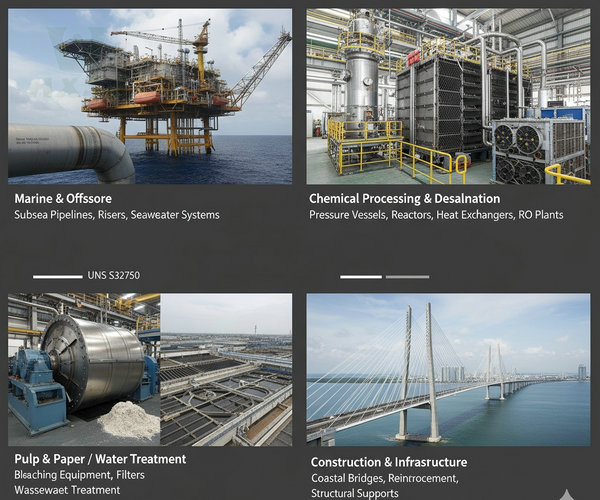
The unique properties of Duplex and Super Duplex steels make them indispensable materials across critical industries where safety, reliability, and long service life are paramount.
Marine and Oil & Gas Industries
This is the most critical application field for Super Duplex Stainless Steel, as it must withstand the extreme combination of high pressure, high chlorides, and often low temperatures.
Subsea Pipelines and Risers: Used for transporting corrosive, high-chloride crude oil and gas. 2507 Super Duplex is widely used in these critical structures due to its exceptional pitting resistance and high strength, ensuring reliable energy delivery.
Seawater Cooling Systems: Offshore platforms and FPSOs (Floating Production Storage and Offloading units) use S32750/S32760 to manufacture pumps, valves, piping, and heat exchangers for handling highly corrosive seawater.
Downhole Equipment: Tools and wellheads used in deep drilling and high-pressure environments.
Chemical Processing and Pressure Vessels
The chemical industry frequently deals with corrosive acids and high-pressure reactions.
Pressure Vessels, Tanks, and Reactors: 2205 is the ideal choice for medium-corrosivity storage, offering strong resistance to stress corrosion cracking.
Heat Exchangers: Shell-and-tube heat exchangers handling corrosive fluids benefit from the combined corrosion resistance and high thermal conductivity of Duplex steel.
Phosphoric and Acetic Acid Production: In these processes, SDSS provides a significantly longer corrosion-resistant lifespan compared to austenitic steels.
Pulp & Paper and Water Treatment
Pulp Bleaching Plants: The bleaching process involves chlorides and hypochlorites, which are highly corrosive. Duplex Stainless Steel Grades are used for washers and filters.
Seawater Desalination Plants: This is a flagship application for SDSS. The Multiple-Stage Flash (MSF) or Reverse Osmosis (RO) processes, which handle hot, concentrated brine (high-chloride), require 2507 Super Duplex or higher grades to prevent rapid corrosion failure.
Construction and Infrastructure
Bridges and Structures: In coastal areas, bridges and buildings are exposed to salt spray. The high strength and corrosion resistance of Duplex steel make it ideal for reinforcement bars, tension rods, and structural supports, drastically extending the structure’s lifespan and reducing maintenance.
Huaxiao Metal: Your Trusted Duplex and Super Duplex Stainless Steel Supplier and Manufacturer
When selecting high-performance alloys, finding a reliable Duplex and Super Duplex Stainless Steel Supplier and Manufacturer is paramount. Huaxiao Metal leverages decades of industry experience, stringent quality control, and a global supply chain to be your ideal partner.
Our Product Range and Expertise
As a specialized Super Duplex Stainless Steel Manufacturer, we offer the most comprehensive range of product forms across all major Duplex and Super Duplex Stainless Steel Grades:
Plates/Sheets: Thick plates for pressure vessels and structural fabrication.
Pipes/Seamless Tubes: For heat exchangers, hydraulic systems, and process piping.
Bars/Rounds: Used in the manufacture of fasteners, shafts, and pump components.
Flanges, Fittings, and Accessories: A full range of piping connection components in various sizes and pressure ratings.
Quality and Standards: Our materials strictly comply with international standards, including ASTM A240, ASTM A790, ASTM A928, ASTM A182, NORSOK M-630, and others. Every shipment comes with a comprehensive Material Test Report (MTC), ensuring the highest quality and traceability.
Global Supply and Stock Advantage
Time is money, especially for critical oil and gas or chemical projects.
Abundant Duplex/Super Duplex Stainless Steel Stock: We strategically hold large volumes of Super Duplex Stainless Steel Stock for popular grades (like 2205 and 2507) to ensure rapid response to urgent procurement needs from clients worldwide.
Customization Services: With our advanced production and processing capabilities, we can provide customized cutting, water-jet cutting, drilling, and machining services, minimizing your need for further in-house processing.
Why Choose Huaxiao Metal?
Professional Technical Support: Our team of metallurgical engineers offers expert material selection consultation, helping you find the perfect balance between performance requirements and Duplex Stainless Steel Prices.
Competitive Pricing: As a direct source Manufacturer, we offer highly competitive Super Duplex Stainless Steel Prices, streamlining the supply chain and reducing your procurement costs.
Global Service: No matter your location, Huaxiao Metal ensures the secure and timely delivery of your order.
FAQ: Duplex and Super Duplex Stainless Steel
Are duplex and super duplex stainless steels magnetic?
Yes. Due to their ferritic phase, both duplex and super duplex grades exhibit partial magnetism.
What is the main Difference Between Duplex and Super Duplex Stainless Steel?
The primary difference lies in the alloy content (particularly molybdenum and nitrogen), which directly impacts the PREN value. Super duplex stainless steel (SDSS) has a higher PREN value (>40), giving it superior corrosion resistance in harsh environments with higher chloride content and temperatures. The differences lie in corrosion resistance, strength, and price.
Which Duplex Stainless Steel Grades are most commonly used?
The most widely used duplex stainless steel grade is UNS S32205 (2205), as it offers an excellent balance between strength, corrosion resistance, and cost-effectiveness.
What are the advantages of 2205 Duplex Stainless Steel compared to 316L Stainless Steel?
2205 Duplex has double the yield strength of 316L and significantly higher resistance to stress corrosion cracking and pitting corrosion. In many applications, this allows for reduced material thickness, which can lower overall cost.
Duplex Stainless Steel vs 316
As a Manufacturer, does Huaxiao Metal offer custom sizes and hold Super Duplex Stainless Steel Stock?
Yes, Huaxiao Metal, as a professional Super Duplex Stainless Steel Manufacturer and Supplier, provides a wide range of standard and custom sizes for plates, pipes, and bars, and maintains a large Super Duplex Stainless Steel Stock to guarantee quick delivery.
How are Duplex Stainless Steel Prices determined?
Duplex Stainless Steel Prices are primarily influenced by the fluctuating international market prices of alloying elements like nickel, chromium, and molybdenum. Prices also depend on the product form (plate, pipe, bar), quantity, and the specific grade required (Super Duplex prices are generally higher than standard Duplex).
Conclusion: Choose Huaxiao Metal for Project Success
In this complete guide to duplex and super duplex stainless steel, we provide an in-depth look at how these high-alloy materials, with their unique dual-phase microstructure, deliver unparalleled performance in critical engineering environments. From standard duplex grades like 2205 to high-performance super duplex grades like 2507, understanding the differences between duplex and super duplex stainless steel is crucial for making the best material selection.
As your trusted supplier and manufacturer of duplex and super duplex stainless steel, Huaxiao Metal offers not only high-quality products but also expert material consulting and global logistics support. Whether you have questions about specific super duplex stainless steel pricing or need to review our current duplex stainless steel inventory, our team of experts is ready to assist you.
We don’t just sell products; we offer reliability, expertise, and a commitment to long-term partnerships. Your project demands the most reliable materials—choose Huaxiao Metal.
Contact Huaxiao Metal today to get updated duplex and super duplex stainless steel prices, check available stock, or request a quotation directly from our professional sales team.