Call Us Today! +86-13761906384

304 vs 347 Stainless Steel: Key Differences, Price & Ultimate Guide

In this article, we will focus on two common stainless steel alloys, 304 vs 347 stainless steel. These two alloys are widely used in engineering and manufacturing, but there are important differences, advantages, and disadvantages between them. Understanding these differences is critical to properly selecting materials to meet specific needs.

304 stainless steel, a classic stainless steel alloy, is known for its good corrosion resistance and versatility, but may have some limitations in high-temperature and welding applications. In contrast, 347 stainless steel performs better under high temperatures and welding conditions, making it the preferred choice in some specific areas. 

Are you searching for the right material for high-temperature equipment, complex welded structures, or corrosive environments? Let’s take a closer look at these two stainless steels to help you determine which is best for your project.

The table below summarizes the core differences between 304 and 347 stainless steel in terms of performance, composition, application and cost, providing a quick reference for your initial decision.

Properties304 Stainless Steel347 Stainless Steel
CompositionApprox. 18–20% Cr, 8–10.5% Ni, small amounts of Mn and SiApprox. 17–19% Cr, 9–13% Ni, about 0.3–0.4% Nb (Columbium), may also contain Tantalum
Core DifferenceGeneral-purpose, cost-effectiveStabilized with Nb, offering higher thermal stability and oxidation resistance
Carbide Precipitation ResistanceSusceptible to sensitization at certain temperaturesExcellent resistance to sensitization, especially after welding
High-Temperature PerformanceWithstands intermittent exposure up to ~870°C (1600°F)Superior high-temperature resistance, in some cases up to 1050°C
Corrosion ResistanceGood corrosion resistance in many environmentsBetter performance in high-temperature or acidic conditions; Ta addition enhances resistance at elevated temperatures
WeldabilityExcellent, commonly welded using 308L electrodesSimilar to 304 but requires more precise heat management to avoid black lines or “sugaring”
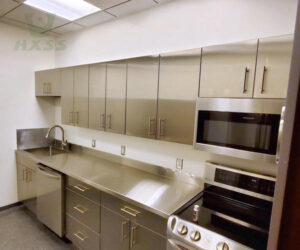
Typical ApplicationsKitchenware, architectural decoration, food processing equipmentAerospace exhaust systems, boilers, chemical equipment, heavy-duty welded components
CostRelatively lower, simpler alloy composition and lower production costHigher cost, but superior performance makes it valuable in critical applications
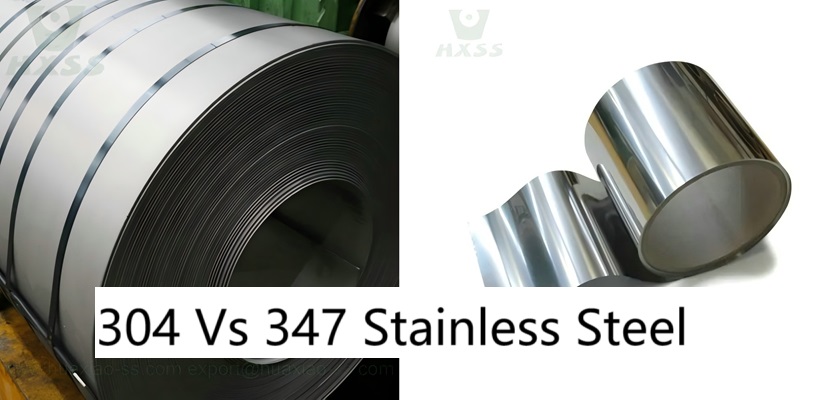
304 Vs 347 Stainless Steel

What is 304 Stainless Steel?

304 stainless steel is generally considered the standard for austenitic steel and is widely used in many industries. It has excellent corrosion resistance and is relatively easy to form and weld. Its unique composition also allows it to withstand extreme temperatures, both hot and cold, making it ideal for applications with high temperatures or extreme cold. It is also non-magnetic and has excellent mechanical properties, making it an excellent choice for many projects.
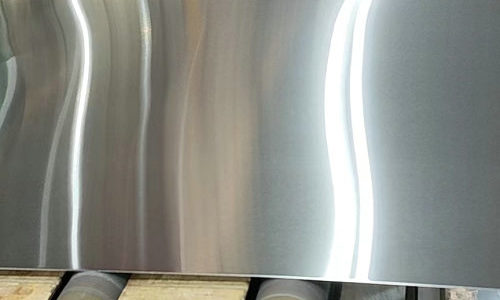
304 NO.4 STAINLESS STEEL SHEET

Need high‑quality 304 stainless steel? Huaxiao Metal offers factory‑direct pricing and customizable sizes — 👉 Request a quote now

What is 347 Stainless Steel?

347 stainless steel has many advantages over 304 stainless steel, but its main advantage is its ability to withstand higher temperatures without losing strength or becoming brittle. This makes it an excellent choice for extreme temperature applications, such as turbines or boilers where temperatures may exceed 1000°F (537°C). It has higher corrosion resistance than 304 stainless steel due to its higher chromium, nickel, molybdenum, titanium, and aluminum content. Additionally, 347 stainless steel is non-magnetic and has good ductility (can be easily formed into a variety of shapes).
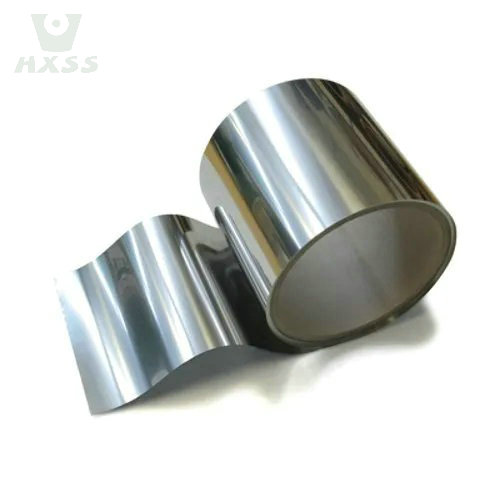
Stainless Steel Foil, Stainless Steel Foil For Heat Treating, 304 Stainless Steel Foil, 309 Stainless Steel Foil, 316 Stainless Steel Foil, 316l Stainless Steel Foil, Stainless Steel Foil Manufacturers, Stainless Steel Foil Roll, Thin Stainless Steel Foil, 321 Stainless Steel Foil, 301 Stainless Steel Foil, China 304 Stainless Steel Foil, Stainless Steel Foil Price, Stainless Steel Foil Suppliers, Ultra Thin Stainless Steel Foil

304 vs 347 Stainless Steel – What’s the Difference

304 vs 347 stainless steel are both stainless steel alloys, but they have some key differences, particularly in their composition and application. Here’s a comparison between 304 and 347 stainless steel:

Characteristics304 Stainless Steel347 Stainless Steel
Core DifferenceGeneral-purpose, economicalStabilized with niobium (Nb)
Intergranular Corrosion ResistanceAverage, susceptible to sensitization at certain temperatures after weldingExcellent, especially after welding
High-Temperature PerformanceGood, but strength decreases at high temperaturesExcellent, with better creep and stress rupture resistance
Welding PerformanceGood, but may require annealing treatment for thick-section weldingExcellent, retains corrosion resistance after welding without heat treatment
CostRelatively lowRelatively high
Typical ApplicationsKitchenware, architectural trim, food processing equipmentAerospace exhaust pipes, boilers, chemical equipment, heavy welded components

Composition: 304 vs 347 Stainless Steel

304 Stainless Steel: It is an austenitic stainless steel and contains approximately 18-20% chromium and 8-10.5% nickel. It also has a small amount of manganese and silicon.

347 Stainless Steel: It is also an austenitic stainless steel but contains approximately 17-19% chromium, 9-13% nickel, and about 0.3-0.4% columbium (also known as niobium). The addition of columbium makes 347 stainless steel more stable against carbide precipitation during welding.

Carbide Precipitation Resistance: 304 vs 347 Stainless Steel

304 Stainless Steel: While 304 is corrosion-resistant and widely used in various applications, it is susceptible to sensitization, which can lead to the formation of chromium carbides along grain boundaries when exposed to high temperatures during welding or heat treatment. This can reduce its corrosion resistance in certain environments.

347 Stainless Steel: The addition of columbium in 347 stainless steel makes it more resistant to sensitization and carbide precipitation during welding and high-temperature applications. This makes 347 stainless steel suitable for applications where elevated temperatures are a concern.

 High-Temperature Applications: 304 vs 347 Stainless Steel

304 Stainless Steel: It is suitable for a wide range of applications and environments, but it may not perform as well as 347 stainless steel in high-temperature applications due to its sensitivity to carbide precipitation.

347 Stainless Steel: 347 is often chosen for applications where exposure to elevated temperatures, such as in exhaust systems and high-temperature chemical processing equipment, is a concern. Its resistance to sensitization and carbide precipitation at high temperatures makes it a better choice in these situations.
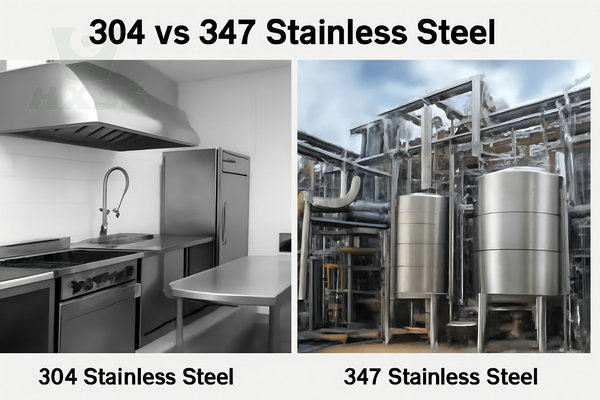
Applications of 304 vs 347 Stainiese Steel

Corrosion Resistance: 304 vs 347 Stainless Steel

Both 304 and 347 stainless steel offer good corrosion resistance in a wide range of environments, including exposure to moisture, acids, and salt.

Cost: 304 vs 347 Stainless Steel

The prices of different types of stainless steel, 304 and 347, depend on various factors, including market demand, production costs, specifications, and suppliers. Generally speaking, 304 stainless steel is usually cheaper than 347 stainless steel because its alloy composition is simpler, and the production cost is relatively low. Here are some factors that may affect the price of these two types of stainless steel:

Alloy composition: 347 stainless steel contains more alloying elements, such as cobalt (or niobium). The higher cost of these elements may make the price of 347 stainless steel slightly higher than that of 304 stainless steel.

Specifications and shapes: Stainless steel materials of different specifications and shapes usually have different prices. For example, the price of stainless steel in shapes such as plates, pipes, bars, etc., may be different.

Market supply and demand: Market factors also have an important impact on stainless steel prices. Supply and demand, price fluctuations in international markets, and geographical location may all affect the price of stainless steel.

Suppliers and regions: Stainless steel prices may vary between suppliers and regions. Some suppliers may offer competitive prices, while others may charge higher prices.

Cost Factors304 Stainless Steel347 Stainless Steel
Initial Material CostLowerHigher
Post-Weld Treatment CostMay require annealing after welding to restore corrosion resistanceUsually does not require post-weld annealing, saving time and cost
Failure Risk CostRisk of sensitization and intergranular corrosion at high temperatures, which may lead to costly equipment failures and safety issuesVery low sensitization risk, providing higher reliability and safety in critical applications
Replacement Cycle CostMay require more frequent replacement in harsh environmentsLonger service life, reducing replacement frequency and downtime costs

Why is 347 stainless steel more advantageous?

To truly understand the differences between 304 and 347 stainless steel, the two grades, it’s necessary to delve deeper into their behavior at the microscopic level, especially when faced with high temperatures and welding challenges.

Sensitization: The Core Technical Advantage of 347 Stainless Steel

For any application requiring high-temperature operation or welding, “sensitization” is a critical flaw that cannot be ignored. Sensitization occurs when austenitic stainless steels (such as 304) are exposed to high temperatures ranging from 450°C to 850°C (840°F to 1560°F). At these temperatures, carbon atoms combine with chromium atoms to form chromium carbides at grain boundaries.

The precipitation of these carbides causes a sharp decrease in the chromium content near the grain boundaries, resulting in a “significant reduction” in the material’s corrosion resistance. In practical applications, this can lead to severe intergranular corrosion, manifested as “flaking” or the shedding of thin flaked material from the material surface. This is a catastrophic failure mode for equipment that relies on the corrosion resistance of stainless steel.

To address this issue, 347 stainless steel incorporates stabilizing elements such as niobium (columbium) and tantalum. These elements bond more strongly with carbon than chromium, preferentially bonding with carbon and preventing it from bonding with chromium. This allows 347 stainless steel to maintain its inherent corrosion resistance even when welded at high temperatures or after extended service, making it an ideal choice for high-temperature environments such as aerospace and chemical equipment.

Practical Welding Considerations: From Theory to Practice

While the weldability of 347 stainless steel is very similar to that of 304, its unique composition requires more meticulous heat management. Welders have reported that 347 welds can be “extremely inconsistent.” For best results, it is recommended to weld 347 with “clean metal,” “shortened arc,” and “very small weave.” Furthermore, when “black lines” begin to appear on 347, it indicates that the heat input has reached its tolerance limit.

For both materials, when performing full penetration welds, inert gas shielding must be applied to the back of the weld to prevent “saccharification” or graining, which is caused by oxidation of the molten metal on the back side. In addition, for 304 stainless steel, the 308L welding rod is usually recommended for welding.

Which one should you choose?

When to Choose 304:

  • Standard food processing and kitchen equipment.

  • Architectural paneling and decorative trim.

  • Applications where operating temperatures stay below 800°F.

  • Budget Priority: 304 is significantly more cost-effective for high-volume production.

When to Choose 347:

  • Aerospace: Jet engine components and aircraft exhaust stacks.

  • Oil & Gas: Refinery equipment and high-pressure steam pipes.

  • Chemical Processing: Equipment operating in the carbide precipitation range.

  • Power Plants: Radiant superheaters and boiler tubes.

Not sure which grade fits your application? Send Huaxiao Metal your project details — we’ll recommend the best material and quote a competitive price.

FAQ: 304 vs 347 Stainless Steel

304 stainless steel is a general-purpose stainless steel with excellent corrosion resistance and is suitable for general environments. 347 stainless steel, based on 304 stainless steel with the addition of tantalum, offers enhanced heat resistance and oxidation resistance, making it suitable for high-temperature environments and welding applications.

If your project involves high-temperature environments, 347 stainless steel is a more suitable choice. 347 stainless steel offers superior high-temperature resistance, particularly in the chemical and aerospace industries.

Yes, 304 stainless steel is widely used in the food processing industry. It offers excellent corrosion resistance, easy cleanability, and stability, meeting food hygiene standards.

347 stainless steel offers excellent weldability, particularly for welding applications in high-temperature environments. It maintains good corrosion resistance and mechanical properties after welding.

304 stainless steel offers good corrosion resistance in most environments, but 347 stainless steel performs better in high-temperature or highly acidic environments. Tantalum enhances 347’s corrosion resistance in high-temperature environments.

The choice between 304 and 347 stainless steel depends on your application. For general-purpose applications, 304 stainless steel is an ideal choice. However, if your project involves high temperatures or specialized welding requirements, 347 stainless steel will offer better performance.

  • What is the equipment’s operating temperature? If it consistently exceeds 425°C, consider 347.

  • Is extensive welding or thick-section welding required? If so, and post-weld annealing is impractical or cost-prohibitive, choose 347.

  • What is the budget? If the application environment is mild and there is no risk of weld corrosion, 304 is more attractive due to its lower upfront cost.

  • What are the consequences of failure? For critical applications where failure could result in serious safety issues or significant financial losses, the added reliability provided by 347 is well worth its higher price.

Because 347 stainless steel contains more alloying elements (such as tantalum), it’s generally slightly more expensive than 304 stainless steel. However, its superior high-temperature and corrosion resistance make it worthwhile in certain applications.

304 stainless steel is suitable for seawater environments, but its corrosion resistance is more modest. If your application requires long-term use in a highly corrosive environment, 347 stainless steel will offer better corrosion resistance, especially at high temperatures.

Yes, choosing between different types of stainless steel will directly impact cost. While 347 stainless steel is more expensive, its performance advantages in specific applications may make it a more cost-effective choice, especially in high-temperature and highly corrosive environments.

For general building applications, including facades, railings, kitchen facilities, etc., 304 stainless steel is the best choice for cost considerations. 347 stainless steel is more suitable for more demanding special applications, such as industrial facilities and chemical plants.

Yes — sheets, coils, strips, bars, and custom‑cut shapes are all available.

 Conclusion: 304 vs 347 Stainless Steel

Whether to choose 304 or 347 stainless steel depends entirely on your application requirements.

Choosing 304 stainless steel: When your project involves non-high-temperature, non-harsh environments, and cost is a primary consideration, 304 is an ideal general-purpose choice. It excels in applications such as kitchen appliances, architectural decoration, and food processing.

Choosing 347 stainless steel: When your project requires high-temperature, highly corrosive environments, or requires extensive welding, 347 is the superior choice. Its use in aerospace exhaust systems, boilers, and chemical equipment has proven its value and reliability in critical applications.

Ultimately, a wise decision isn’t based solely on material price, but rather on a comprehensive consideration of the application, welding requirements, and long-term total cost of ownership.

Facebook
Twitter
LinkedIn
Pinterest
Reddit

Table of Contents

We will answer your email in 24 hours!

Related Posts

Request a Quote

Fill out the form below, and we will be in touch shortly.