If you are sourcing stainless steel for welded applications — heat exchangers, furnace parts, exhaust systems, or petrochemical equipment — you have probably encountered the choice between 410 and 410S Stainless Steel. The difference matters more than most suppliers will tell you.
410 is a martensitic grade that hardens in the weld heat-affected zone, requiring preheating and post-weld annealing to avoid cracking. 410S is a ferritic grade that stays soft and ductile through the welding thermal cycle, making it the go-to choice when weldability is the priority.
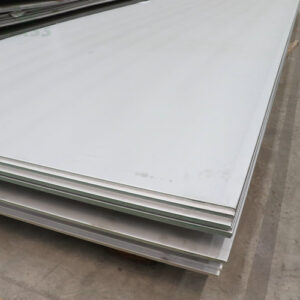
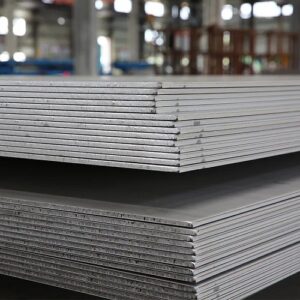
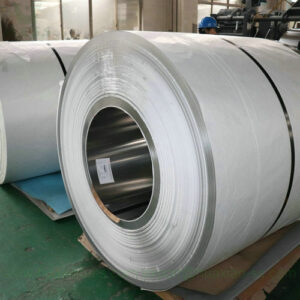
This guide covers everything a buyer or fabrication engineer needs to know about welding 410S: filler metal selection, preheat requirements, post-weld treatment, defect prevention, and how it compares to welding 410. If you need 410S material for your project, request a quote from Huaxiao Metal — we supply 410S cold rolled coil, hot rolled coil, sheet, and plate with full MTC documentation.
Why 410S Is the Weldable Alternative to 410
The Carbon Difference That Changes Everything
The single most important difference between 410 and 410S is carbon content:
| Grade | Carbon (max) | Microstructure | Hardenable |
|---|---|---|---|
| 410 | 0.08-0.15% | Martensitic | Yes — HRC 40-50 after quench |
| 410S | ≤0.08% | Ferritic | No — stays soft |
When you weld 410, the heat-affected zone (HAZ) heats above the critical temperature and then cools rapidly. The high carbon content causes the HAZ to transform to hard, brittle martensite. Without preheating and post-weld annealing, this martensite cracks — sometimes immediately, sometimes weeks later in service.
410S avoids this entirely. Its low carbon content suppresses martensite formation, so the HAZ remains ferritic and ductile. This is why 410S is classified as UNS S41008 under ASTM A240 as a non-hardenable ferritic stainless steel — not a “low-carbon martensitic” as some sources incorrectly state. For a deeper comparison, see our 410 vs 410S stainless steel guide.
Ferritic vs Martensitic: What It Means at the Weld
| Property | 410S (Ferritic) | 410 (Martensitic) |
|---|---|---|
| HAZ after welding | Soft, ductile ferrite | Hard, brittle martensite |
| Cracking risk | Low | High without preheat |
| Preheat required | Generally no (optional 150-200°C for thick sections) | Yes, 250-350°C mandatory |
| Post-weld annealing | Not required | Required (700-750°C) |
| Filler metal | AWS E/ER 309L or 430 | AWS E/ER 410 or ERNiCr-3 |
This table tells you why 410S saves fabrication time and cost. No preheat setup. No post-weld furnace cycle. No delayed cracking surprises. For welded structures, 410S is simply the better choice.
410S Welding Properties at a Glance
| Parameter | Recommendation |
|---|---|
| Weldability rating | Good to excellent |
| Preheat | Not required for ≤3mm; 150-200°C for >3mm or restrained joints |
| Interpass temperature | Keep below 150°C |
| Recommended filler | AWS E/ER 309L (most common), E/ER 430 (matching chemistry) |
| Shielding gas (GTAW/GMAW) | 98% Ar + 2% O₂ or pure Ar |
| Post-weld heat treatment | Optional stress relief at 700-750°C |
| Sensitization risk | Low (but avoid 450-850°C prolonged exposure) |
| Grain growth risk | Moderate — keep heat input low |
Welding Methods for 410S Stainless Steel
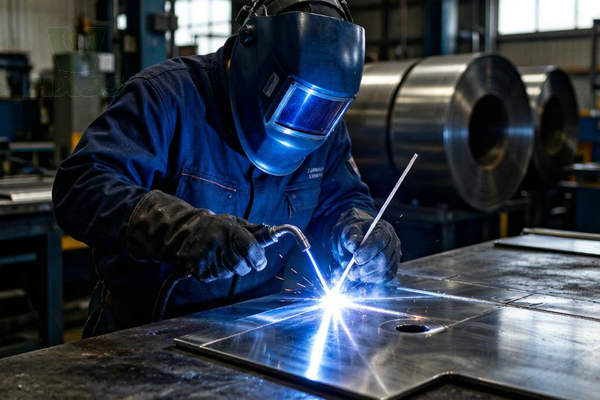
GTAW (TIG) — Recommended for Root Pass
TIG welding gives the best control over heat input and produces clean, high-quality root passes. Use a 2% thoriated tungsten electrode, 98% Ar + 2% O₂ shielding gas, and ER309L filler wire (1.6mm or 2.4mm diameter). Keep the arc length short and travel speed steady. TIG is ideal for thin-gauge 410S sheet (0.5-3mm) commonly used in heat exchanger fabrication.
GMAW (MIG) — High Productivity Fill
For thicker sections and production welding, MIG offers higher deposition rates. Use short-circuit or pulse-spray transfer with ER309L wire (0.8mm or 1.0mm). Set wire feed speed to maintain low heat input — the goal is full penetration without excessive grain growth in the HAZ.
SMAW — Field Repairs
For on-site repairs where gas shielding is impractical, shielded metal arc welding with E309L electrodes (3.2mm) works well. Note that SMAW produces higher heat input than TIG, so it is less suitable for thin-gauge material.
Resistance Welding
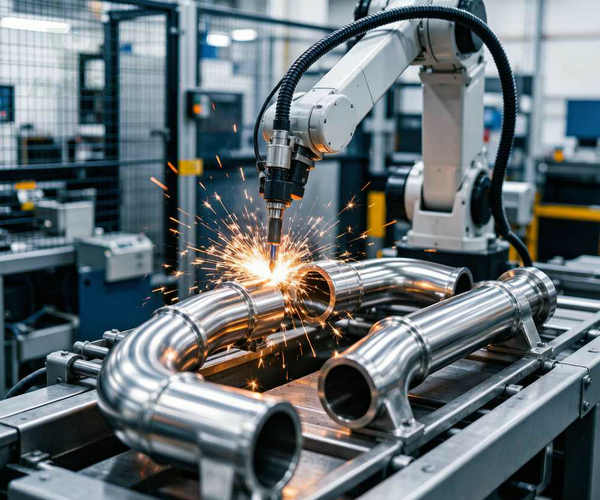
410S responds well to spot welding and seam welding — a significant advantage in automotive exhaust manufacturing. The ferritic structure ensures consistent weld nuggets without martensitic embrittlement. This is why 410S is widely used in welded exhaust tube production.
Filler Metal Selection Guide
| Filler Metal | AWS Class | When to Use | Characteristics |
|---|---|---|---|
| ER309L | AWS A5.9 | Most common; dissimilar to carbon steel or austenitic | High ductility, crack-resistant, slightly over-matched Cr/Ni |
| ER430 | AWS A5.9 | Matching chemistry; same-color weld | Matching ferritic structure, lower ductility than 309L |
| ER410 | AWS A5.9 | When matching 410S chemistry exactly | Risk of hardening if carbon pick-up occurs |
| ENiCr-3 (Alloy 82) | AWS A5.14 | Dissimilar to nickel alloys or high-restraint joints | Excellent crack resistance, high cost |
Buyer’s tip: Use ER309L for most applications. It provides the best balance of weldability, crack resistance, and cost. The slightly higher Cr and Ni content compared to 410S base metal does not cause problems in most service environments.
Preheat and Interpass Temperature
One of the biggest advantages of 410S is that preheating is generally not required. This eliminates a time-consuming step in your fabrication process.
| Section Thickness | Preheat Recommendation | Reason |
|---|---|---|
| ≤ 3mm | None needed | Low thermal stress, thin sections cool evenly |
| 3-6mm | Optional 150°C | Reduces thermal gradient in moderate thickness |
| > 6mm | Recommended 150-200°C | Prevents brittle fracture in restrained thick joints |
Interpass temperature: Keep below 150°C between weld passes. Excessive interpass temperature promotes grain growth in the ferritic HAZ, which reduces toughness.
Warning: Never preheat 410S above 425°C. Prolonged exposure in the 425-600°C range causes 475°C embrittlement — a permanent loss of toughness that cannot be reversed without full re-annealing.
Post-Weld Heat Treatment
For most 410S welded applications, no post-weld heat treatment is required. The HAZ does not harden, so there is no need for a softening anneal.
| Situation | PWHT Recommendation |
|---|---|
| Standard welded structures | None required |
| High-restraint thick-section welds | 700-750°C stress relief, furnace cool |
| Welds subject to cyclic thermal loading | 700-750°C stress relief recommended |
| Welds in sour service (H₂S environments) | 700-750°C stress relief per NACE MR0175 |
When performing stress relief, heat uniformly to 700-750°C, hold for 1 hour per 25mm of thickness, then furnace cool to below 425°C before air cooling. Never cool through the 425-600°C range slowly — this is the embrittlement zone.
410S vs 410 Welding Comparison
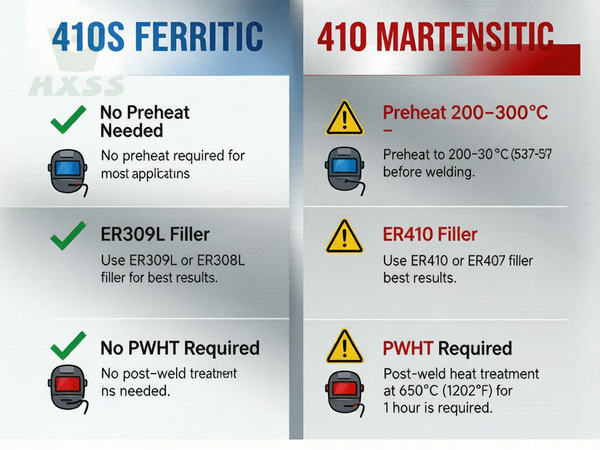
| Welding Parameter | 410S (Ferritic) | 410 (Martensitic) |
|---|---|---|
| Preheat | None / 150-200°C | 250-350°C mandatory |
| Filler metal | ER309L or ER430 | ER410 or ERNiCr-3 |
| Post-weld treatment | None / optional 700-750°C | Mandatory 700-750°C anneal |
| HAZ hardness | Stays soft (<89 HRB) | Hardens to HRC 40-50 |
| Cracking risk | Very low | High without proper procedure |
| Field repair feasibility | Good | Difficult — needs furnace access |
| Total fabrication cost | Lower | Higher (preheat + PWHT + slower cycle) |
| Typical welded applications | Heat exchangers, exhaust, furnace parts | Valve bodies, pump shafts (usually machined, not welded) |
The cost difference is significant. A typical 410 welded assembly requires 2-4 hours of preheat setup and 4-8 hours of post-weld annealing. 410S eliminates both steps, reducing fabrication cost by 20-30% for welded components.
Common Welding Defects and How to Avoid Them
1. Grain Growth in HAZ
Cause: Excessive heat input causes ferrite grains to grow large, reducing toughness.
Fix: Use low heat input parameters. Limit single-pass weld to 1.5-2.5 kJ/mm. For multi-pass welds, allow interpass temperature to drop below 150°C between passes.
2. Sensitization (Intergranular Corrosion)
Cause: Prolonged exposure to 450-850°C causes chromium carbide precipitation at grain boundaries, depleting chromium and creating corrosion-susceptible zones.
Fix: 410S’s low carbon content makes this less likely than with 410, but it can still occur with very slow cooling of thick sections. Use rapid cooling (air blast or water quench) through the 850-450°C range for thick weldments.
3. Brittle Fracture at High Restraint
Cause: While 410S does not form martensite, the ferritic structure has lower toughness than austenitic grades. Highly restrained joints with notch-like discontinuities can crack under residual stress.
Fix: Design joints to minimize restraint. Avoid undercut and slag inclusions. Grind weld toes smooth. For highly restrained thick-section welds, apply 150°C preheat and 700-750°C post-weld stress relief.
4. 475°C Embrittlement
Cause: Long-term service or slow cooling through 425-600°C causes alpha-prime precipitation, permanently embrittling the steel.
Fix: Avoid prolonged exposure in this temperature range. If embrittlement occurs, full re-annealing at 780-830°C can restore properties.
Welding Applications: Where 410S Excels
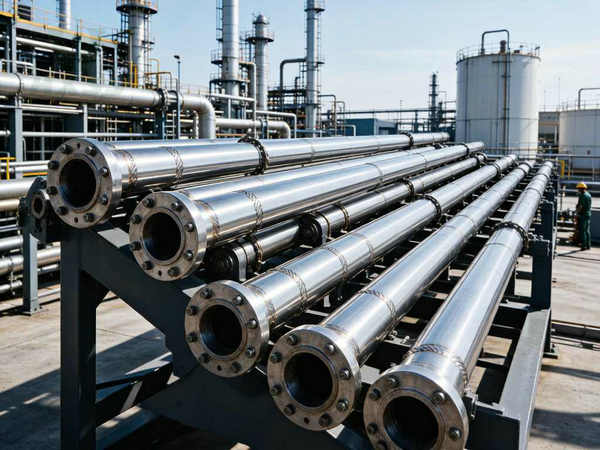
| Industry | Component | Why 410S | Alternative Considered |
|---|---|---|---|
| Petrochemical | Distillation column trays | Weldable, oxidation-resistant to 705°C | 410 (too brittle welded), 304 (more expensive) |
| Automotive | Exhaust manifolds and pipes | Weldable, moderate oxidation resistance, low cost | 409 (similar), 304 (overkill cost) |
| Power generation | Heat exchanger baffles | Good weldability, moderate corrosion resistance | 410 (needs PWHT), 316L (higher cost) |
| Steel mills | Annealing box covers | Withstands thermal cycling, weldable | 410 (cracks at welds) |
| Food processing | Welded tank linings (non-contact) | Weldable, food-grade compatible, magnetic | 430 (similar), 304 (non-magnetic) |
| Mining | Ore processing screen panels | Abrasion + weldability balance | 410 (harder but unweldable) |
If your application involves welding and moderate temperature/corrosion service, 410S is likely your most cost-effective option. Browse our 410S cold rolled coil and 410S hot rolled coil specifications to find the right material for your fabrication.
Quality Requirements for Welded 410S
When sourcing 410S for welded applications, verify the following before placing your order:
| Requirement | What to Check | Why It Matters |
|---|---|---|
| Carbon content ≤0.08% | Request MTC, verify C value | Higher carbon = martensite risk in HAZ |
| ASTM A240 compliance | MTC must reference ASTM A240 / ASME SA240 | Ensures material meets pressure vessel standards |
| Surface finish | No oxide scale, pickled and passivated | Surface oxide causes weld contamination |
| Flatness tolerance | Check mill certificate for flatness value | Warped material causes fit-up gaps → weld defects |
| Heat number traceability | Every coil/sheet must have heat number | Required for WPS qualification and quality tracking |
| PMI verification | XRF or OES test report | Confirms you received 410S, not 410 or 430 |
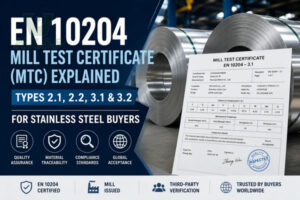
Every shipment from Huaxiao Metal includes EN 10204 3.1 MTC with full chemical analysis. Learn more in our EN 10204 MTC guide. We also provide PMI test reports and WPS documentation for welded applications.
Standards and Certifications
International Standards for 410S Welding
| Region | Standard | Scope |
|---|---|---|
| USA | ASTM A240 / ASME SA240 | Material specification for 410S plate/sheet/coil |
| USA | AWS D1.6 | Structural welding code for stainless steel |
| USA | ASME Section IX | Welding procedure and performance qualification |
| Europe | EN 10088-2 | Stainless steel sheet/plate — 1.4000 (X6Cr13) |
| Europe | EN ISO 15614-1 | Welding procedure qualification |
| Europe | EN 10204 3.1 | Mill test certificate |
| Japan | JIS G4304/G4305 | Hot/cold rolled stainless steel — SUS410S |
| China | GB/T 4237/4238 | Stainless steel hot/cold rolled — 06Cr13 |
Compliance for Export Markets
| Market | Certification | Requirement |
|---|---|---|
| European Union | REACH / RoHS | Required for all stainless steel imports |
| European Union | CE marking (PED 2014/68/EU) | Required for pressure equipment |
| South America | Certificate of Origin | Required for customs clearance (Mercosur preferential tariff) |
| North America | MTR (Material Test Report) | Required for ASME-code fabrication |
| Middle East | API 6A / ASME B31.3 | Required for oil & gas piping and equipment |
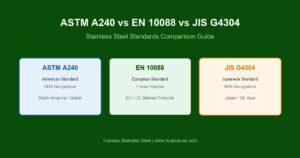
For a complete comparison of international stainless steel standards, see our ASTM A240 vs EN 10088 vs JIS G4304 comparison.
Sourcing Welded 410S Components from China
Ordering Checklist
Before sending your inquiry, prepare the following information to get an accurate quote within 12 hours:
Grade confirmation: 410S (not 410 — specify clearly to avoid receiving hardenable material)
Product form: Cold rolled coil / hot rolled coil / cold rolled sheet / hot rolled plate
Dimensions: Thickness × width × length (or coil weight)
Surface finish: 2B / BA / No.1 / No.4 (specify for welding prep)
Quantity: Metric tons (MOQ: 1 ton)
Documentation: MTC type (EN 10204 3.1 standard; 3.2 available with third-party)
Destination port: For CIF/CFR quotation
Export Logistics
| Parameter | Detail |
|---|---|
| HS Code | 7219.34 (cold rolled, width ≥600mm, 1-3mm); 7219.24 (hot rolled, 4.75-10mm); 7220.20 (width <600mm) |
| MOQ | 1 metric ton |
| Lead time | 7-15 days for stock material; 25-35 days for new production |
| Packaging | Wooden pallet with steel strapping; waterproof paper + plastic film; desiccant for sea freight |
| Trade terms | FOB Shanghai / CIF / CFR / DAP (per buyer preference) |
| Payment terms | T/T (30% deposit, 70% against B/L copy); L/C at sight for orders >$50,000 |
| +86-13761906384 (12-hour response, weekends included) |
Why Buyers Choose 410S from Huaxiao Metal
Grade verification: 100% PMI testing on every shipment — you receive 410S, not 410 or 430
Full documentation: EN 10204 3.1 MTC + PMI report + dimensional report with every order
Welding support: We can provide WPS/PQR documentation for your fabrication team
Stock availability: 1,000+ tons of 410/410S inventory across coil, sheet, and plate
Export experience: Ships to 50+ countries including Brazil, Germany, Italy, Spain, Chile, Colombia
12-hour response: Quotes sent within 12 hours, including weekends for urgent orders
Batch traceability: Heat number on file for repeat orders — ±0.01mm dimensional matching
Frequently Asked Questions
Can 410S stainless steel be welded without preheating?
Yes. 410S is a ferritic stainless steel that generally does not require preheating for thin sections (<3mm). For thicker sections (≥3mm) or highly restrained joints, a light preheat of 150-200°C is recommended to reduce thermal stress and prevent brittle fracture.
What filler metal should I use for welding 410S?
AWS E/ER 309L is the most commonly recommended filler for 410S, providing good ductility and crack resistance. For matching chemistry, AWS E/ER 410 or 430 filler can be used. For dissimilar welding to carbon steel or austenitic grades, 309L is preferred.
Does 410S need post-weld heat treatment?
In most cases, no. 410S does not require mandatory post-weld heat treatment because it does not harden in the heat-affected zone. For highly stressed or thick-section welds, an optional stress relief at 700-750°C followed by slow cooling can improve ductility.
Why is 410S easier to weld than 410?
410S has a carbon content of ≤0.08%, which keeps it ferritic even after rapid cooling from welding temperatures. 410 has 0.08-0.15% carbon, causing the heat-affected zone to form hard, brittle martensite that cracks easily. This is why 410 requires preheating (250-350°C) and post-weld annealing, while 410S typically does not.
What welding methods work best for 410S?
GTAW (TIG) is recommended for root passes and precision work. GMAW (MIG) offers high productivity for fill passes. SMAW works for field repairs. Resistance welding (spot and seam) is also suitable for thin-gauge 410S sheet. Key principle: keep heat input low to avoid excessive grain growth.
Is 410S magnetic after welding?
Yes. 410S is magnetic in all conditions — before, during, and after welding. This is because it has a ferritic microstructure that remains stable through thermal cycling. If your application requires non-magnetic properties, consider austenitic grades like 304 or 316L instead.
What is the maximum service temperature for welded 410S components?
410S resists oxidation continuously up to 705°C (1300°F) and intermittently up to 811°C (1500°F). Above 1093°C (2000°F), embrittlement occurs. For welded components in high-temperature service, keep operating temperature below 705°C for long-term reliability.
Can I get MTC and welding procedure specifications with 410S from Huaxiao Metal?
Yes. Every 410S shipment from Huaxiao Metal includes EN 10204 3.1 Mill Test Certificate with chemical composition and mechanical properties. We can also provide PMI test reports, hardness test reports, and dimensional inspection certificates. For welded components, we supply WPS/PQR documentation upon request.
Conclusion
410S stainless steel is the smart choice for any application that requires welding. Its ferritic structure eliminates the preheating, post-weld annealing, and cracking risks that make 410 difficult and expensive to fabricate. By choosing 410S for welded components — heat exchangers, exhaust systems, furnace parts, petrochemical equipment — you reduce fabrication cost by 20-30% while maintaining good corrosion resistance and oxidation resistance up to 705°C.
The key to a successful 410S project is sourcing material with verified low carbon content (≤0.08%) and full documentation. At Huaxiao Metal, every 410S shipment comes with PMI verification, EN 10204 3.1 MTC, and heat number traceability. Explore our 410S cold rolled coil, 410S hot rolled coil, 410S cold rolled sheet, and 410S hot rolled plate specifications.