


Precipitation Hardening Stainless Steel
Precipitation hardening stainless steel was developed by the United States Steel Corporation in the 1940s. It has high strength after precipitation hardening heat treatment, plasticity and corrosion resistance is superior to other stainless steel. The most well-known precipitation hardening steel is 17-4 PH.
Contents [hide]
Precipitation Hardening Stainless Steel Suppliers | Manufacturers | Exporters
Precipitation hardening (PH) stainless steels are also corrosion-resistant alloys, some of which can be heat treated to provide tensile strengths of 850MPa to 1700MPa and yield strengths of 520MPa to 1500MPa or more-its strength is approximately three to four times that of austenitic stainless steels.
For example, Type 304 or grade 316 are often used in the oil and gas, nuclear energy, and aerospace industries, which require high strength, corrosion resistance, and generally low but acceptable toughness. Precipitation hardening is achieved by adding copper, molybdenum, aluminum, and titanium alone or in combination.
The precipitation hardening stainless steel series can be divided into three main types-low carbon martensite(17-4 PH), semi-austenite(17-7 PH), and austenite(A-286).
The most well-known precipitation hardening steel is 17-4 PH. The name comes from the additions of 17% Chromium and 4% Nickel. It also contains 4% Copper and 0.3% Niobium. 17-4 PH is also known as stainless steels grade 630. cond
Huaxiao is 17 4 ph stainless steel suppliers, if you need 17 4 ph stainless steel prices, please free to contact us.
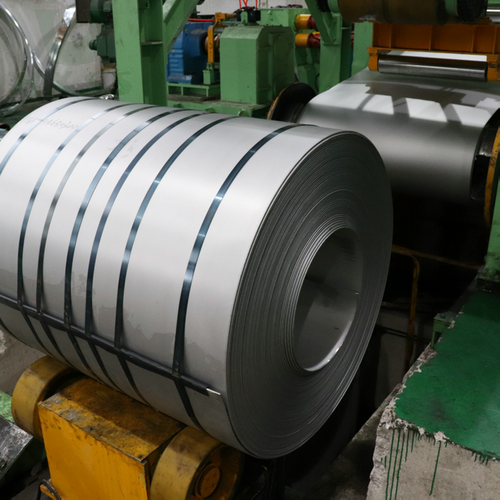
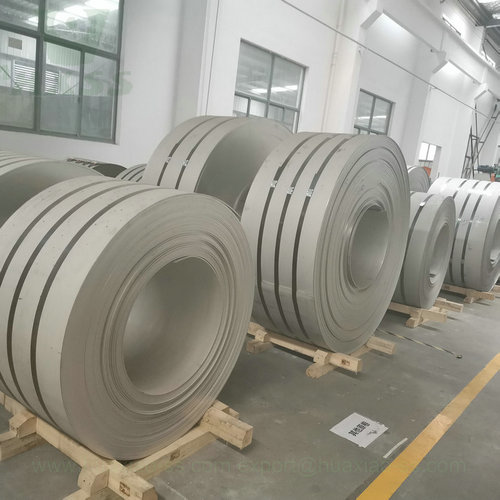
Huaxiao Capacity about Precipitation hardening stainless steel, Precipitation hardening HRC
Thickness: 1.2mm – 10mm
Width: 600mm – 1500mm, the narrowed products, pls check in the strip products
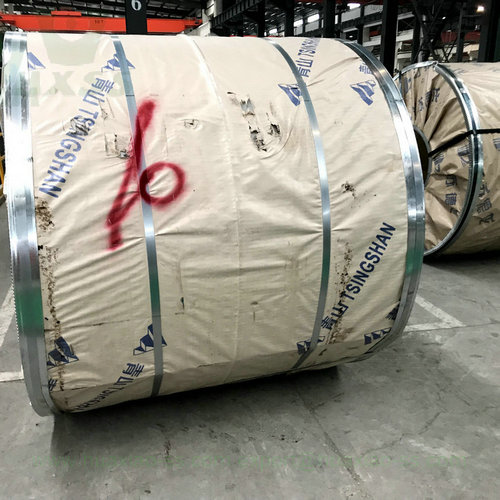
Max coil weight: 20MT
Coil ID: 508mm,610mm
Finish: NO.1, 1D, 2D, #1, 2B finished, black, Anneal and pickling, mill finish, etc.
- Quality Certifications and Standards: Our materials adhere strictly to international standards to ensure quality and traceability:
- International Standards: ASTM A693, ASTM F899
- Aerospace Standards: AMS 5643 (17-4PH), AMS 5659 (15-5PH), AMS 5644 (17-7PH)
- Company Certification: ISO 9001 Quality Management System Certification (AS9100 aerospace certified materials available; please inquire for details).
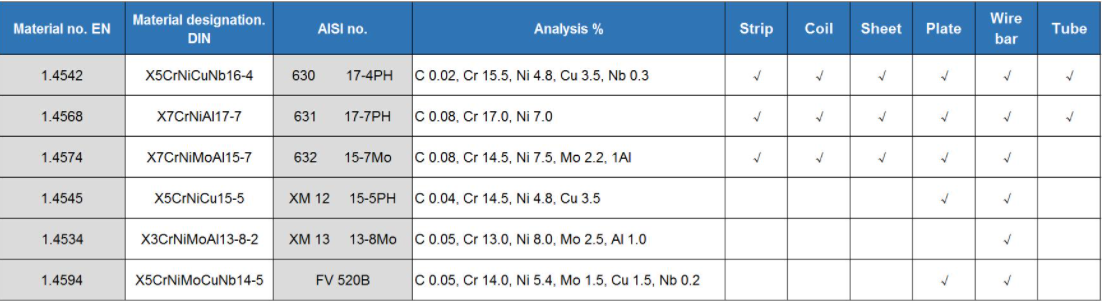
Grade about Normal Precipitation Hardening Stainless Steel
- S17400 17-4PH 0Cr17Ni4Cu4Nb
- S15500 15-5PH 0Cr15Ni4Cu4Nb
- S17700 17-7PH 0Cr17Ni7Al
- 17-10P 0Cr17Ni7Al
Optional Heat Treatment Conditions
We offer a full range of standard delivery conditions, and all materials are equipped with a traceable MTC (Material Test Certificate).
| Grade | Typical Delivery Status |
| 17-4PH / 15-5PH | Condition A(Solution treated, easy to machine)、H900、H1025、H1150 |
| 17-7PH | Condition A、Condition TH1050、Condition RH950 |
S17400 Chemical Component ASTM A564
| C | Si | Mn | Cr | Ni | S | P | Cu |
|---|---|---|---|---|---|---|---|
| ≤0.07 | ≤1.0 | ≤1.0 | 15.0~17.5 | 3.0~5.0 | ≤0.03 | ≤0.04 | < 3.0~5.0 |
S17400 Mechanical Property ASTM A564
- Tensile strength : > 1310 Mpa
- Yield Strength : >1170 Mpa
- Elongation (%): > 35%
- Hardness: > Brinell 388
Typical Mechanical Properties for Stainless Steel Alloy 17-4PH
| Grade 17-4PH | Annealed | Cond 900 | Cond 1150 |
|---|---|---|---|
| Tensile Strength (MPa) | 1100 | 1310 | 930 |
| Elongation A5 (%) | 15 | 10 | 16 |
| Proof Stress 0.2% (MPa) | 1000 | 1170 | 724 |
| Elongation A5 (%) | 15 | 10 | 16 |
Typical Physical Properties for Stainless Steel Alloy 17-4PH
| Property | Value |
|---|---|
| Density | 7.75 kg/m3 |
| Modulus of Elasticity | 196 GPA |
| Electrical Resistivity | 0.8 x 10⁻⁶ Ω.m |
| Thermal Conductivity | 18.4 W/m.K |
| Thermal Expansion | 10.8 x 10⁻⁶/K |
Define about Precipitation Hardening Stainless Steel
Precipitation hardening (PH): A heat treatment process in which a metal in a supersaturated solid solution is segregated in a solute atom and/or in which dissolvable particles are dispersed and dispersed in the matrix to cause hardening. If austenite precipitated stainless steel is subjected to precipitation hardening at 400-500°C or 700-800°C after solution treatment or after cold working, high strength can be obtained.
That is, the supersaturated solid solution of some alloys is left at room temperature or heated to a certain temperature. The solute atoms will accumulate in a certain area of the solid solution matrix or form a second phase, resulting in an increase in the hardness of the alloy.
Precipitation hardening stainless steel and its classification
Precipitation-hardening stainless steel was developed by the United States Steel Corporation in the 1940s. It has high strength after precipitation hardening heat treatment, plasticity, and corrosion resistance is superior to other stainless steels.
Precipitation-hardening stainless steels can be classified into martensitic, semi-austenitic, and austenitic types according to the metallographic structure of the matrix.
(1) Martensitic type
Martensitic precipitation-hardening stainless steels are usually supplied in the martensitic state and undergo precipitation hardening after simple aging treatment. One or both martensite formation and precipitation hardening mechanisms can obtain the properties of martensite precipitation-hardened stainless steel, which is the most widely used steel for precipitation hardening.
(2) Semi-austenitic type
The substrate of semi-austenitic stainless steel is austenite, which contains 5% to 20% delta ferrite. Through special heat treatment before hardening, the austenite is transformed into martensite and then subjected to aging treatment. Semi-austenitic stainless steels can be processed into a variety of products, but they are mainly used for flat-rolled sheets and strips. This precipitation-hardening stainless steel is generally not used in valve products.
(3) Austenite type
Austenitic stainless steels are supplied in austenitic conditions, and these steels are rarely used.
| Alloy | UNS No. | Composition, % | ||||||||
|---|---|---|---|---|---|---|---|---|---|---|
| C | Mn | Si | Cr | Ni | Mo | Cu | Ti | Other | ||
| Martensitic | ||||||||||
| PH 13-8 Mo | S13800 | 0.05 | 0.10 | 010 | 12.8 | 8.0 | 2.3 | – | – | Al=1.1 |
| 15-5PH | S15500 | 0.07 | 1.0 | 1.0 | 14.8 | 4.5 | – | 3.5 | – | Nb=0.3 |
| 17-4PH | S17400 | 0.09 | 1.0 | 1.0 | 16.3 | 4.0 | – | 4.0 | – | Nb=0.3 |
| Custom 455 | S45500 | 0.05 | 0.5 | 0.5 | 12.0 | 8.5 | 0.5 | 2.0 | 1.1 | Nb=0.3 |
| Semi-austenitic | ||||||||||
| PH15-7Mo | S15700 | 0.09 | 1.0 | 1.0 | 15.0 | 7.1 | 2.5 | – | – | Al=1.1 |
| 17-7PH | S17700 | 0.08 | 0.9 | 0.5 | 16.5 | 7.5 | – | – | – | Al=1.0 |
| Sandvik Nanoflex | S46910 | <0.012 | – | – | 12.0 | 9.0 | 4.0 | 2.0 | 0.9 | Al=0.35 |
| Austenitic | ||||||||||
| A-286 | S66286 | 0.08 | 2.0 | 1.0 | 15.0 | 25.5 | 1.25 | – | – | Ti: 2.1 Al: ≤0.35 V: 0.3 |
Why Choose Precipitation Hardening Stainless Steel?
Precipitation Hardening Stainless Steel (PH Stainless Steel) is a class of specialty alloys that, through a heat treatment process involving Solution Treatment and Age Hardening (Precipitation Hardening/Aging), achieves an optimal combination of extremely high strength, superior hardness, and excellent corrosion resistance.
These alloys perfectly blend the corrosion resistance of austenitic stainless steels (e.g., Type 304) with the high strength characteristics of martensitic stainless steels (e.g., Type 410), making them the material of choice for critical applications in aerospace, oil and gas, precision machinery, and the nuclear industry.
| PH Steel Classification | Representative Grades | Primary Hardening Mechanism / Characteristics | Key Application Advantage |
| Martensitic (Martensitic PH) | 17-4PH (UNS S17400), 15-5PH (UNS S15500) | Austenitic structure is rapidly cooled after solution treatment to form martensite, which is then aged to precipitate Cu or Nb compounds for hardening. | High strength and hardness, single low-temperature aging process, excellent dimensional stability. |
| Semi-Austenitic (Semi-Austenitic PH) | 17-7PH (UNS S17700) | Retains austenitic structure after solution treatment, which is transformed into martensite through low-temperature conditioning (Condition A) or sub-zero treatment (Condition RH), followed by age hardening (Al precipitation). | Good formability (in solution-treated condition), achieving extremely high strength after final heat treatment. |
| Austenitic (Austenitic PH) | A-286 (UNS S66286) | Hardening achieved by the precipitation of compounds like Ni3(Ti,Al) within the austenitic matrix during aging. | Excellent high-temperature strength, superior heat and creep resistance. |
Key Heat Treatment Condition Comparison: 17-4PH vs. 17-7PH
| Grade | Condition | Heat Treatment Process | Key Characteristics | Typical Applications |
| 17-4PH (Martensitic PH Steel) | Condition A | Solution Annealed (approx. 1040∘C), Water/Air Cooled. | Relatively soft, excellent machinability, and formability for subsequent processing. | Initial machining and fabrication; requires aging for full strength. |
| Condition H900 | A-Condition material → Aged at 482∘C (900∘F) for 1 hour. | Maximum strength and hardness, moderate toughness. | Aerospace structural components, high-pressure pump shafts, high-strength fasteners. | |
| Condition H1075 | A-Condition material → Aged at 579∘C (1075∘F) for 4 hours. | Balanced strength/toughness, improved Stress Corrosion Cracking (SCC) resistance. | Chemical processing equipment, valve parts. | |
| Condition H1150 | A-Condition material → Aged at 621∘C (1150∘F) for 4 hours. | Optimal toughness and SCC resistance, moderate strength. | Marine environment components, large cross-section or complex forgings. | |
| 17-7PH (Semi-Austenitic PH Steel) | Condition A | Solution Annealed (approx. 1065∘C), Air Cooled. | Purely austenitic structure, excellent ductility and formability; ideal for deep drawing. | Stamped parts, complex thin-walled structures (must be subsequently heat-treated). |
| Condition TH1050 | A-Condition → Precipitation Treatment (T – Austenite Conditioning) → Aged at 565∘C (1050∘F) for 90 minutes. | High strength, good toughness; strength is generally higher than 17-4PH Condition H1050. | Pressure diaphragms, bellows, structures requiring balanced strength and toughness. | |
| Condition RH950 | A-Condition → Deep-Freeze Treatment (R – Sub-Zero Treatment) → Aged at 510∘C (950∘F) for 60 minutes. | Highest strength and hardness; exceptional elastic properties. | High-strength springs, precision instrument components requiring extreme strength. |
Welding of Precipitation Hardened Steels
Precipitation hardened steels can be easily welded using procedures similar to 300 series stainless steels.
17-4 PH precipitation hardening stainless steel can be successfully welded without preheating at room temperature. Post-weld heat treatment can be used to make the weld metal have the same properties as the base metal. The recommended grade of electrode for welding 17-4 PH is 17-7 PH.
Application of precipitation hardening stainless steel
The high-strength properties of precipitation hardening stainless steel make it suitable for aerospace and other high-tech industries.

Applications include:
- Gear
- Valves and other engine parts
- High-strength shaft
- Turbine blades
- Nuclear waste barrels, etc.
FAQ
What are the main differences between 17-4PH and 15-5PH? How should I choose?
Both are martensitic PH steels, but 15-5PH is a refined and improved version of 17-4PH.
17-4PH: Offers excellent cost-effectiveness, the widest range of applications, and meets most high-strength requirements.
15-5PH: Through stricter composition control and metallurgy (e.g., VAR), delta ferrite is minimized. Therefore, 15-5PH should be chosen for large cross-sections or critical applications requiring excellent transverse mechanical properties and improved toughness (e.g., aircraft structures).
Can 17-7PH be used in its Condition A state?
The primary purpose of Condition A (the solid solution state of 17-7PH) is to provide excellent machinability and formability, allowing it to be easily stamped, drawn, or bent into complex shapes. The strength and hardness in this condition are relatively low, and it is generally not suitable for direct use in final load-bearing structural components. Only after TH or RH heat treatment can its strength meet the design requirements.
What is the weldability of precipitation-hardened stainless steel?
The weldability of precipitation-hardened stainless steel is generally good, surpassing that of traditional high-carbon martensitic stainless steel.
17-4PH / 15-5PH: Welding in Condition A (solution) or H1150 is generally recommended. To achieve maximum strength, a complete solution-aging (or direct aging) heat treatment is usually required after welding. ER630 welding consumables are recommended.
17-7PH: Weldable in Condition A, but a subsequent TH or RH process is required to restore strength.
What do heat treatment codes such as H900 and H1150 mean?
These designations specify the aging condition of precipitation-hardened stainless steel.
H: Stands for age hardening.
The number represents the aging temperature (in degrees Fahrenheit).
- For example, H900 refers to aging at 900°F (approximately 482°C) for one hour. At this temperature, the precipitates are fine-grained, resulting in the material achieving maximum strength and hardness.
- H1150 refers to aging at 1150°F (approximately 621°C) for four hours. At this temperature, the precipitates are larger, sacrificing some strength in exchange for increased toughness and stress corrosion resistance.
As a professional alloy steel supplier, we not only offer standard specifications but also focus on providing precise material solutions for your critical projects.
Request a spot quote & MTC certificate for 17-4PH / 15-5PH / 17-7PH